@canadavisa_com@AnthropicAI@DarioAmodei@OpenAI@sama no brainer to open offices here. 40% discount on employees (USD -> CAD) + Canadians get paid about 30-50% less compared to US counterparts. Business structure (US comparative to Canada) aside, pays for itself…
AI professionals could soon have a faster route to work in Canada.
The federal government has announced plans for an expedited work permit stream that would issue permits in 20 days or less, with measures to support future PR transitions.
What we know so far ⬇️
The Government is asking Parliament for an additional $11.1B in additional funding through Supplementary Estimates.
Highlights:
* $3.1B for Indigenous claims and settlements
* $2.7B for housing and infrastructure programs
* $1.2B for defence operations and procurement
* $899M for Indigenous services and programs
* $740M for airport screening and scanners
* $673M to support Canada Post operations
* $571M for benefits and social programs
* $351M for public safety programs
* $311M for Indigenous mental health and addictions
* $262M to cover VIA Rail operations
* $235M for dental care and health programs
* $210M for Atlantic ferry services
* $203M for the gun buy back program
* $202M for Indigenous child and family services
The Supreme Court of Canada has upheld a ruling that Aboriginal title cannot be declared over private land, in a decision the federal government says will have an impact on the Cowichan case in BC.
Important ruling for homeowners and the future of this country. https://t.co/YY5I7WtTpj
@kyle_e_walker Crazy need for small and mid sized companies. The best company I’ve seen so far is Dovetail AI they are boots on the ground doing this work. https://t.co/lOs4bKcjzV
Just how much worse have things become since Justin Trudeau’s Liberals took power in 2015? Take a look as Jesse Kline examines Canada’s lost decade through 13 economic indicators
https://t.co/bjQhAUlMuj
ANNOUNCEMENT
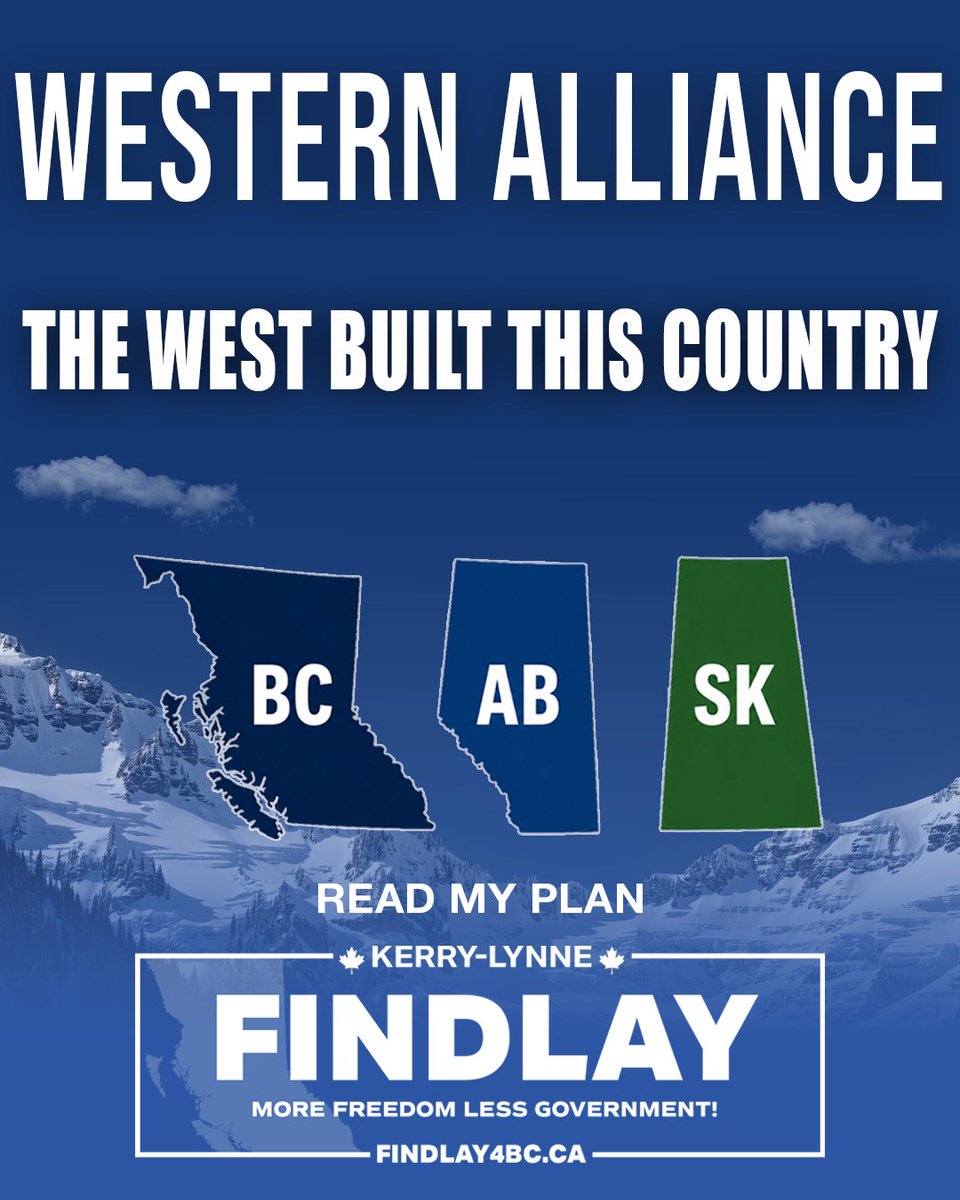
Kerry-Lynne Findlay just announced the 'Western Alliance' - a bold 5-pillar plan to build what Ottawa never could for BC, Alberta and Saskatchewan.
"The West has built this country. Prosperity will be delivered. The Western Alliance is my commitment."
Here is exactly how we deliver it 1/5
Another thought: what does the trump administration and other United States First Nation tribes think about this on-going murky water in British Columbia and 51st state talk… they must be contemplating how they can legally claim and or sign agreements and/or make back door deals with CAN/US First Nation tribes. Based on their agenda and first principles this has to be something they are taking a very serious look at.
https://t.co/5BQeJwVjrh
A multi-perspective analysis of the Musqueam Rights Recognition Agreement with the Govt. of Canada. Not in isolation, tied to current legal decisions and on going court decisions and proceedings. https://t.co/s6IOdHCdWW
Introduction
On February 20, 2026, the Musqueam Indian Band (xʷməθkʷəy̓əm) and the Government of Canada signed the šxʷqʷaltəĺ̓tən — a Rights Recognition Agreement that formally acknowledges Musqueam’s unextinguished Aboriginal Rights and Title within a territory spanning much of Metro Vancouver. This journal examines the agreement from multiple perspectives: as a Greater Vancouver homeowner, through the lens of mortgage underwriting and lending risk, and from the standpoint of land use planning, permitting, and development.
While the agreement is deliberately structured as a framework rather than an operational mandate, its implications, particularly when read alongside the landmark Cowichan Nation v. City of Richmond ruling from 2025, signals a trajectory of change that warrants careful attention from anyone with a financial or professional stake in Greater Vancouver’s built environment (and among the 90% of unceded land across the province of British Columbia).
Part 1: The Agreement - What It Is and What It Is Not
The šxʷqʷaltəĺ̓tən is not a treaty, not a land claims agreement, and not a transfer of property. Section 5.1 explicitly states it does not constitute a treaty or land claims agreement within the meaning of the Constitution Act, 1982. Section 5.2 confirms it does not create, amend, define, establish, abrogate, or derogate from Musqueam’s Rights and Title. These provisions are designed to make clear that the agreement recognizes what already exists - it does not create new rights.
The agreement’s purposes, set out in Part 2, include recognizing Musqueam’s Rights and Title within their territory, demonstrating progress in incrementally implementing those rights, contributing to the implementation of the United Nations Declaration on the Rights of Indigenous Peoples, and providing a foundation for reconciliation and an ongoing mutually beneficial relationship.
Three concrete Incremental Implementation Agreements are listed in Annex A: a revenue-sharing agreement relating to federal lease revenues from Vancouver International Airport, a stewardship and marine management agreement, and a fisheries agreement. Notably, none of these directly address residential land use or private property.
The Territory Defined
Musqueam Territory, as defined in the agreement, encompasses the lands, lakes, and streams within a boundary commencing at Harvey Creek in Howe Sound, proceeding eastward to the height of land around the entire watershed draining into English Bay, Burrard Inlet, and Indian Arm, then south along the height of land between the Coquitlam and Brunette Rivers to the Fraser River, across to the South Arm to the sea, and extending to the centre of the Strait of Georgia. In practical geographic terms, this covers Vancouver, significant portions of Burnaby and Richmond, Sea Island, and surrounding areas - the urban core of Metro Vancouver.
Part 2: The Homeowner’s Perspective
For the average homeowner in Greater Vancouver, the immediate practical impact of this agreement is negligible. No property is being seized, no ownership rights are being revoked, and no changes to zoning, building codes, or property taxes flow from the agreement itself. The protective clauses in Part 5 are designed to ensure that neither party’s legal positions are prejudiced by the agreement’s existence.
However, the agreement does something that matters at a deeper level: it places the federal government’s formal recognition behind the fact that Musqueam holds unextinguished Aboriginal title across the same geography where hundreds of thousands of people own fee simple property. That legal reality has always existed, but it now carries the weight of a signed federal agreement. For homeowners, the question is not what changes today, but what the agreement enables over time through its Future Discussions and Negotiations framework in Part 7.
Part 7 creates an open-ended process where either party can propose any subject matter for potential Incremental Implementation Measures related to Musqueam’s Rights and Title. There are no restrictions on what topics can be raised. This means that future negotiations could touch on shared decision-making over land use and development, revenue or benefit sharing from development activity, heritage and cultural site protections affecting what can be built and where, or environmental stewardship overlays interacting with municipal bylaws - and any other topic that pertains to the agreement.
For homeowners contemplating renovations, additions, or property sales, none of these potential future measures exist yet. But for those thinking in terms of long-term property value and the regulatory environment over the next decade or two, the direction of travel is worth understanding.
Part 3: The Lending and Underwriting Perspective
Mortgage underwriting rests on a fundamental assumption: that the property securing the loan has clear, enforceable, and transferable title. A mortgage is only as secure as the asset backing it, and that asset’s value depends on both market conditions and legal certainty about what the owner can do with the property.
The Musqueam agreement introduces a layer of complexity to this calculus. While Section 5.4 protects against the agreement being used to prejudice either party’s position on the scope of rights and title, the agreement simultaneously confirms that Musqueam holds unextinguished Aboriginal title across territory that includes Metro Vancouver’s most valuable residential and commercial real estate. The agreement does not resolve the overlap between Aboriginal title and the fee simple titles registered in BC’s Land Title Office - it acknowledges both exist.
Risk Factors for Lenders
An underwriter evaluating exposure in this context would consider several categories of risk. The probability of direct property loss remains very low. There is no realistic near-term scenario in which residential homes are seized or transferred. Courts have established that Aboriginal title does not automatically displace existing interests, and the political consequences of mass property displacement make it a non-starter.
The probability of new regulatory burdens affecting property value is moderate and increasing. If future incremental agreements introduce consultation requirements, development restrictions, or additional approval layers, those measures could affect what can be built on a property, how long approvals take, and what additional costs attach to development. These factors influence property values, particularly for development-stage land.
The risk of market perception shifts is the most unpredictable factor. Property markets are driven by confidence. If buyers begin to perceive uncertainty about long-term development rights or governance structures in the region, demand and pricing could be affected, not because anything concrete has changed, but because the narrative around ownership certainty has shifted.
Portfolio-Level Considerations
From a portfolio perspective, lenders with heavy BC exposure face a systemic issue. Virtually the entire province is subject to overlapping Aboriginal title claims, most of which are unextinguished. The modern treaty process has resolved some (Tsawwassen, Nisga’a), but the vast majority remain outstanding. This means a lender cannot diversify away from Aboriginal title risk by shifting between regions within British Columbia. The risk is embedded across the entire provincial market.
Practical adjustments a risk team might consider include differentiated assessment by location, with closer scrutiny for properties near culturally significant sites or areas likely to be subject to early shared decision-making measures; monitoring incremental agreements for any that begin to touch land-based activities; evaluating whether title insurance policies adequately address the evolving legal landscape; and stress testing for regulatory change scenarios where Indigenous governance introduces new costs or restrictions on development.
Part 4: The Cowichan Ruling - A Real-World Stress Test
The Cowichan Nation v. City of Richmond ruling, handed down by the BC Supreme Court in 2025, transforms the Musqueam agreement from a political milestone into a data point within an active and escalating legal trend.
In that case, the court found that the Cowichan Nation had established Aboriginal title to over 5.7 square kilometres of land on the Fraser River in Richmond. The ruling declared Crown and city titles on the land defective and invalid, and found that the granting of private titles on it unjustifiably infringed on Cowichan title. The judge suspended the decision for 18 months to allow the parties to make necessary arrangements.
The ruling’s impact on lending was immediate and tangible. A Richmond city councillor reported that a local company was refused financing for a $100-million project because of uncertainty over their site. This is not theoretical risk modeling - it is a lender declining to fund a project based on title uncertainty created by an Aboriginal title ruling.
Both the federal and provincial governments have appealed the Cowichan decision, and British Columbia is seeking a stay of implementation. The BC Attorney General has stated the province’s appeal will seek to establish that fee simple title holds superior standing. However, the province’s legal position is complicated by the fact that in the separate Haida Nation case, BC upheld a deal allowing Aboriginal and private property rights to coexist - effectively arguing opposite positions in two different courts.
This inconsistency means there is currently no settled legal framework in British Columbia for how Aboriginal title and fee simple title interact. Until the courts or the legislature resolve this question, lenders, developers, and homeowners are operating in a legal grey zone.
Connecting Cowichan to Musqueam
The Cowichan ruling demonstrates what can happen when Aboriginal title claims move from negotiation to litigation. Musqueam has chosen an incremental negotiation path through this agreement, which could be read as a more orderly approach that reduces the risk of a sudden courtroom shock. Alternatively, it could be read as confirmation that the underlying legal reality - unextinguished Aboriginal title over Metro Vancouver’s urban core - is now formally acknowledged at the federal level, and the Cowichan case shows courts are willing to enforce those rights in ways that directly impact existing property titles.
Musqueam’s claim is arguably stronger than the Cowichan’s in this context, given over 8,000 years of continuous documented occupation, extensive archaeological evidence including the nationally significant Marpole site, continuous use and presence, and now a federal agreement explicitly recognizing their unextinguished Rights and Title. The agreement’s own language acknowledges that further work is required to address and implement Musqueam’s Rights and Title, leaving the door open for future measures that could look very different from today’s incremental steps.
Part 5: Land Use, Planning, and Permitting — The Future Regulatory Landscape
The agreement does not mention zoning, building codes, permitting, or municipal planning. What it does is create an open-ended framework where future negotiations could touch any subject matter related to Musqueam’s Rights and Title. The Musqueam Narrative embedded in the agreement references shared decision-making and the right to participate in decisions about the use and development of territory, drawing on Supreme Court rulings that Aboriginal title includes jurisdictional and economic components.
The Spectrum of Shared Decision-Making
Shared decision-making in land use could manifest across a wide spectrum. At the lighter end, municipalities might be required to refer certain development applications to Musqueam with defined response timelines and obligations to demonstrate how input was incorporated, similar to how applications are currently routed through engineering or environmental review departments.
In the middle of the spectrum, co-management structures could emerge where Musqueam and municipal or provincial authorities jointly assess and approve certain categories of development. This might include joint review panels for major projects or Musqueam representation on planning committees with actual decision-making authority rather than advisory status. Precedents exist in British Columbia: the Great Bear Rainforest agreements created shared decision-making between First Nations and the province over land use in that region.
At the stronger end, for areas or activities where title claims are strongest, a consent requirement could apply - meaning a project cannot proceed without Musqueam’s agreement. This aligns with the free, prior, and informed consent standard embedded in the UN Declaration on the Rights of Indigenous Peoples, which this agreement explicitly ties itself to implementing.
Practical Implications by Development Type
For standard residential renovations and additions, the near-term impact is likely minimal. Standard permits through municipalities would proceed as normal unless a property is located on or adjacent to a culturally significant site.
For major rezonings and new subdivisions, the impact could be significant over time. Large developments in Vancouver, Burnaby, or Richmond might eventually require formal Musqueam engagement as part of the approval process, potentially including conditions on design, benefit-sharing arrangements, or in some cases the ability to withhold consent.
For infrastructure projects — new roads, utilities, transit extensions, port development — the most structured form of shared decision-making would likely apply, particularly for anything touching waterways or marine areas given the stewardship agreement already in effect.
For development near the airport corridor and Sea Island, which sit at the heart of Musqueam’s territory with some of the strongest historical connections, future development could face particularly robust shared decision-making requirements. The existing YVR revenue-sharing agreement sets a financial precedent that could extend to other significant developments in the area.
Part 6: The Broader Context - Where This Is Heading
This agreement does not exist in isolation. It sits within a rapidly evolving legal and political landscape that includes BC’s own Declaration on the Rights of Indigenous Peoples Act (2019), federal UNDRIP legislation, strengthening Aboriginal title case law, the Cowichan ruling and its appeal, the Haida Nation title recognition, and growing institutional momentum toward Indigenous governance in land use decisions.
The trajectory across all of these developments points in one direction: Indigenous nations in British Columbia are building institutional recognition of their decision-making authority within their territories, and both federal and provincial governments have committed, through legislation and agreements, to support that process.
For Greater Vancouver specifically, the convergence of Musqueam’s agreement, the Cowichan precedent, and the broader legal framework creates a situation where the governance and regulatory environment around property and development is likely to look meaningfully different within the next decade. The question for homeowners, lenders, developers, and planners is not whether these changes will come, but in what form, at what pace, and through what mechanisms.
A Note on Uncertainty and Resolution
It is worth noting that the markets which have gone through modern treaty settlements in BC — such as Tsawwassen - have in some cases seen property values increase. The resolution of uncertainty was viewed positively by the market, because what investors and lenders dislike most is ambiguity. The Musqueam agreement’s incremental approach could, if it produces clear and predictable rules for how Aboriginal title and existing property interests coexist, ultimately reduce rather than increase risk.
The worst outcome for property values and lending confidence is not a clear framework for shared governance, it is prolonged legal ambiguity where different courts reach different conclusions and no one knows what the rules are. The Cowichan ruling, the Haida precedent, and BC’s contradictory legal positions in those two cases illustrate exactly that kind of ambiguity. To the extent that the Musqueam agreement represents a negotiated path toward clarity, it may be the most constructive route available.
Conclusion
The šxʷqʷaltəĺ̓tən is a framework document, not an operational one. It does not change property rights, zoning, taxes, or permitting requirements today. But it formalizes a legal reality that has always existed and creates the architecture for future negotiations that could reshape how land use decisions are made across Metro Vancouver.
For homeowners, the immediate impact is nil but the long-term direction warrants attention. For lenders, the agreement adds to a growing body of factors that should be incorporated into long-horizon risk models, particularly in light of the Cowichan ruling’s demonstrated impact on financing decisions. For the planning and development sector, the agreement signals that Indigenous consultation and shared decision-making are moving from often voluntary engagement to further structural integration in how communities are built and governed.
The common thread across all perspectives at this point in time is that certainty matters more than any particular outcome. A clear, negotiated framework for how Aboriginal title and existing property interests coexist will serve everyone better than the current patchwork of contradictory court rulings and unresolved claims. Whether the Musqueam agreement delivers that clarity will depend on what happens in the years ahead - but it has, at minimum, created a structured path toward answers.
I read the agreement. Here's what Greater Vancouver and the 90% of unseeded land in BC should understand:
The federal government just formally recognized Musqueam's unextinguished Aboriginal title across most of Metro Vancouver: Vancouver, Burnaby, Richmond, Sea Island, the Fraser corridor. That's not new legally. What's new is Canada putting its signature on it.
The agreement itself is carefully designed to change nothing immediately. No treaty. No property transfers. No zoning changes. But it builds the architecture for everything to change later. Part 7 lets either party bring ANY topic to the negotiation table. That's the section people should be paying attention to.
Now pair this with the Cowichan ruling - the Court declared Crown-granted titles in 5.7 acres of Richmond "defective and invalid" under Aboriginal title. A $100M project already got denied financing. That's not theory. That's capital leaving the market.
Here's what nobody in government wants to say out loud: there is no settled legal framework in BC for how Aboriginal title and fee simple title coexist. BC argued they CAN coexist in the Haida case, then argued they CAN'T in Cowichan. The province is literally contradicting itself across two courtrooms. Homeowners have every right to want answers.
The underwriting implications alone should concern people. Every mortgage in Metro Vancouver is secured against property with fee simple title. That title now sits on land where Aboriginal title is formally recognized as unextinguished. Lenders stress test for interest rates and natural disasters - how many are stress testing for this?
For developers: the trajectory is clear. Musqueam is building toward substantive decision-making authority over land use in their territory. Not advisory input. Actual authority. The agreement references "shared decision-making" and "the right to participate in decisions about the use and development of territory." That's not ambiguous language.
This will hit permitting and planning first. Expect consultation requirements, referral processes, new assessment categories, longer timelines. Municipalities that get ahead of this and build predictable processes will keep investment flowing. The ones that don't will look like Richmond after Cowichan, uncertainty, stalled projects, angry residents.
Here's my honest take: the Musqueam approach is actually the smart path. Negotiated, incremental, structured. Areas that went through treaty settlements like Tsawwassen saw property values stabilize or increase because uncertainty was removed. The worst thing for property values isn't shared governance, it's not knowing the rules.
But we need governments to stop playing both sides. Pick a legal position on coexistence and commit to it. Homeowners, lenders, developers, and First Nations all deserve a clear framework. The current ambiguity serves nobody.
This could reshape Greater Vancouver over the next decade. Ignoring it won't make it go away. Understanding it is the only move.
To make a bit of an excuse for Microsoft: the world is just waking up to the fact that coding agents are general agents.
It’s bitter lesson adjacent: Writing and executing code will likely outperform years of handcrafting vertical-specific agents with expert knowledge.
Actually it might exactly map in bitter lesson: Program synthesis is a form of scalable search.