1/ With the #Brisbane2032 Olympics fast approaching, Brisbane has a rare opportunity to define itself. In global terms, Brisbane is still somewhat of a blank canvas. This thread is my (slightly utopian) pin-up board of what we should be promoting & building over the next decade.
Economists sometimes call it “Japanification” when trapped capital, ageing incumbents and weak productivity growth reinforce each other over time.
Parts of this Budget risk pushing Australia in a disturbingly similar direction.
My latest opinion piece in The Australian https://t.co/560djOrEYI
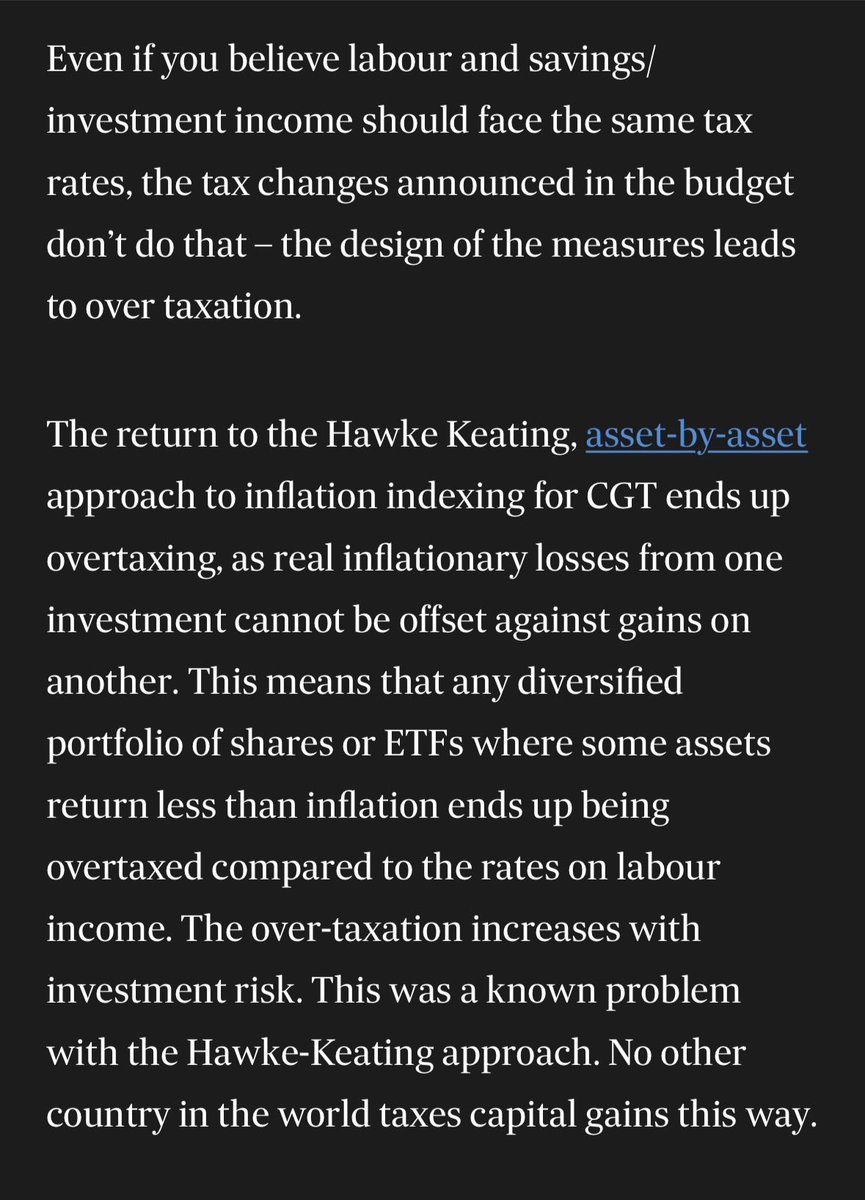
This is one of the clearest explanations so far of why the proposed CGT changes are economically flawed and could damage long term investment in Australia, written by former Treasury official Geoff Francis.
One of Geoff’s key criticisms is the return to inflation indexation on an asset by asset basis, something I’ve also been raising over the past week. Because inflation adjusted losses on one investment can’t offset gains on another, diversified investors can end up paying tax rates higher than their actual real returns. It also suggests the housing changes are based on flawed assumptions about property investors and will likely reduce housing supply, increase rents and hurt long term renters.
More broadly, Geoff argues the reforms do little to improve productivity or economic growth. He also points out that the additional tax revenue isn’t being used to reduce inefficient taxes elsewhere, but instead to fund more spending and debt, while the modest WATO tax offset will likely be quickly eroded by bracket creep.
https://t.co/4bwT3wK3UF
The federal government’s refusal to lift income tax brackets in line with inflation means every dollar earned today above $190,000 is taxed at 47 per cent, instead of the top rate kicking in at more than $280,000.
The top income tax threshold now sits at the lowest inflation-adjusted level in 20 years. It would be $281,450 by now if it had kept up with inflation since 2008-09, the last time high earners had their top income tax threshold substantially increased under changes initiated by the Howard government.
Prime Minister Anthony Albanese’s former economic policy adviser Alex Sanchez said Labor’s decision in 2024 to increase the top $180,000 tax bracket to $190,000, instead of the $200,000 legislated by Liberal prime minister Scott Morrison under the stage 3 tax cuts, was a “terrible mistake”.
https://t.co/CIcSmbnGW5
Any honest audit of Australia’s current position should give serious pause to anyone who believes the country is on a sustainable path. https://t.co/p7yTQpNOyV
Today marks 40 years since Paul Keating warned Australia it was on the road to becoming a banana republic. The reforms that followed — floating the dollar, cutting tariffs, compressing government — produced decades of rising living standards and an economy resilient enough to absorb the GFC with comparatively minor damage.
A new CIS paper asks a direct question: what happened to that project? In Banana Republic Redux, economist Alex Sanchez — a former senior adviser to the Albanese government — argues Australia has replaced the Hawke-Keating framework of productivity, participation, and competition with a new governing philosophy built on redistribution, regulation, and resilience. The language has changed.
The economic consequences have not. Commonwealth spending is near pandemic-era highs. Gross debt is approaching $1 trillion. Productivity is flat. Real GDP per capita is in reverse. And the political incentive to act — let alone to make the case publicly — has rarely been weaker. Sanchez is not calling for austerity. He is calling for something more demanding: a governing project, of the kind Keating prosecuted, that holds as its central conviction that a smaller, more efficient government is the precondition for a productive economy that actually helps those most in need.
The banana republic remark worked because it forced a reckoning before the consequences became irreversible. That, Sanchez argues, is the model for today.
Read the introduction here
Australians will pay some of the highest tax rates on capital gains from property, shares and other investments if the Albanese government axes the 50 per cent discount as expected. https://t.co/kr3sWSGAtp
The single biggest winner from the budget: the tax-free owner-occupied home, which is where people will put their money. After the budget doubles the capital gains tax on productive businesses/assets from circa 23.5% to 46-47%, investors will understandably pull money from businesses, shares, commercial property and rental housing and plough it into their tax-free owner-occupied home. It's a great way to push up the prices of these houses. On the other hand, cutting negative gearing while also doubling CGT makes investing in rental properties extremely unattractive. It hammers the capital gain upside on any asset: shares, commercial property, the small or medium sized business you built, venture capital and private equity. It will give Australia the most unattractive capital gains tax in the WORLD (see table below)! So the government's policies will (1) push up owner-occupied house prices, (2) push up rents, and (3) reduce the capital available for investing in any small, medium or large sized business that is driving employment, innovation, growth and productivity/prosperity. Investors will go to other countries where they pay half the capital gains tax, or less. Since these pollies have never worked a day of their lives in the private sector, it is no surprise that when they decide to completely and unilaterally rewrite the entire tax system for all investors and businesses -- after promising before the last election more than 50 times NOT to change the capital gains tax and negative gearing rules -- that they would blow the entire Aussie economy up... Your best bet will be to buy a house, live in it, and hope they keep dropping 500,000 new people into the country every year to pump-up prices...
Hold shares outside super? Your CGT exposure just doubled.
Hold them inside super? Apparently you’re fine.
Same asset. Different tax reality. Make it make sense.
Mass liquidity incoming. Capital flight to follow....
Club cycle of pain. You import a star, the next kid below leaves, the star leaves 2 years later. Now you have to import again because the talent is not there. The kid comes back and scores against you, just to rub it in.
The problem is not that ISIS supporters welcomed ISIS Brides. Or that Middle Eastern males punched a female Australian journalist in the stomach. Or that they screamed “Shut up slut” at another female.
No. The problem is that we didn't shut the door to this when Bilal and Mohammed Skaf showed an innocent and naive Australia what we were allowing into this country.
Consider that every single one of the thugs had no hesitation appearing, unmasked in front of a TV crew acting this way. For them it's perfectly normal behaviour. The sort which would roam beachside suburbs on a Saturday night.
Meanwhile we have government talking about "violence against women" while literally importing it.
1/ With Airtrain’s QLD Govt contract entering its last decade & Cross River Rail nearing completion, the no brainer next city shaping project Brisbane should pursue is the old Brisbane Subway concept first touted in 2010, extended to what will then be an expanded airport.
4/ It also addresses two pressures at once: providing fast, reliable access to an expanded airport as visitor numbers grow, while delivering long-term, easily scalable transit capacity through a growing corridor where road widening is increasingly ineffective.
1/ With Airtrain’s QLD Govt contract entering its last decade & Cross River Rail nearing completion, the no brainer next city shaping project Brisbane should pursue is the old Brisbane Subway concept first touted in 2010, extended to what will then be an expanded airport.
3/ A proper driverless metro ala Sydney makes sense because it would put a high-capacity, high-frequency spine right through Brisbane’s densest growth corridor, where a younger demographic sits alongside the city’s main cultural & recreational amenities.
Milton Friedman: “I am not a conservative. I’ve never been a conservative. Hayek was not a conservative.”
“We are liberals in the true meaning of that term: concerned with freedom. We are not liberals in the current distorted sense—those liberal with other people’s money.”