Ron DeSantis explains why the GOP "screaming socialism" doesn't work anymore:
"Young people have a very positive view of socialism compared to capitalism. The question is, why is that? Some of it is the education in our universities. But I think a big part of that is, what they're comparing is not free enterprise versus socialism. What they're comparing is how government gets involved in business, and you have crony capitalism. The best kind of indirect supporters of socialism are some of these corporatist republicans who propagate these crony policies. The average person is seeing that and saying, 'Wait a minute, you're trying to bend the government to funnel benefits to this corporation or that industry. What about having a competitive market? ... Young people really aren't seeing that. They're seeing just a handful of companies that have an outsized influence on our economy and on our society"
"Between 2019 and 2025, the price of electricity in D.C. rose by nearly 66 percent, more than double the 29 percent average national increase," @TheFrackingGuy and @mitchrolling of @AlwaysOnEnergy write. https://t.co/ku5GjjTktf
I'm in the @washingtonpost today with @mitchrolling discussing the enormous costs of DC's solar mandates.
Cut your losses on solar power, Mayor Bowser. D.C. will thank you. https://t.co/OruIyMhntt
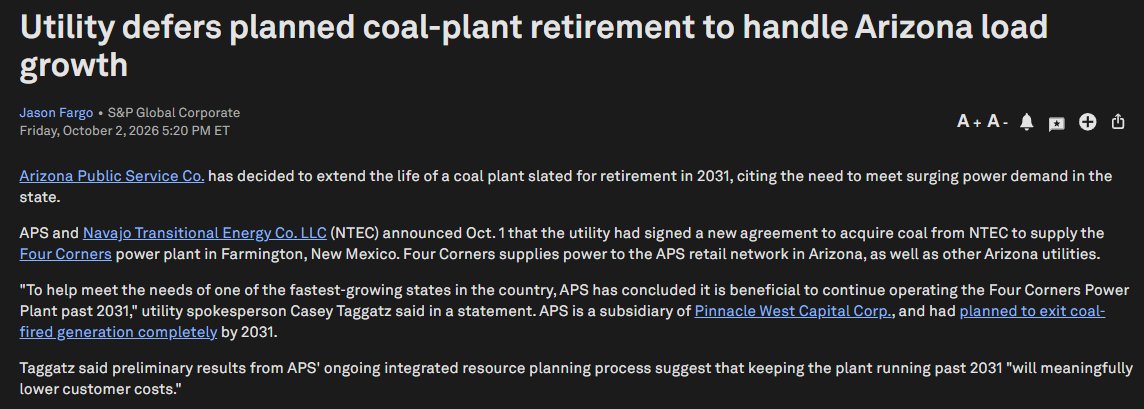
Arizona Public Service is going to keep the four corners coal plant running past 2031 in a move that will "meaningfully lower customer costs."
We have worked with @azfec on multiple occasions to show why keeping the plant open was the right move. @apsFYI clearly agrees!
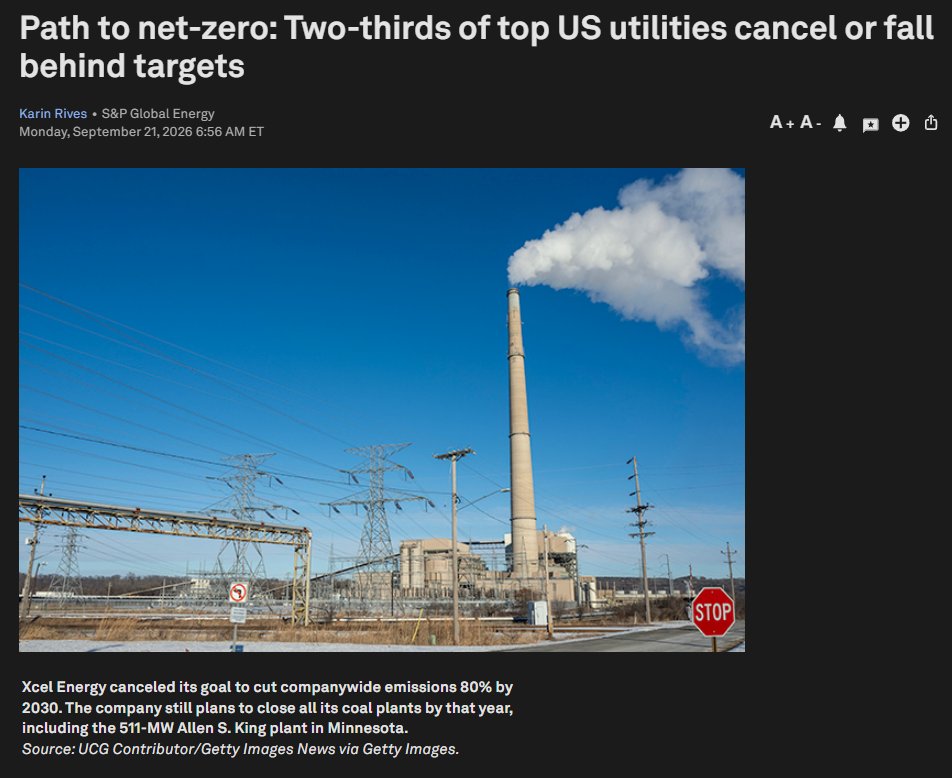
Step 1: Make unrealistic net zero targets to Green Plate your system and rake in fat stacks for shareholders.
Step 2: Two-thirds of top utilities cancel or fall behind net zero targets.
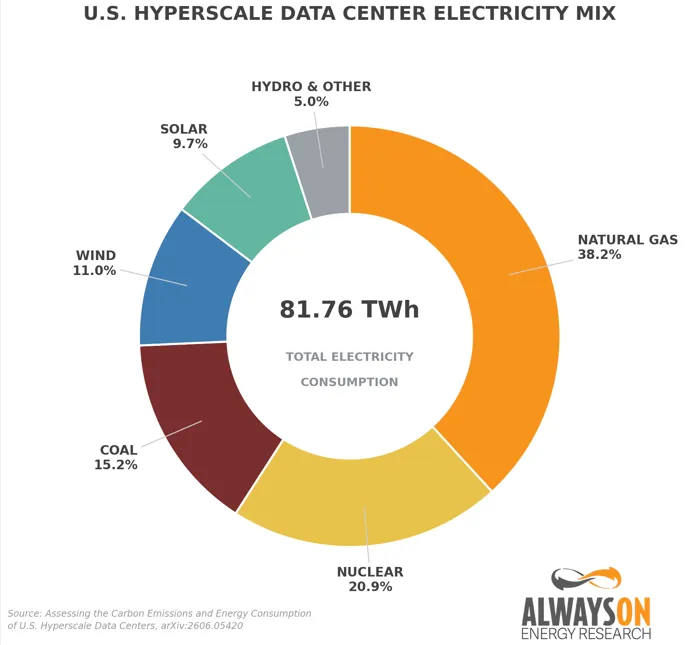
The right comparison has to be USA natty vs China coal though and us only being twice as much on natty is a sign even more about how they are kicking our ass...
IN FACT, federal taxes have consumed a roughly level percentage of the U.S. economy for more than 60 years, and the main driver of the national debt is actually increased spending on social programs. Here are the specifics:
• Since 1960, federal revenues in every decade have averaged 17% to 19% of the U.S. economy with no upward or downward trend.
• In contrast, federal spending has risen from 18% of the U.S. economy in the 1960s to 24% over the most recent decade with a definitive upward trend and a spike to 31% during the Covid-19 pandemic.
• Over the same period, federal spending on social programs has risen from 21% of all federal outlays in 1960 to 60% in 2024 with a steep upward trend and a spike to 74% during the Covid-19 pandemic.
• Social programs — which provide healthcare, income security, education, nutrition, housing, and cultural services — are mostly mandatory programs in which spending continues indefinitely unless Congress and the president pass new laws to change the status quo.
• Thus, the Congressional Budget Office projects that even though taxes will remain above the historical average for the coming decade, increased spending on mandatory programs and interest on the debt will cause the national debt to grow “well above the previous record.”
• In total, social programs and interest on the national debt currently account for about 76% of all federal spending.
• Contrary to media outlets that blame the national debt on military spending, federal outlays for national defense and veterans’ benefits have plummeted from 53% of all federal expenditures in 1960 to 17% in 2024.
• Contrary to media outlets that blame the national debt on tax cuts, most “tax cuts” are actually “tax evens” that correct for “bracket creep” that consumes an ever-growing share of people’s incomes over time due to tax laws that aren’t indexed for inflation or wage growth.
• Murray cites no source for her claim, but it accords with a 2024 study by the Committee for Responsible Federal Budget that places all tax cuts into one bucket while splitting the added spending into three buckets.
• When all of the spending is placed into one bucket, the study shows that added spending accounted for 61% of the growth in debt from 2021 to 2023, while tax cuts accounted for 37%.
• More importantly, the study states that the figures above don’t account for the “effects of the built-in spending growth in certain parts of the budget, while it takes for granted the built-in growth in revenue.”
• That methodology overstates tax cuts by ignoring the effects of bracket creep, and it understates added spending by excluding the soaring growth of mandatory social programs.
• Putting aside the study’s methodology, it still conflicts with Murray’s claim that “Republican-led tax cuts” are to blame for the debt, because the study states that “77 percentage points of debt-to-GDP can be explained by legislation with some meaningful level of bipartisan support,” “while highly partisan Democratic actions explain 12 percentage points, and highly partisan Republican actions explain 8 percentage points.”
Hyperlinks to the sources of all the facts above are available at https://t.co/R9mJU56mG7
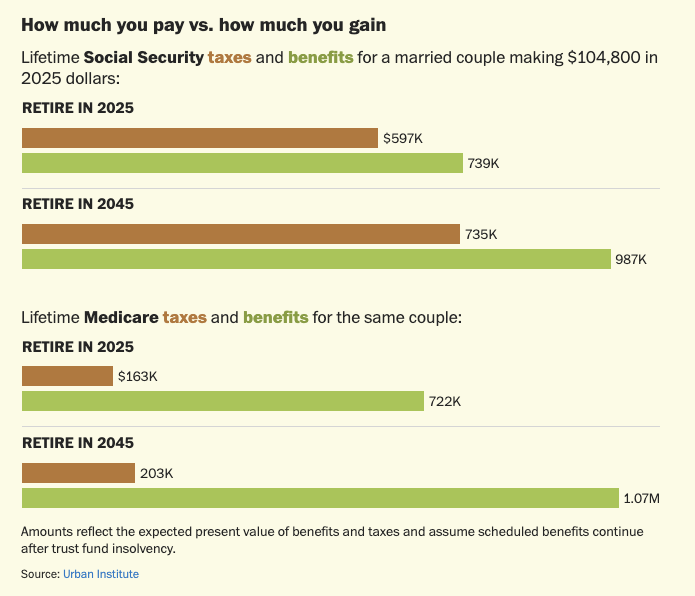
When discussing entitlement reform, people think they're just getting back in retirement what they paid in taxes during their careers.
The truth: The current system gives you back far more than you paid in taxes.
That's part of the reason why it's going bust in the early 2030s.
“#AllOfTheAbove” is DEI of energy policy. Wind, solar, and batteries are extremely expensive, intermittent, and dependent on taxpayer subsidized welfare and a Chinese supply chain. @SecretaryWright says it best:
https://t.co/HjQFxzNwmZ
Retirees are scheduled to receive more then SEVEN TIMES as much in Social Security benefits than what they themselves pay in taxes.
Adding the employer payment and adjusting for inflation and interest, it’s still 133% as much.
Don't blame data centers for what politicians did:
"Since 2011, retail electricity prices in California and New England have skyrocketed 90 percent. In the rest of the country? Just 23 percent.
What about inflation over the same period? 39.5 percent."
- @AlwaysOnEnergy
If you ask voters whether they’re personally willing to give up even $10 a month to fight climate change, they stare at you with fury, smack you on the cheek, and tell you to take your UN sustainable development goals back to the ESG hellscape they came from.
Despite all the talk of climate change, voters, simply put, don't care.
Climate ranks 14th on list of top issue for the midterm vote (at 3%).
Those who say it's a very big problem is the same as in 2016 (~40%).
Not even a majority agree humans cause any climate change.
When we talk about slashing Social Security, seniors say we should cut deficit spending instead.
OK, well let's take a look at what's causing that deficit spending.
Wouldn't you know, it's seniors.
https://t.co/Rt2e8MIkDF
Pretty sure at this point 99% of the energy transition narrative circa 2020-2023 was rooted in ignorance about how limiting the realities of flowing power to serve load worked.
Situation was understandable though. Narrative came from investors and academics, in places like the UK and Australia and lots of places in Europe this little detail is explicitly neglected in the financial layer.