Most people think building a $50,000 award-winning website requires a team and weeks of work.
This 25-minute tutorial does it in a single Claude Code and Fable 5 session, step by step from the first prompt to the finished site.
🚨 ANTHROPIC JUST KILLED THE DEMO AGENT ERA.
Their Agents team showed exactly what production grade looks like.
Not theory. Not a tutorial. A four layer framework for multi agent systems built to actually work in the real world.
30 minutes.
This is the video I wish existed 6 months ago.
Still the best hour on graph engineering ever recorded, Andrew Ng breaking down how to build agentic knowledge graphs from scratch:
00:00 - what agentic knowledge graphs actually are
03:05 - building a graph from scratch
13:58 - the architecture behind multi-agent systems
22:57 - building a real one with Google ADK
01:06:02 - why graphs are the future of AI agents
I've seen $500 courses that teach less.
Watch it, then take it further with my step-by-step guide on graph engineering below.
ANTHROPIC ENGINEERS JUST SHOWED HOW THEY BUILD A FULL APP FROM SCRATCH USING A LOOP OF AGENTS
36 minutes from the team behind Claude Code
three agents, cycling until the app actually works:
> one plans
> one builds
> one judges
the winners won't have the smartest model
they'll have the best loop
watch it, then read the full guide on using loops below 👇
The biggest opportunities right now:
1. build for solving loneliness (the more AI floods everything, the more people crave real human connection, IRL and small social)
2. build for agents that need to spend money (they're getting virtual cards and budgets, someone builds the spend controls, fraud protection, receipts)
3. build for people drowning in AI output (everyone generates infinite drafts now, the bottleneck moved to reviewing and choosing, build the judgment layer)
4. build for the burnout economy (everyone is expected to always be on and always optimizing, and the backlash toward rest, slowness, and enough is building)
5. build for verifying humans (deepfakes broke trust, every dating app, marketplace, and video call needs proof-of-human within 2 years)
6. build for the physical world (the trades, hardware, robots that AI is finally reaching)
7. build for the agent that answers the phone (every local business misses calls after 5pm, a voice agent that books the job is worth thousands a month)
8. build for the aging (70M+ boomers who want to stay healthy, sharp, and connected)
9. build for the LLM-search land grab (being the cited answer is the new SEO)
10. build for the newly automated (the paralegal, the analyst, the marketer whose job just changed and needs to reskill fast)
11. build for the seat-pricing collapse (software repricing from $50/seat to per-outcome, whoever nails outcome billing wins a category)
12. build for AI enablement (95% of businesses use nothing beyond ChatGPT, someone has to onboard the other 95%)
13. build for the agency everyone resents (businesses pay $1k/mo to agencies they hate, an agent that does 80% of it undercuts the model)
14. build for verticals on 2011 software (dentists, HOAs, contractors, all overdue for an AI-native rebuild)
15. build for reviving dead software (thousands of abandoned apps with real users, agents can maintain what a team couldn't, buy and revive)
16. build for markets too small to matter before (500 lobster fishermen was never worth a team, now it's a weekend and a real business)
17. build for agents hiring agents (a shadow economy is forming, it needs escrow, reputation, and dispute resolution for machines)
18. build for the anti-AI premium (as everything gets generated, human-made and analog become status symbols people pay up for)
19. build for distribution-first (anyone can build the product now, so the audience is the moat, media company first, product second)
20. build for the reinvention of college (what does an MBA even mean anymore)
21. build for a world with more free time than it knows what to do with (if AI takes the busywork, the question becomes what people do with the hours, and that's a civilization sized market)
note: more trends/ideas @ideabrowser (free to sign up)
22. build for the return to the physical (screens fill with slop, people crave the real world, the hands-on, the local, the analog)
23. build for the caregiving wave. The population is aging fast, tens of millions are caring for parents, and the whole burden is landing on families with no support.
24. build for the longevity shift (people want to live to 100 healthy, and a whole industry is forming around actively managing your own biology)
25. build for the housing and rootlessness problem (people can't afford to settle down, and the whole idea of a stable home base is up for grabs)
26. build for spiritual hunger (as institutions hollow out, the need for meaning, ritual, and belonging is exploding into new forms)
KEEP BUILDING
INSTEAD OF WATCHING AN HOUR OF NETFLIX TONIGHT.
This 1 hour Stanford lecture by Joel Peterson will teach you more about negotiation and getting what you want than most people learn in years.
Bookmark it and give it an hour, no matter what.
I know many Indians, including me, struggled with 1 thing
Not math, coding, problem-solving
Communication 🗣️
It was my biggest weakness when I joined consulting.
If it is something you face, listen to this 1-hour on How to Speak
Share 🔖 Bookmark
AI companies pays a $1M/year for Forward Deployed Engineers who can turn frontier models into working business systems
This 41-minute conversation reveals the full FDE roadmap:
• 10% → 2:03 - what an FDE actually does, and why model access is no longer the advantage
• 30% → 14:59 - the two skills every FDE needs: engineering judgment + communication
• 55% → 27:36 - audit: finding the workflow worth rebuilding before writing code
• 75% → 31:47 - evals: turning unpredictable AI outputs into measurable evidence
• 100% → 38:59 - the 30-day plan to build, harden, measure and defend a production agent
the full operating loop:
audit → evals → deployment → measurable business value
41 minutes replaces a $500 Forward Deployed Engineering bootcamp
bookmark & watch - then read the full FDE roadmap in the article below ↓
"Wall Street turned a pile of shaky home loans into a AAA bond and called the risk gone. it wasn't gone - it was folded into a model so elegant nobody wanted to check the one number holding it up."
"Quants: The Alchemists of Wall Street" - a VPRO documentary on the physicists and mathematicians who priced the machine that broke in 2008.
bundle thousands of mortgages and you have half a million correlations to estimate, says the film's quant guru Paul Wilmott - so they assumed one number for all of them: 0.6. "completely ridiculous," he says. Mike Osinski, who wrote the software that mass-produced those bonds at Lehman, titled his own confession "how I helped build the bomb that blew up Wall Street." he quit and now farms oysters.
so 2008 wasn't a failure of math. it was math worn as a costume - a mountain of proofs resting on a single input nobody could defend, because defending the truth would have killed the trade.
and the rot underneath wasn't an equation, it was an incentive: the desks risked other people's money and kept the upside. heads, they make millions. tails, the client goes bankrupt.
the men who built the machine, walking you through exactly where it broke - free, and almost nobody's watching. bookmark. the software didn't blow up Wall Street. it just made the lie fast enough to sell.
Lecture 11 is a tool-use/function calling/agentic 101! I almost skipped this one, as this chapter started as the only skill-specific topic in the book, but since writing it tool-use has only become more foundational to modern models.
This is a tour from the basics -- why LLMs need tools -- to some of the cutting edge challenges scaling agentic RL. Of course, there's plenty of history and fundamentals along the way.
Personally, I'm excited to get much more deeply into this area as a researcher again soon. Just a few more lectures left, but I'll likely keep making a few more videos now that I have pipelines that are lightweight and fun.
00:00 Introduction & Motivations
07:29 Part 1: Why Language Models Need Tools (+ related work)
15:30 Part 2: Infra - How Tool Calls Actually Work
24:17 Part 3: Training for Tool Use & OpenThoughts-Agent
36:38 Takeaways
Thanks for watching & sharing questions.
An Anthropic engineer shared the exact system they use as a second brain.
Three folders. One file. One evening to build.
Most people use Claude the same way every day. Open a new tab. Rebuild context. Get an answer. Close the tab. Tomorrow it remembers nothing. You are still the one holding all the context. You are still the one resetting.
This architecture solves that problem.
The system is built around three folders and one file.
raw/ holds everything unstructured. Articles, transcripts, PDFs, voice memos, screenshots. Drop it in and never touch it again. Immutable ground truth.
wiki/ is where Claude converts everything in raw into structured, linked, cross-referenced knowledge. Clean. Organized. This is the folder Claude actually thinks from. The human reads it. The model writes it.
output/ is where finished work lands. Reports, posts, documents, presentations. Everything Claude builds using the wiki as its source.
At the center is CLAUDE.md. Not a prompt, but a persistent layer of identity, preferences, goals, and project context. Claude reads it before every session. You never explain yourself again.
Five automations run the system.
Ingest captures and extracts new sources into the wiki. Write retrieves context and drafts outputs. Manage links decisions to context. Review summarizes and updates. Maintain prunes and improves connections.
Every session adds to the system. Every source makes the wiki smarter. The returns compound over time.
One month in, context stops disappearing. Three months in, the vault surfaces ideas you forgot you had. Six months in, the gap between compounding and resetting becomes impossible to ignore.
Build once. Maintain daily. Let it compound.
Bookmark this.
This is the man who just bought Leopold's fund, Ken Griffin and this video captures exactly the mindset that let Citadel scoop up Situational Awareness's wrecked portfolio (Save this).
Griffin keeps a $10 plaque behind his desk stating that if everyone is going to eat, someone has to sell, a blunt reminder that every part of running a firm, hiring, raising capital, winning clients, is fundamentally a sales process.
He explains that you're always selling, whether to candidates, vendors, counterparties, or customers and if you're always selling, you're going to hear no constantly.
He illustrates just how brutal that rejection can get with two stories from a single rough day in 1994, a year when Citadel was down about 4% and Griffin flew to Switzerland for a critical lunch meeting.
His lunch date sat down, realized he had the wrong Griffin, mistook him for someone else entirely, and simply got up and left.
Later that same day, a Swiss banker spent 45 minutes with him over a cigar in a beautiful office, only to end the meeting by essentially telling him he'd wasted his talent on the wrong career.
Two rejections in one day for the founder of what became one of the most successful hedge funds in history and Griffin's takeaway was that you just have to tolerate it, since you have to become accustomed to constantly marketing your ideas and what you stand for.
That mentality is exactly why Citadel could move so decisively to buy Situational Awareness's beaten down stock portfolio after Leopold's fund got hammered in the AI rout, since Griffin has spent three decades building a firm around absorbing rejection and market pain as just the cost of doing business, then capitalizing when others panic.
Just like Griffin, Milk Road Pro went shopping during the chaos and bought a bunch of beaten down stocks, if you want to see exactly what we bought, you can join us using the link below for just $1.
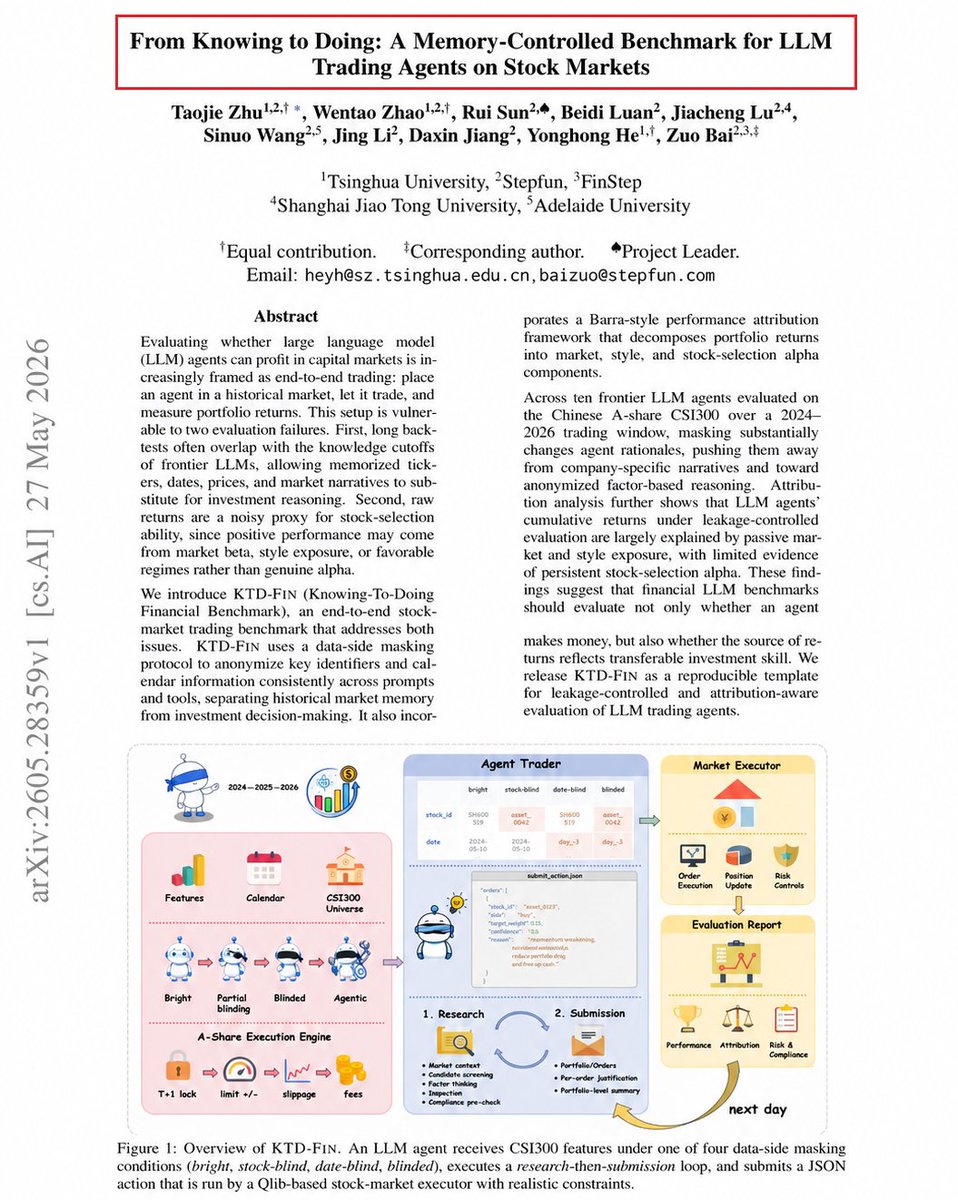
As anyone building trading agents knows, the hardest part isn't getting an LLM to place a trade. It's proving the model isn't just pattern-matching a name it already knows from pretraining.
This paper solved it with a 4-level masking protocol -
hide the ticker, hide the date, or both - then had an
independent panel of LLMs try to break it.
Sharpe ratio: 2.02
Bookmark it, this is best read of week for me.
Jim Simons once stood at a board explaining the messy proof that came before his own work.
That's the mess Chern inherited. He reduced it to what Simons calls, almost affectionately, a one-pager.
He did it with one clean trick, lifting the curvature form onto the sphere bundle, and watching the whole tangled argument fall apart on its own.
That's the part people miss about real elegance in mathematics. It isn't about adding more machinery, it's finding the one small, correct move that makes an enormous, tangled problem collapse into something simple.
This is oddly the same instinct underneath every casino floor and trading desk. Nobody wins by piling on complexity, the house wins with a single small, boring edge repeated enough times that the Law of Large Numbers turns a whisper into certainty.
Simons found this same pattern decades later in the market. His edge was barely half a percent per trade, applied with the same disciplined repetition, and it built the greatest track record markets have ever recorded.
Genius rarely means doing something complicated well. It means finding the one small, elegant move worth repeating until the structure gives way on its own.