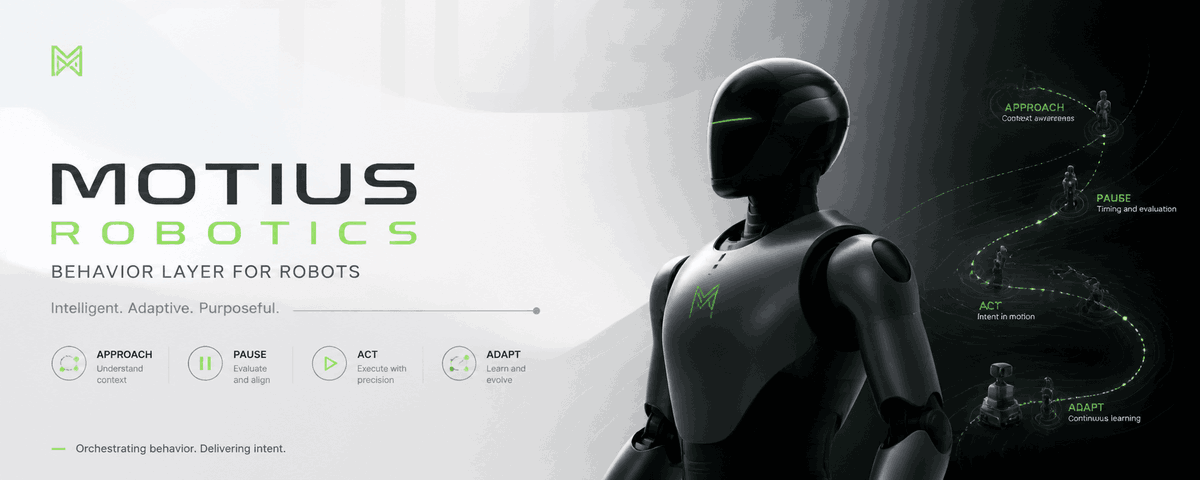
Motius Robotics - $MOTIUS
An overview of the project's purpose, functionality, and key components—highlighting what it does, how it works, and why it was built.
Our core belief is simple: the next robot stack is not only perception, planning, and control. It also needs behavior. A robot may already be able to move, navigate, and complete a task, but that does not mean it knows how to behave well in front of a human. In real service settings, the difference between a useful robot and an uncomfortable one often comes down to approach timing, stopping distance, waiting behavior, handover rhythm, pacing, and how the robot exits an interaction.
This problem matters because service robots are no longer hypothetical. They are already entering hotels, lobbies, delivery routes, reception areas, and other shared public-facing environments. In these settings, success is not defined only by task completion. A robot can arrive at the right location and still feel too abrupt, too mechanical, too hesitant, too cold, or simply inappropriate for the moment. In practice, those behavior differences are still often handled through one-off scripts, deployment-specific tuning, and local runtime adjustments. That means behavior quality rarely compounds. One site learns something, but the next site often starts again from scratch.
Motius is designed to change that. Instead of treating behavior as a hidden implementation detail, Motius treats it as a software layer that can be surfaced, adapted, validated, and improved over time. The goal is not simply to define a few fixed profiles, but to build a system in which behavior can shift for different users and different service contexts while still staying inside a coherent runtime structure. The same robot should be able to behave more patiently for an elderly guest, more conservatively around a child, and more efficiently in a business-facing exchange, all without changing the robot body underneath.
This is why Motius is not just a controller wrapper and not just a static profile catalog. It is a behavior system built around adaptive profile bands, contributor-driven reference data, validation loops, and runtime-safe execution mapping. Contributors help expand the Reference Network by uploading short interaction clips and attaching behavior cues. Those references improve how behavior is evaluated, compared, and eventually adapted. Better behavior then makes real deployments more valuable, and those deployments create more useful data in return. Over time, this creates a compounding flywheel: more references improve adaptation, better adaptation improves deployments, and more deployments generate the next layer of behavioral intelligence.
Our core belief is simple: the next robot stack is not only perception, planning, and control. It also needs behavior. A robot may already be able to move, navigate, and complete a task, but that does not mean it knows how to behave well in front of a human. In real service settings, the difference between a useful robot and an uncomfortable one often comes down to approach timing, stopping distance, waiting behavior, handover rhythm, pacing, and how the robot exits an interaction.
This problem matters because service robots are no longer hypothetical. They are already entering hotels, lobbies, delivery routes, reception areas, and other shared public-facing environments. In these settings, success is not defined only by task completion. A robot can arrive at the right location and still feel too abrupt, too mechanical, too hesitant, too cold, or simply inappropriate for the moment. In practice, those behavior differences are still often handled through one-off scripts, deployment-specific tuning, and local runtime adjustments. That means behavior quality rarely compounds. One site learns something, but the next site often starts again from scratch.
Motius is designed to change that. Instead of treating behavior as a hidden implementation detail, Motius treats it as a software layer that can be surfaced, adapted, validated, and improved over time. The goal is not simply to define a few fixed profiles, but to build a system in which behavior can shift for different users and different service contexts while still staying inside a coherent runtime structure. The same robot should be able to behave more patiently for an elderly guest, more conservatively around a child, and more efficiently in a business-facing exchange, all without changing the robot body underneath.
This is why Motius is not just a controller wrapper and not just a static profile catalog. It is a behavior system built around adaptive profile bands, contributor-driven reference data, validation loops, and runtime-safe execution mapping. Contributors help expand the Reference Network by uploading short interaction clips and attaching behavior cues. Those references improve how behavior is evaluated, compared, and eventually adapted. Better behavior then makes real deployments more valuable, and those deployments create more useful data in return. Over time, this creates a compounding flywheel: more references improve adaptation, better adaptation improves deployments, and more deployments generate the next layer of behavioral intelligence.
Aped base:0x60a646e3fd75cde4c5b604b22d4fcd04639913c8 at 400k mc
0x60A646e3fD75CdE4c5b604b22d4Fcd04639913C8
1. base:0x60a646e3fd75cde4c5b604b22d4fcd04639913c8 — The first fully on-chain LLM on https://t.co/64O6Mg5mTS APIs. No oracles. No off-chain servers. Model weights live directly in smart contracts. Inference runs 100% inside the EVM using integer arithmetic. Every output is deterministic, verifiable, and reproducible by anyone. True Verifiable AI is here.
https://t.co/sMQqU8V2qx
2. You can run models for free right now (just gas). Pay a fraction of a cent only if you want to permanently inscribe the output on-chain. 70% of fees go straight to model creators, 30% burned. A real creator economy powered by on-chain AI.
3.Already built:
- Discovery Registry & Router
- Autonomous Agents (Genesis Memory Agent is live & self-prompting)
- Bench & Arena (models & agents compete with real money)
- Quill-v2 model deployed
- Mixture of Experts (MoE) + massive gas optimizations coming this summer
Just bought $LBM at 2M
I was just introduced to it by @techy0x and I see great potential.
0x15B15FA54b629C634958E8BD639b2fc8af654974
Litebeam is an infrastructure project for AI Agents on Base, and it just launched on https://t.co/b1B1f0xWli. The standout feature is its routing layer that lets you access thousands of microservices with just one single connection through real-time auction.
No API keys needed, payments are on-chain, and providers compete directly on relevance, performance, and cost. This feels like a logical and necessary step to build scalable, cost-efficient AI Agent systems.
Personally, I see this as one of the important infrastructures for the upcoming agent era. I'm following the development closely.
$LBM #Litebeam #Virtuals #AIAgents
🔵 $MEI
Aped some of it in this dippy dip, r/r seems pretty good there if it reverses.
A defi safety tool and am seeing dev doing pretty good work on x non stop.
0x568bAC4E1C5A097d4B3B903b9A511534BD45eBa3
Motius Robotics - $MOTIUS
An overview of the project's purpose, functionality, and key components—highlighting what it does, how it works, and why it was built.
Our core belief is simple: the next robot stack is not only perception, planning, and control. It also needs behavior. A robot may already be able to move, navigate, and complete a task, but that does not mean it knows how to behave well in front of a human. In real service settings, the difference between a useful robot and an uncomfortable one often comes down to approach timing, stopping distance, waiting behavior, handover rhythm, pacing, and how the robot exits an interaction.
This problem matters because service robots are no longer hypothetical. They are already entering hotels, lobbies, delivery routes, reception areas, and other shared public-facing environments. In these settings, success is not defined only by task completion. A robot can arrive at the right location and still feel too abrupt, too mechanical, too hesitant, too cold, or simply inappropriate for the moment. In practice, those behavior differences are still often handled through one-off scripts, deployment-specific tuning, and local runtime adjustments. That means behavior quality rarely compounds. One site learns something, but the next site often starts again from scratch.
Motius is designed to change that. Instead of treating behavior as a hidden implementation detail, Motius treats it as a software layer that can be surfaced, adapted, validated, and improved over time. The goal is not simply to define a few fixed profiles, but to build a system in which behavior can shift for different users and different service contexts while still staying inside a coherent runtime structure. The same robot should be able to behave more patiently for an elderly guest, more conservatively around a child, and more efficiently in a business-facing exchange, all without changing the robot body underneath.
This is why Motius is not just a controller wrapper and not just a static profile catalog. It is a behavior system built around adaptive profile bands, contributor-driven reference data, validation loops, and runtime-safe execution mapping. Contributors help expand the Reference Network by uploading short interaction clips and attaching behavior cues. Those references improve how behavior is evaluated, compared, and eventually adapted. Better behavior then makes real deployments more valuable, and those deployments create more useful data in return. Over time, this creates a compounding flywheel: more references improve adaptation, better adaptation improves deployments, and more deployments generate the next layer of behavioral intelligence.
Our core belief is simple: the next robot stack is not only perception, planning, and control. It also needs behavior. A robot may already be able to move, navigate, and complete a task, but that does not mean it knows how to behave well in front of a human. In real service settings, the difference between a useful robot and an uncomfortable one often comes down to approach timing, stopping distance, waiting behavior, handover rhythm, pacing, and how the robot exits an interaction.
This problem matters because service robots are no longer hypothetical. They are already entering hotels, lobbies, delivery routes, reception areas, and other shared public-facing environments. In these settings, success is not defined only by task completion. A robot can arrive at the right location and still feel too abrupt, too mechanical, too hesitant, too cold, or simply inappropriate for the moment. In practice, those behavior differences are still often handled through one-off scripts, deployment-specific tuning, and local runtime adjustments. That means behavior quality rarely compounds. One site learns something, but the next site often starts again from scratch.
Motius is designed to change that. Instead of treating behavior as a hidden implementation detail, Motius treats it as a software layer that can be surfaced, adapted, validated, and improved over time. The goal is not simply to define a few fixed profiles, but to build a system in which behavior can shift for different users and different service contexts while still staying inside a coherent runtime structure. The same robot should be able to behave more patiently for an elderly guest, more conservatively around a child, and more efficiently in a business-facing exchange, all without changing the robot body underneath.
This is why Motius is not just a controller wrapper and not just a static profile catalog. It is a behavior system built around adaptive profile bands, contributor-driven reference data, validation loops, and runtime-safe execution mapping. Contributors help expand the Reference Network by uploading short interaction clips and attaching behavior cues. Those references improve how behavior is evaluated, compared, and eventually adapted. Better behavior then makes real deployments more valuable, and those deployments create more useful data in return. Over time, this creates a compounding flywheel: more references improve adaptation, better adaptation improves deployments, and more deployments generate the next layer of behavioral intelligence.