Rare but real? Two cases of ophthalmic lymphoid hyperplasia on dulaglutide therapy, presenting with vision loss, resolving after discontinuation of dulaglutide https://t.co/0eletzBir9
👁️ Can rapid glucose lowering worsen #retinopathy? Prof David Matthews (EASD Past President) explains why sudden glycaemic shifts, not #GLP1RAs, pose risks for people with longstanding #diabetes. Who’s vulnerable & how to monitor?
📺🔗 Watch now: https://t.co/n86lyGIgEb
Understanding, accepting, and working with reality is both practical and beautiful. I have become so much of a hyperrealist that I’ve learned to appreciate the beauty of all realities, even harsh ones, and have come to despise impractical idealism.
Don’t get me wrong: I believe in making dreams happen. To me, there’s nothing better in life than doing that. The pursuit of dreams is what gives life its flavor. My point is that people who create great things aren’t idle dreamers: They are totally grounded in reality. Being hyperrealistic will help you choose your dreams wisely and then achieve them.
By interacting with my digital twin, you can evaluate your own decision-making processes and evolve your approach in real-time. The faster you evolve, the faster your results will follow. Click the link below/in my bio to start our comversation now. #principleoftheday
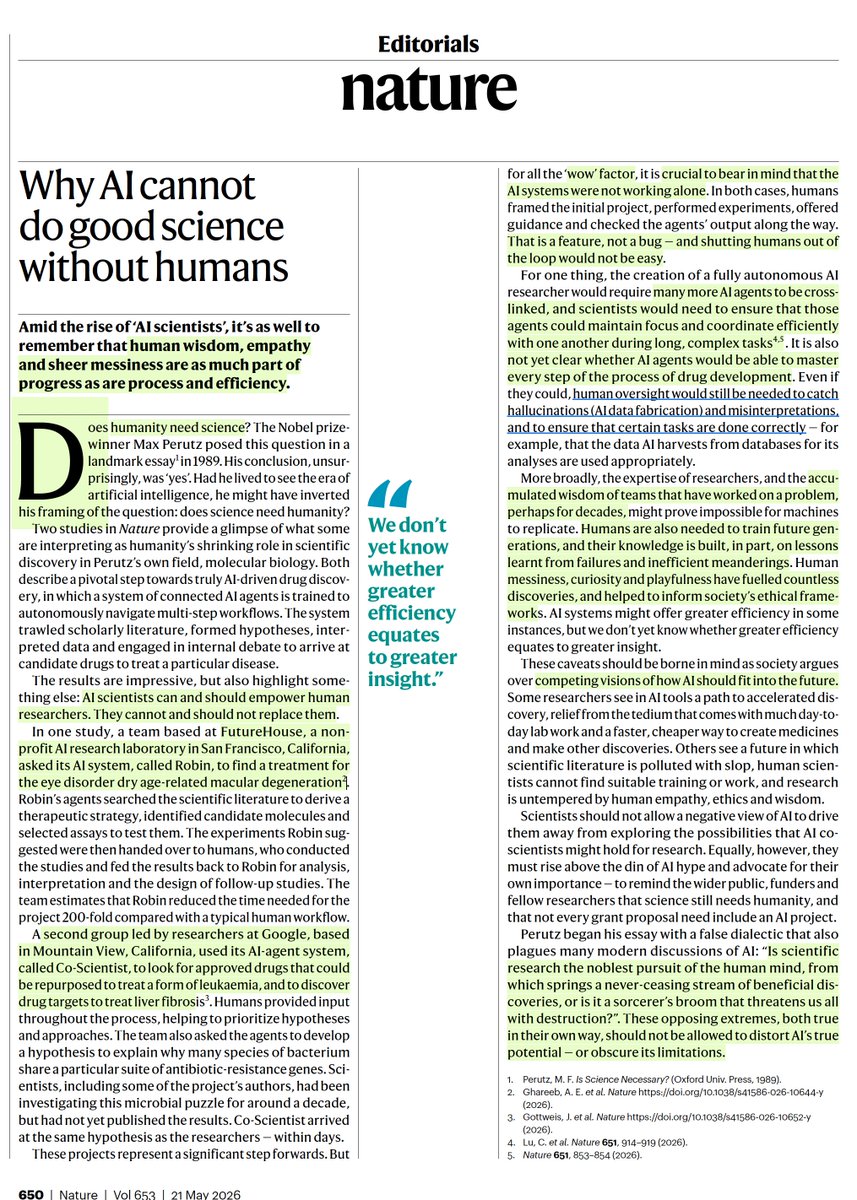
Important editorial @Nature on the new "AI-scientist" papers
"AI scientists can and should empower human
researchers. They cannot and should not replace them."
https://t.co/CZQUrMV8D1
“You have to be your own worst critic. You have to be so demanding to get very sharp proof yourself, in your own laboratory, that by the time you announce it to others; they have to accept it". - Thomas Cech
A privilege to meet him and receive a signed copy of his book.
Thomas Cech was awarded the 1989 Chemistry Prize after studying the microorganism Tetrahymena thermophila (shown) and discovering that RNA could function as an enzyme.
The discovery came as a complete surprise to scientists and caused many chapters in textbooks to be revised.
In his official Nobel Prize interview Victor Ambros spoke about the importance of failure and how much it can teach us.
Watch his full interview at https://t.co/T16cTEmqIW
Outstanding keynote by Prof. Thomas Cech (Nobel ’89).
CRISPR isn’t simple “cut & paste”—it’s editing across a million pages.
From RNA biology to mRNA therapeutics! 🌟#ARVO2026
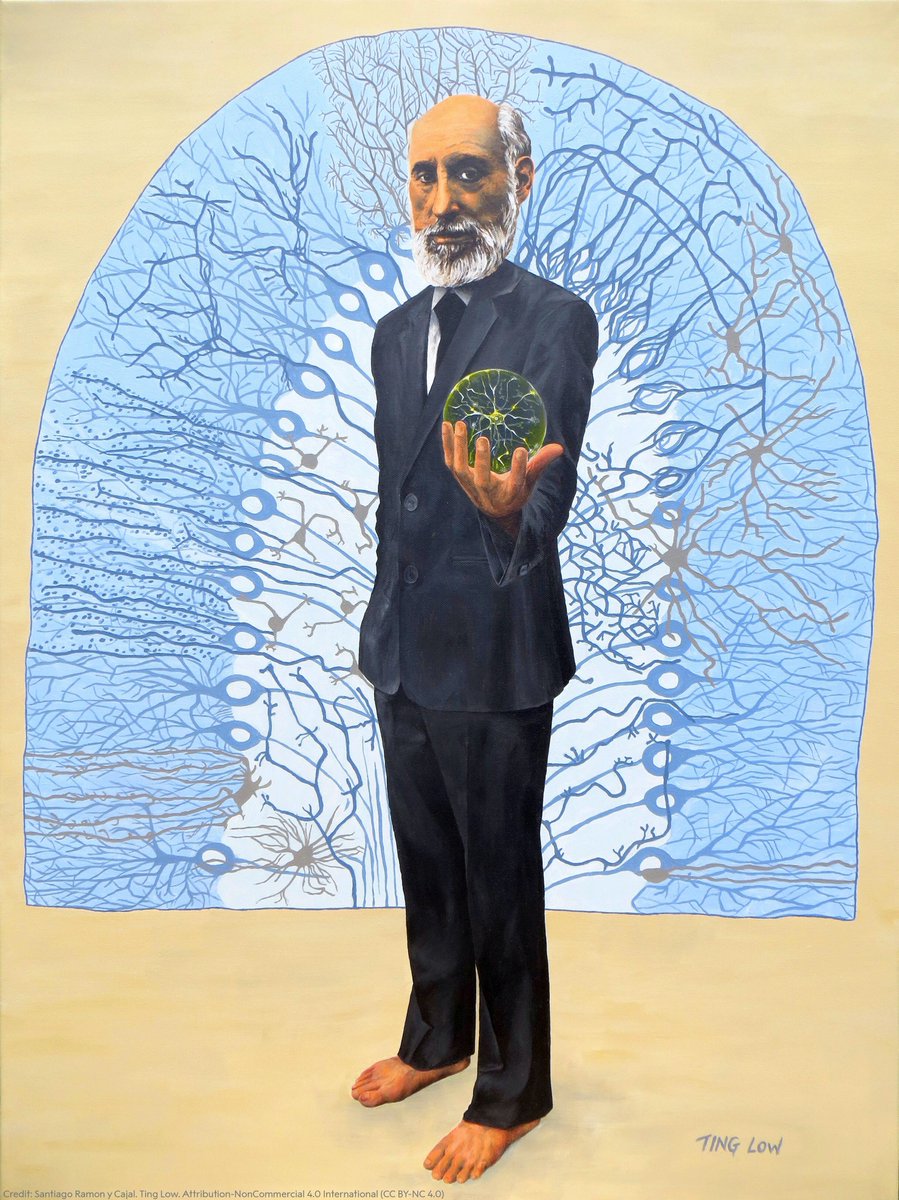
Did you know that Santiago Ramón y Cajal wanted to be an artist as a boy but his father wanted him to study medicine? He put his artistic skills to good use in the detailed and beautiful pictures of the nervous systems he studied.
Learn more: https://t.co/BjwkxnlDW3
At @CommonsHealth, we heard from @solomon19400 of @SheffieldHosp about the real pressures NHS teams face when pilot projects are launched.
Consideration also needs to be given to the strain placed on staff, resources, and services, which are often already at their limit.
"Language about rare disease is a powerful—but underused—lever for change."
In a new Comment, authors call for a profound shift in how health-care providers use language within the rare disease ecosystem.
Find out more in our latest issue: https://t.co/BFju1eV7ay
My favourite academia joke of all time. "The moral of this story is: The topic of your dissertation isn't really important; what's important is who your advisor is."
—Harvey Cox, When Jesus Came to Harvard
"Science is really a process of seeking the truth."
Our newest medicine laureate Mary Brunkow on the joy of science and what she loves about research.
Brunkow was awarded the 2025 medicine prize for discoveries concerning peripheral immune tolerance.
#WomenInScience
In May 1921, Fredrick Banting met his research assistant Charles Best in John Macleod's lab to begin their experiments with insulin. In January 1922, the first person received an insulin injection. By 1923, insulin was commercially available. Banting and Macleod received the 1923 Nobel Prize in Physiology or Medicine.
#WorldDiabetesDay
One of my principles is that if you’re worried, you don’t need to worry — and if you’re not worried, you need to worry.
That’s because worrying about what can go wrong will protect you and not worrying about what can go wrong will leave you exposed.
I’ve found this to be true in business, and in life.
Radical open-mindedness and radical transparency are invaluable for rapid learning and effective change. Learning is the product of a continuous real-time feedback loop in which we make decisions, see their outcomes, and improve our understanding of reality as a result. Being radically open-minded enhances the efficiency of those feedback loops, because it makes what you are doing, and why, so clear to yourself and others that there can’t be any misunderstandings. The more open-minded you are, the less likely you are to deceive yourself— and the more likely it is that others will give you honest feedback. If they are “believable” people (and it’s very important to know who is “believable”), you will learn a lot from them. #principleoftheday
Join us tomorrow at the @exeternihr Open Evening!
Meet the team, explore exciting research, and find out how you can get involved. No booking needed!
https://t.co/dULm3t8nSi
#NHSResearch#ClinicalTrials#Exeter
"Follow your passions. If you keep the passion to answer the question, you'll do very well."
Get some valuable career advice from our 2023 Nobel Prize laureates Katalin Karikó, Claudia Goldin and Anne L'Huillier.