India's peak power demand hit 260 GW yesterday. New all-time record. During a heatwave with 47°C temperatures across North India.
The grid held. No blackouts. That sentence alone is an engineering achievement most people will not appreciate.
Five years ago India had chronic power deficits. Load shedding was normal. In 2023, peak demand hit 243 GW and several states struggled. In April 2026, the grid delivered 260 GW without a single major failure.
What changed: 26.5 GW of new capacity added in FY26 — largest annual addition in a decade. Solar alone contributed 18 GW. New HVDC transmission corridors connecting surplus regions to deficit ones. Battery storage deployments cushioning peak load.
But the margin is razor thin. India's grid is designed for about 270 GW. We just touched 260 GW. That is 96% utilisation during peak hours. One more heatwave spike or an unexpected plant outage and the buffer disappears.
This is why every power stock hit 52-week highs. The market sees what the headlines miss — India needs $150 billion in power infrastructure investment over five years just to keep up. Data centres, EVs, semiconductor fabs, industrial expansion — all need reliable 24/7 power. The grid is the bottleneck holding everything else together.
There is a BIG rotation underway (and its early stages).
For US, the Mag 7 premium is gone and consumer staples multiples are picking up. For India, Private Capex is picking up and Capex theme is doing better, while the mainstay Consumption is under pressure. Few get this.
HArtnett || The Great Rotations: big political, geopolitical, financial events of past 50 years always ignited big asset market leadership changes…
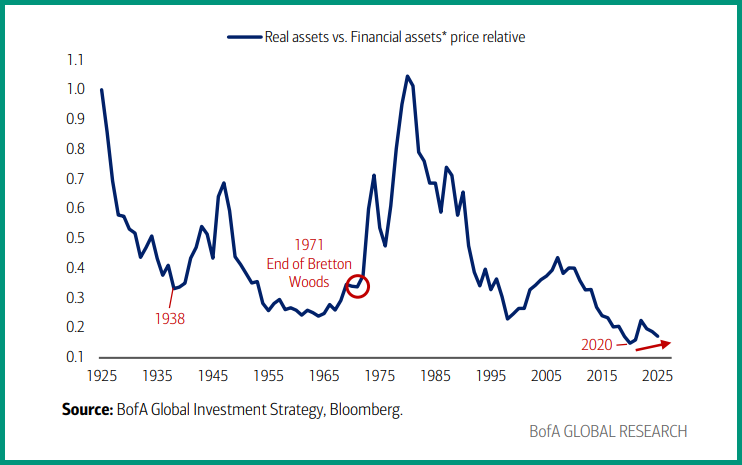
• 1971: end of Bretton Woods, era of stagflation, oil shocks, end of Nifty Fifty bull market… new secular leader was gold & real assets (up 417% from ’71 to ’80), laggard bonds & financial assets (paltry 67% );
1971… secular leader = real assets
Real vs financial assets price relative
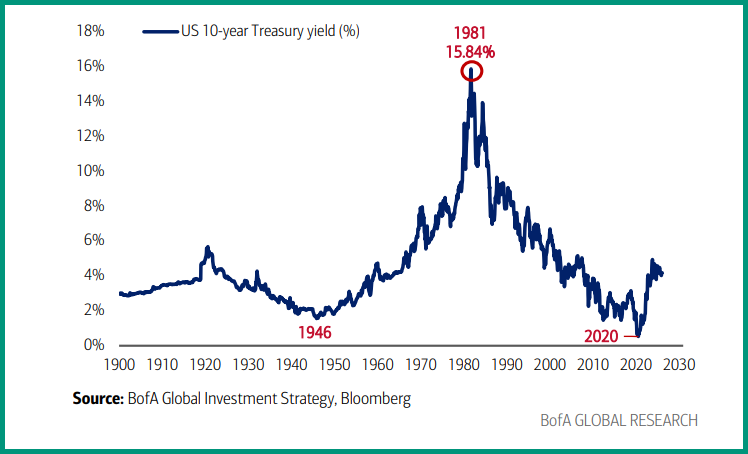
* 1980: Reagan/Thatcher/Volcker shocks, peak inflation (14.8% in Mar’80), peak government… secular leader was bonds (10-year Treasury yield fell 16% to 6% by 1985 );
1980… secular leaders = bonds
10-year US Treasury yield since 1900
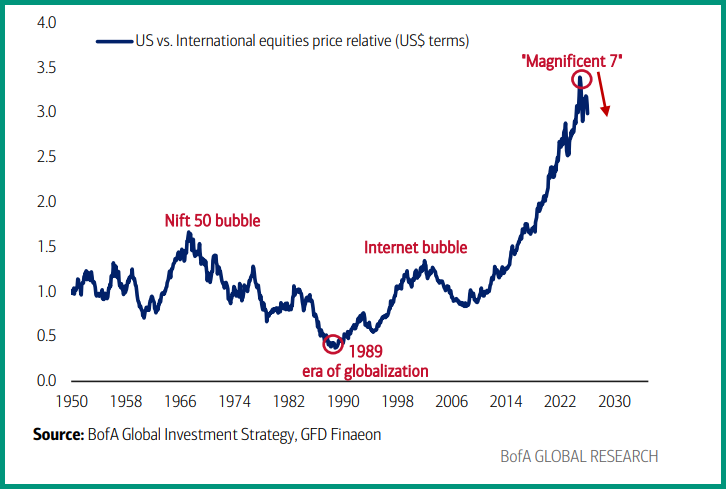
• 1989: fall of Berlin Wall, start of era of globalization, disinflation… secular leader US stocks (in 1989 hit lowest level vs global stocks in past 75 years ), laggard commodities (copper only asset to record negative annual return in 1990s);
1989… secular leader = US stocks
US vs international equities price relative (US$ terms)
• 2001: 9/11, China enters WTO, start of “rise of China & BRICS”… laggard was US$ & tech stocks, leaders EM/commodities , financials/resources sectors;
2001… secular leaders = EM stocks & commodities
EM vs US equities price relative (US$ terms)
@mybmc Mumbai lacks winter, but not hurdles for those Winter Olympic vibes! The path under Mrinal Tai Gore Flyover (next to Nesco) is a literal life hazard. These steel beams have turned a commute into a high-stakes obstacle course. Let's fix this before someone gets hurt!
1 year return of ACWI and MAGS.
who would have thought a year back that All country world index (ACWI) will outperform MAGS.
The best part is that rotation out of MAGS has not even started.
I am so happy neutral influencers are realising WB’s real worth
The PR will change
People just needs to look beyond barabazar & pice hotels
Welcome to West Bengal people
The land of happening
The land of happiness
The companies have to immediately take steps to update their systems so that the new rates are reflected.
From 22nd September the new rates should be picked up by their systems for generating invoices.
Secondly, they have to ensure that rate cut benefits are passed on to consumers and they should not hold back any benefits accrued due to this rate cut, with themselves.
The department is closely monitoring price trends pre-cut and post-cut so that in case any kind of intervention is required, we will be ready to take that to ensure that benefits are ultimately passed on to consumers.
But, we are otherwise confident that industries on their own will pass on the benefits. These kinds of assurances are being given by various chambers and associations to us.
- Smt @nsitharaman in an interview to @timesofindia. #NextGenGST
Just check these stats for DSP Multicap Fund.
* The fund delivered 20% CAGR since 1997
* 7 lakh investors entered & exited during this period
* Only 23 investors stayed the course in this fund. Just 23!!!!
@KalpenParekh@dspmf@arunrajendran