Tweeting updates and tips on how to use the mizer package to set up and explore a dynamic multi-species size-resolved ecosystem models of fish communities.
AI coding agents like Claude Code or Gemini can be genuinely useful for building and calibrating mizer models — but only if they actually know the mizer API. The new mizerAgents R package fixes that with a single setup call.
Blog post: https://t.co/i9wpH5qJir
Pre-announcing mizer 3.0: growth diffusion, better numerics, interactive analysis objects, and composable extension chains. Please try the GitHub version and send feedback before the CRAN release.
https://t.co/qhbKH1TqeG
mizer has temporarily disappeared from CRAN because one of the unit tests failed due to rounding errors on macOS 13.3 and version 14.3 of the CLT toolchain. We will get it back asoon. In the meantime you can install mizer with `remotes::install_github("sizespectrum/mizer")`
The new mizer version 2.4.0 is now on CRAN. I have blogged about it here: https://t.co/Ypjy5Zz59A. The highlights in this version: `setResource()` to change the resource dynamics without changing the steady state and `matchGrowth()` to match mizer growth rates to observations.
A PhD in developing ensemble models to explore ecosystem effects of management actions with a particular focus on the marine environment with @CefasGovUK @kitlynam @shefmathbio
https://t.co/XwBWhUwVFl
The next 3-week online mizer course starts coming Monday. Register now. On the course website at https://t.co/WzBQhiQau7 you can already now find the guest talk by Ken Andersen @69kno introducing the principles behind multi-species size-spectrum modelling.
A new online mizer course is starting next week! If you want a guided introduction to mizer and see how easy it has become to build a new mizer model, then this is for you: https://t.co/WzBQhiQau7.
Many thanks to @PhoebeJefcoats who has contributed a great post to the mizer blog that demonstrates how one can work with temperature-dependent physiological rates in mizer to investigate effects of global warming. https://t.co/QCr6bfYkcn
mizer is a very powerful modelling framework, but it takes some guidance to get started with your own model. This course in August will consist of online videos and tutorial worksheets supported by live online Q&A sessions. See https://t.co/uu5fwxP1XG
Great article that explores how sensitive model predictions are to changes in model parameters. This is a very important topic. Mizer now makes it easy to change model parameters, so hopefully you feel encouraged to perform such explorations in your own model.
Excited to share our newest paper! We used sensitivity analyses to identify influential life history parameters of a 🐟 size spectrum model implemented in @mizer_model.
Link: https://t.co/ZOnzwUUJsU
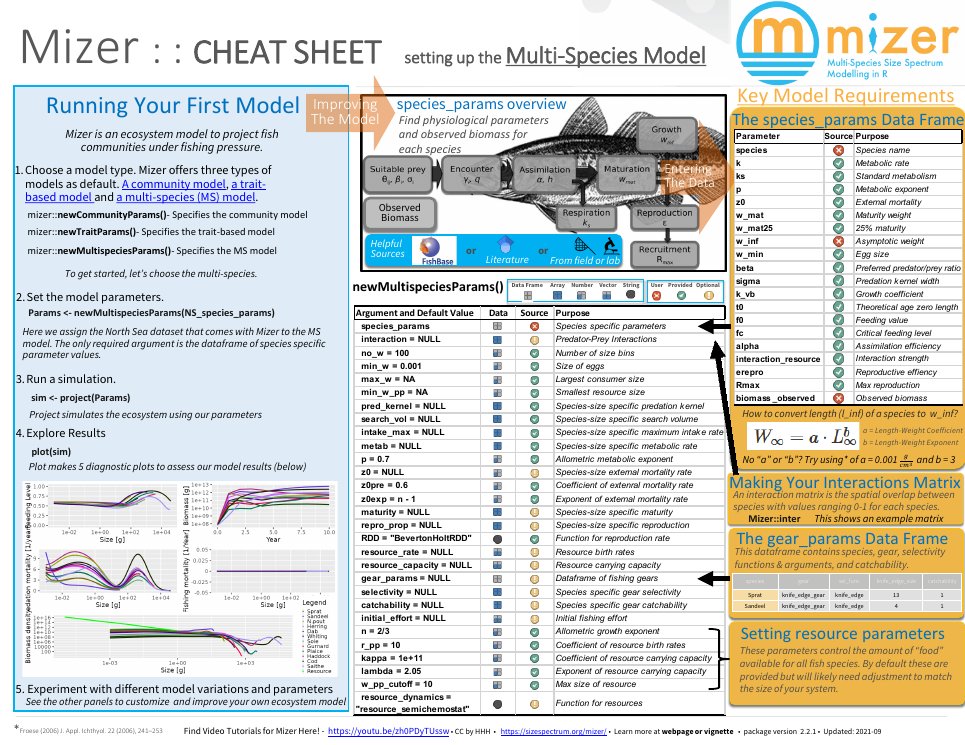
Many thanks to @henry_h_hansen for contributing a first cheat sheet for setting up a mizer model. It is now linked to from the mizer Get Started page at https://t.co/agij2jg234. Such community contributions to the mizer documentation are very welcome.
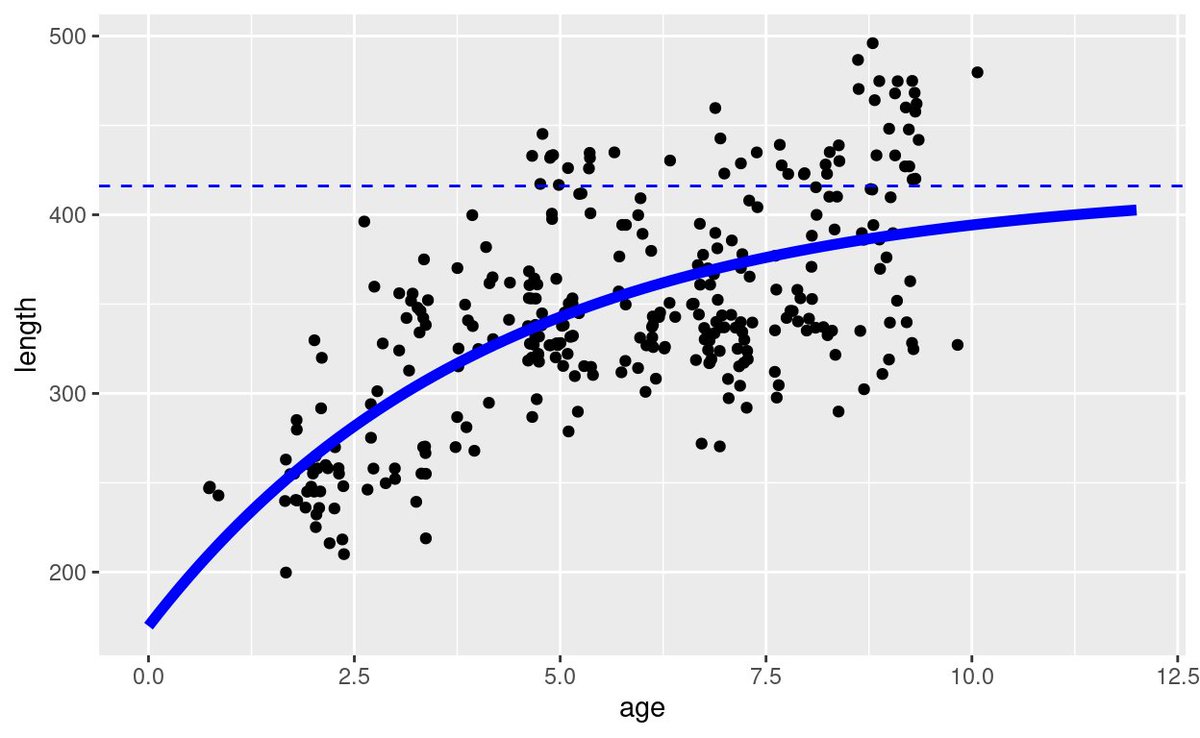
Tuning a mizer model to observed growth curves used to be a tedious task. No longer! I am excited to introduce you to the first application of our shiny tuning gadget: https://t.co/P2UMO64RzD
We are planning to release version 2.3.0 of mizer very soon. You can see what's new at https://t.co/oN13WBEw8c Let us know if there is anything else you think we should include in this release.
Samik Datta has kindly contributed a new plot function for comparing observed biomasses to model biomasses, see https://t.co/c1lSJe7Om7. Let us know if you like it and it can be included in the next mizer release.
Why are high biomass densities often observed at particular body sizes? Next SPECTRE session on September 16 at 7 am and 3 pm British Summer Time (BST) - we'll be discussing domes (distinct body size ranges characterized by high biomass) in size spectra!
You can now conveniently add multiple size-structured resources to a mizer model: https://t.co/9eOERDWcB2. If this is useful in your model, let us know and share your example.
Thanks to the `steady()` function in mizer, calibrating a model to reproduce observed biomasses has become really easy. Let me know how well the recipe works for your model.
https://t.co/XCGdWvmOg3
New paper on the importance of reproductive hyperallometry. If you want to play with this in mizer: there is a species parameter `m` that controls this. `m=1`(default) means isometry, `m>1` gives hyperallometry. See https://t.co/DZ4CwjySN8 for details.