🚨🚨Calling all LVR influencers🚨🚨
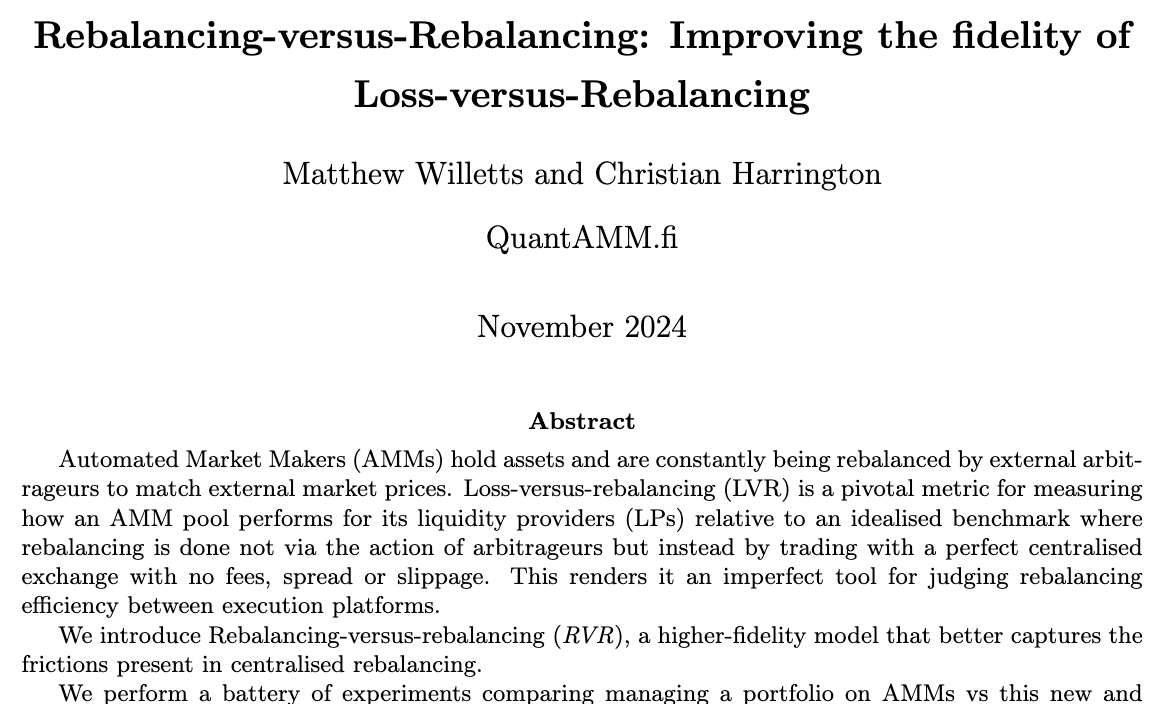
Introducing RVR (Rebalancing-versus-Rebalancing), a new metric for comparing AMM pools as rebalancing engines vs using centralised exchanges.
TLDR: CEXes are not perfect (eg fees exist), which means AMMs can beat them for running portfolios.
At QuantAMM we have been at the forefront of on-chain fund research since 2023. Read our thoughts on how we think on-chain funds need to evolve and how BTFs are well placed to do this
What a weekend. The QuantAMM BTF Base Macro is up since Friday, up +8% (+53% since inception) even prior to incentives! It’s a trend following strategy between $WETH, $cbBTC, $AERO and $USDC. How did this strategy achieve this? Let’s dig in.
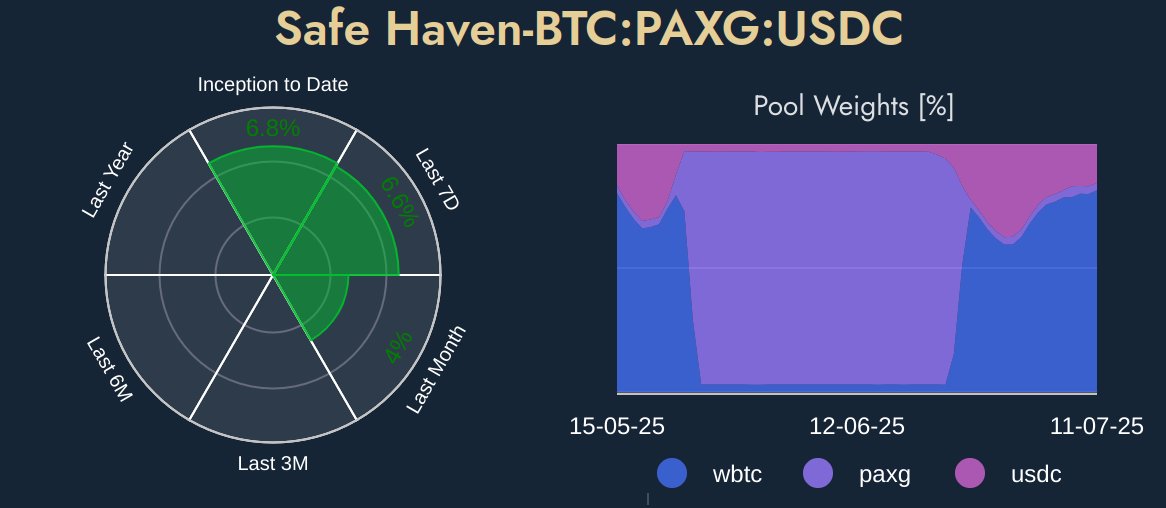
The Safe Haven BTF re-weights LP holdings between the OG safe haven Gold and its successor BTC.
It does this automatically according to a daily on-chain trend-following methodology.
The BTF went bullish on BTC on the 26th June (an early bull!) meaning the Safe Haven BTF has been able to capitalise on the latest large price movements.
This is the value of BTFs, where daily re-weighting and following trends is superior to monthly or quarterly market cap tracking!
@nullcoder_xd@mevquant@danielvf appendix A here https://t.co/B4IrdW0qVe gives the closed form optimal arb trades for two token vanilla pools, and https://t.co/BxKGhAKVWR gives it for the case of multi token pools with multi token trades. These give you the post-trade reserves directly
@hasufl@maxresnick@Togbe0x@EdFelten Gattaca’s plan is having time boost work really really like ethereum, where the 1 min blocks are divided by them (when they win) into mainnet-block-like sub units, which can then be (sub) auctioned off.
From the arbitrum blog:
https://t.co/2vjgui998w
Balancer V3 is providing the most secure, flexible DeFi AMM infrastructure. It was an easy choice to partner with the amazing Balancer Labs team for our groundbreaking Blockchain Traded Funds. Balancer V3's secure vault and hook flexibility (combined with our automated strategy approach) will be future of passive LPing in DeFi: capitalise on underlying volatility inherent in crypto while still earning swap fees and yield.
when @CamutoDante makes a video, I sit my ass down and listen (esp when it's about face-meltingly cool AI methods). model compression using random projections
Yesterday, with @mjfw3's help, I implemented Apple and Meta's SeedLM compression paper.
This implementation:
- Simulates LFSRs using software
- Creates a really simple PyTorch wrapper that can compress layers, or an entire model!
Code is linked below so you can replicate.
Some of these ideas are pretty similar to some stuff @mjfw3 had kicked around during our PHDs:
the idea that random projections could be sufficiently good approximations of an original trained matrix / a solution to an optimization problem.
https://t.co/nbnlfNQlKQ
this paper is bananans btw. compress your weight matrix by finding a random seed that, when fed to a pseudo random number generator, ~ gives you back your OG weight matrix
Apple and Meta have published a monstruously elegant compression method that encodes model weights using pseudo-random seeds.
The trick is to approximate model weights as the linear combination of a randomly generated matrix with fixed seed, and a smaller vector t.
More people would understand the premise of Internet Finance if they thought about the meaning of owning an asset.
- If you do a Seed round deal with a startup, the startup has an excel sheet with your name and the number of shares you purchased. This will often be replicated by a law firm or third party provider (eg Carta). You hold a legal contract that makes certain terms enforceable but your ownership lives on the equivalent of an excel sheet.
- If you own 100 Apple stock on Robinhood, that means Robinhood has a database with your account number and "100 AAPL". Your ownership is subject to their database. If all Robinhood customers combined have 1M Apple stock, then Robinhood's ownership is a database entry with a Depository Trust Company (DTC) that works directly with Apple's CFO department to record which entities own how many stocks.
- Most smaller brokers don't even work directly with the DTC (ie don't participate in self-clearing like Robinhood) but instead add an intermediate custodian. Many firms work with BNY Mellon, for example, in such a way that there are now three steps: your ownership of Apple lives in a database at the Independent Financial Group (IFG); IFG's Apple stocks live in a database controlled by BNY Mellon; and BNY Mellon's Apple stocks live in a database controlled by the DTC.
- You own real estate in Guatemala, there is a literal office with thousands of rolled up papers. These papers house cadastral maps and signatures and together represent the land registry. Your ownership of the land lives within that office. This is still the status quo in many more places than you would expect.
- If you own €1,000 with Deutsche Bank then Deutsche Bank has a database with your name and "€1,000." Your Euros live on their database and nowhere else. They have an account with the European Central Bank that says Deutsche Bank and "€100M".
You get the idea. Any asset you hold — anything you own or owe — within the global financial system is an entry into one of these siloed databases. If you own a home in the US, you may be aware that your ownership is registered with federal, state, and local servers, and only a small group of permissioned administrators can send transactions to these servers. This is what we call the permissioned, siloed database problem.
This system made sense at the time because we did not have the ability to create scalable, permissionless databases that follow set rules and interact with smart contract code. Now we do. And all we are saying is that we should move our assets into a single, unified server in the cloud so that we don't need to keep up this inane system of permissioned, siloed databases and all of the costs that come with it.