Thanksgiving sweet potatoes deserve an upgrade. 🍠🔥
Twice Baked Sweet Potatoes with Bacon & Mini Marshmallows bring sweet, savory, and wood-fired flavor to your holiday table.
Find the recipe in the Traeger App and save it for Turkey Day!
#Traeger#ThanksgivingSides
Six years into the Ryan Smith era, we’ve got a losing team, overpriced season tickets, and a ticketing system that punishes the franchise’s most loyal fans. https://t.co/LJzYEwAJ3Z
The happiest people I've met don't necessarily have the easiest lives or the most impressive accomplishments. But they tend to have four things in common:
-They take their faith or life philosophy seriously.
-They invest in their family relationships.
-They cultivate real friendships.
-They find meaning in work that creates value and serves others.
These are the four areas of life worth paying attention to if you want to live a more fulfilling life.
I have been holding my tongue about something that happened during the Ohio gubernatorial race. I refused to speak while the election was underway because I did not want my words mistaken for an attempt to influence anyone’s vote.
But now that the election is over, I have something to say.
For nearly twenty years, my ministry has taken me among the homeless, the abused, the exploited, and the forgotten. I have sat with victims of sexual violence and witnessed the lifelong wounds of childhood trauma.
What Vivek Ramaswamy’s campaign did to Amy Acton was among the most morally repulsive things I have witnessed in American politics.
They took a woman whose stepfather was indicted for raping her when she was twelve years old and featured her mother, from whom she had been estranged for nearly fifty years, in a political advertisement attacking her credibility.
The advertisement challenged Acton’s account of her childhood without mentioning the sexual abuse allegations or the circumstances of that estrangement. When people expressed their horror, the campaign defended it.
Imagine examining another person’s childhood suffering and fractured family relationships, then deciding those wounds might help win an election.
Anyone who has worked with survivors of childhood sexual abuse understands the painful realities of denial, betrayal, shame, and estrangement. A child growing into a successful adult does not erase what happened. Nor does a parent’s denial make that suffering disappear.
I find it equally disturbing that an elderly mother, whom Acton herself described as unwell, was brought into this spectacle. Whatever her own struggles or responsibility for the past, exploiting that fractured relationship was grotesque.
To everyone who defended this, consider the message you sent to survivors. To the young woman whose family refuses to believe her. To the man who has carried the shame of childhood abuse for forty years. To the frightened child who has yet to tell anyone.
What did you teach them about the value of their suffering?
I am a priest. I believe in repentance, forgiveness, and redemption. But none of those things requires me to pretend that deliberate cruelty is anything less than a grave moral failure.
Your political allegiance does not absolve you of moral responsibility. You do not get to set aside your conscience during an election and retrieve it afterward.
If your loyalty requires you to defend the exploitation of a childhood sexual abuse survivor, your loyalty has become an idol. And if your conscience cannot recognize the wrong here, examine what political tribalism has done to it.
This is not about Republicans or Democrats. We have a choice as a people: continue excusing cruelty from our preferred political camp, or summon the courage to condemn it wherever it appears.
Amy Acton deserved better. Every survivor who watched this unfold deserved better.
And God help us if we have reached the point where winning an election matters more than protecting the dignity of a wounded human being.
Our party abandoned everything it previously stood for to bind itself to a petty, vindictive, anti American fool, who also abandoned his key promises to the American people (low prices, drain the swamp, no wars of choice). We deserve every bit of this.
After the Biden era, Americans wanted an economy that worked for them. Instead, they received a hastily executed war, headline after headline of scandals, a ballooning $40 trillion debt, and unpredictable tariffs.
It’s time for Republicans to return to the principled conservative values that once defined us—and that we've steadily abandoned over the last decade.
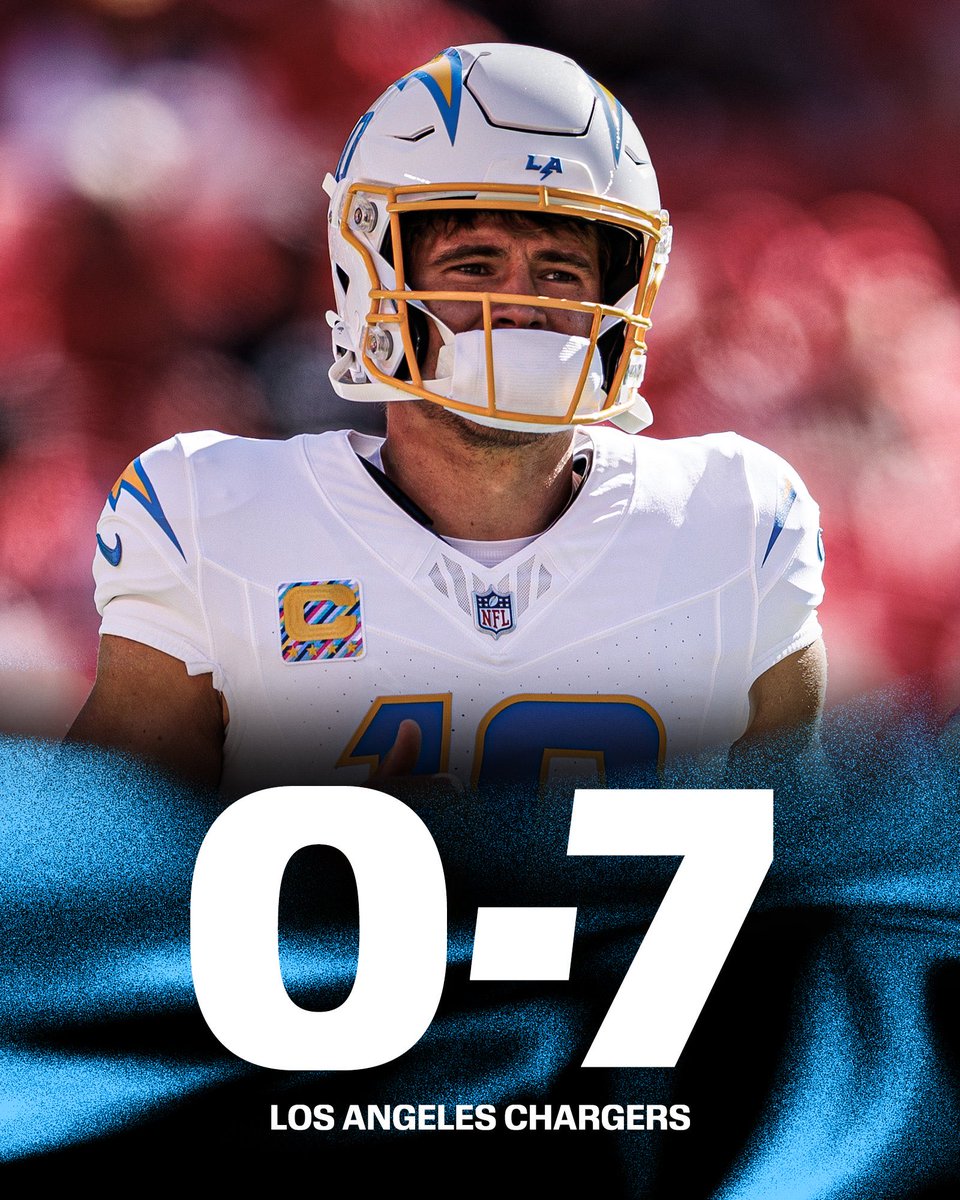
Spanos, please sell the team.
Nothing will change while this family owns the Chargers. Forty-two years of awful coaching hires, front-office decisions and wasted talent.
Fouts. Brees. Rivers. Herbert. FOUR Hall of Fame-caliber QBs. Plus Tomlinson, Gates, Seau, Harrison and Weddle. ONE Super Bowl appearance. ZERO championships.
Any competent franchise with that talent has multiple rings. The problem has never been talent. It’s ownership. Archie Manning was right.
Look at the record:
1998: The front office rated Ryan Leaf ABOVE Peyton Manning and celebrated when Leaf “fell” to #2. An all-time draft disaster.
2003: Traded Junior Seau, the franchise’s heart, to Miami for a FIFTH-round pick. He played seven more years. He should have retired a Charger.
2003: Cut Rodney Harrison as “washed up.” He became an All-Pro and won TWO Super Bowls with New England.
2004: Eli Manning refused to play for the Chargers. He later described watching ownership, the GM and coach argue during his pre-draft visit. He saw the dysfunction immediately.
2005: Played Drew Brees in a meaningless Week 17 game vs. Denver. He wrecked his shoulder. Instead of tagging him as planned, they let a future Super Bowl champion leave.
2006: The 14-2 Chargers lost to New England after Marlon McCree intercepted Tom Brady, then fumbled it back. Another championship-caliber roster, another January collapse.
2007: FIRED Marty Schottenheimer after a 14-2 season because he and A.J. Smith couldn’t coexist. Replaced him with NORV TURNER. Ownership couldn’t manage two adults with a championship roster.
2009-10: A 13-3 season ended against the Jets after Nate Kaeding missed THREE field goals. Then cut LT, who had already sacrificed financially to stay. He joined those same Jets.
2010: #1 offense and #1 defense by yardage. 32nd-ranked special teams. MISSED the playoffs. The only team ever to lead in both yards gained and allowed and miss the postseason.
2013-23: Telesco lasted ELEVEN seasons (84-92; TWO playoff wins) while Rivers’ later prime and Herbert’s early years went to waste.
2015: Fined Eric Weddle $10,000 for watching his daughter perform at halftime, then put the five-time All-Pro on what amounted to phantom IR.
2016: Pushed a stadium ballot measure requiring a TWO-THIRDS majority while excluding supportive county communities outside city limits. It failed; they blamed San Diego.
2017: ABANDONED SAN DIEGO for LA, expecting to retain SD fans AND win over a new market. They remain second fiddle to the Rams, surrounded by visiting fans. Their franchise valuation RANKING FELL relative to the rest of the NFL after the move. They traded a loyal hometown fan base for a market that never asked for them. Some business plan.
2023: Blew a 27-0 playoff lead to Jacksonville; KEPT Staley. Only a 63-21 humiliation by the RAIDERS finally got Staley and Telesco fired.
2024: NFLPA ranked their working conditions 30th of 32. Failing marks for food, locker rooms and treatment of families. Players complained about airport-tarmac waits and having to PAY for game-day childcare. This was a multibillion-dollar team, not a struggling minor-league club.
2024-25: Hired run-first Harbaugh and Greg Roman with an elite passer on a max contract. Herbert took a beating; two 11-win seasons produced two miserable playoff exits and ONE offensive TD total.
In my view, they haven’t made a truly good coach or GM hire since Marty and A.J. Smith. They couldn’t even keep those two working together.
Coaches and GMs get fired. Players get cut. But John Spanos and the family members overseeing football operations have NEVER faced accountability, no matter how many coaches and GMs they hire and fire.
After Leaf, wasted Hall of Famers and January collapses, we still watched. They repaid our loyalty by leaving town.
FOUR franchise QBs. Generations of elite talent. ZERO championships.
The only constant is ownership.
SELL THE TEAM. SELL IT NOW
Move back to San Diego
"That was the most excitement and passion that I've seen since I've been on College GameDay..
That BYU team plays with so much confidence and it starts with Coach Sitake" ~ Coach Saban
#PMSLive
"I've been on College GameDay for 12 years now and Saturday morning in Provo was as good as it gets..
I love this sport so much and that was such a memorable morning" ~ @ReceDavis#PMSLive
***Longer post, feel free to skip***
Bring Back More Low-Stakes Social Gatherings
In the early 50s, my grandparents moved into a small home in Kearns, Utah, that had been built just a few years earlier, after World War II. Among my fondest memories growing up was going over to their house for extended family gatherings, with 25 or more people crammed into their small front room, kitchen, and basement.
Kids sat on laps, and adults sat on couches and the floor, or on a spare chair or two brought in from the dining room. There was no great room, no large flat-screen television for watching shows. It was just a couple of small rooms, a lot of people, and a lot of talking and laughing.
My grandparents also hosted lots of friends at their house during the 60 years they lived in that small house before passing away. I am not aware they ever regretted that their house was the size it was or hesitated to host people. I also am not aware that they ever had a gathering fully catered, sent out elaborate invitations, or did other things that cost a lot of money or required a great deal of time. But they were very social people.
My grandparents' house in Kearns, Utah. They planted the weeping birch tree you see in the front yard.
We aren't getting together like we used to.
It’s my belief that we aren’t getting together as much as we used to. As a result, we are losing valuable chances to connect with each other, becoming more atomized in society and feeling lonelier than we should.
I think a major factor in this is that gathering in one place together has become more formal and more "high-stakes" than it was in the past. Somewhere along the way hosting people in our homes or gathering in larger groups became laden with expectations, and as those expectations have risen for gathering, we do less of it.
I’d suggest that we need to get together more, in person. One key way to do that more is to bring back the types of low-stakes social gatherings that were more common in the past.
What makes for higher-stakes social gatherings?
Some or all of these attributes are present when gatherings are higher-stakes. As these factors become expectations, they add unnecessary weight and result in fewer gatherings:
- They require a lot of money, whether for catering, decorations, entertainment. High-stakes activities may have extensive catering, require expensive food, or even involve renting a venue.
- They require a lot of time to prepare for. Time to prepare goes toward decorating, cleaning, arranging, etc.
- They assume a need for people to have lots of room to spread out. The “minimum requirements” for gatherings have increased, meaning that we are expecting everyone to have ample room to move around, almost as if they were in their own home alone. There is even sometimes a self-imposed requirement by people that homes will be optimized for gatherings, rather than optimized for regular life (and then modestly adapted to gatherings as needed).
- They require a lot of advance notice. This has root causes of its own, but lots of advance notice requires more preparation, more coordination, and results in gathering less.
- They require long time commitments and/or cost to attend/participate. A sign of a higher-stakes activity is that attending places meaningful demands on the visitors as well—a need for an elaborate costume, or travel, or preparation of some sort.
- They are Instagram-worthy. This is a catch-all quality, but you get the idea. They are solving for broadcasting the activity rather than participating in it.
What are the attributes of low-stakes gatherings?
In contrast to higher-stakes activities, low-stakes gatherings put the emphasis on just getting together. The minimum standard is to end up in the same place for a time, have a good time, and do it again soon.
Of course anyone who is inclined toward doing some kind of special preparation or taking other pains can of course do so. Some people’s homes are perfectly designed for hosting and welcoming masses of people. But the main idea is that it should not be expected by either host or guest, and that it is not the point.
- They don’t require a large venue. Above all, this is a mindset. If people can fit around a table, there is enough room. An entire evening can be around a small table, from a meal to games to a long converastion. If there are too many people to fit on the regular furniture in the living room, you bring the chairs from the dining table. It’s kept simple.
- They don’t require a lot of setup/take down/decorating. It’s up to you, of course, but the main idea is that a low-stakes activity doesn’t require a lot of crafting or other preparation. Low-stakes gatherings can get away with a little something that takes 10 minutes, maybe adds a little pizzazz if you want.
- They don’t involve elaborate invitations or other advance planning/preparation. The time from “we should have a gathering” and “we are ready for this gathering” should be small.
- They don’t require participants to overly dress up or take on some major preparation. Low-stakes gatherings are dead simple for someone to attend. The primary spirit is to just show up!
- They are inexpensive. This can be a bit at odds with the “low-preparation” attribute of a low-stakes gathering, but the main idea is to find a balance between cost and time.
So what can we do to create more low-stakes social gatherings?
- Impose some constraints. Consciously design your gatherings to be lower-stakes for both you and your guests.
- Set aside more time. Set aside a night every week or two to have people over. Create a social norm within your friend group to get together in a low-stakes way.
- Make it communal. Ask people to bring one thing: a dish, a game, whatever. Make it a small, simple contribution that in the context of a group gathering makes it easy to constitute plenty of food, fun, etc.
- Take yourself (and others) less seriously. Life is so short, and nobody will remember whether you had your remodel done or an updated paint job when you had them over to play cards. Just do it.
- Focus on the people. The point is the people, not the party. People aren't lonely for accommodations; they're lonely for kindness and connection.
Some of you are already very good at this. What is working for you to gather in low-stakes ways? What did I miss?
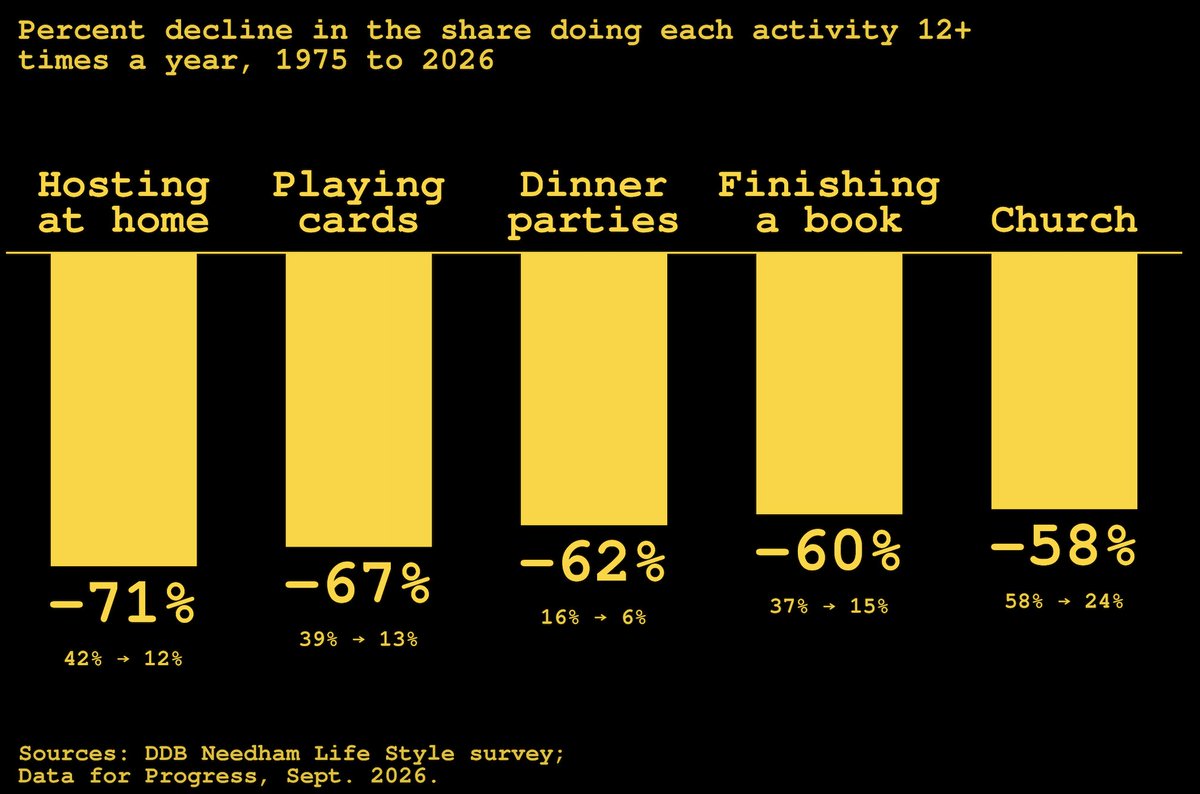
New newsletter: THE DEATH OF THE AMERICAN HOST
The share of Americans who say they host friends or family at their home at least monthly has declined by 70 percent in the last 50 years.
https://t.co/pfubF2qz1v
Every year on or right before 9/11, we show this video to our students. It’s not only powerful story-telling, it’s a reminder to a younger generation about how life altering 9/11 was for those of us who lived it. It’s only 10 min #themanintheredbandana