Clinical Epidemiologist, interested in front line health workers, health system strengthening and use of technology to advance health services delivery.
Boost your #GrantWriting skills! ✍️🌍
We are calling for emerging biomedical & health researchers in Africa to join our Essential Grant Writing Skills Programme.
Master the skills to win your next big grant! 📈🧪
⏳ Deadline: 03 April 2026
🔗https://t.co/GjaFg58Zyp
Non-communicable diseases #NCDs cause between 30-40% of deaths in Kenya and over 50% of total hospital submissions in East Africa, with Cardiometabolic diseases #CMDs driving much of this burden. A new partnership between @novonordiskfond@MOH_Kenya, @SciforAfrica and @NCDAllianceKe is addressing this challenge by closing the research-to-implementation gap for #NCDs & #CMDs. Read more here 👉 : https://t.co/rbGXUlGQOd #NCDsInAfrica #CMDResearch #EvidenceToAction #PolicyAndResearch #HealthEquity #NCDAgenda @gladwellkg Mette Ide Davidsen @EvelynGitau@Caxton_Murira Catherine Karekezi @mkarinja
Together with @LSTMnews our Clinical Trials Community Africa Network team visited the @KEMRI_Kenya Clinical Research Centre & Centre for Global Health Research sites in Kisumu, Kenya to pilot standards for mapping and assessing capabilities of #ClinicalResearch sites.
T-MINUS 8 DAYS! 🤩 Until our longest-running MOOC opens. If you haven't signed up yet, what are you waiting for? Register for free: https://t.co/17dWgWDEQs
Are you working in vaccine R&D? If so, please consider applying to this course! (Scholarships are provided for LMICs applicants)
📅Deadline for application is 17th January
📍Accra, Ghana
Link: https://t.co/u7tdUfg1pw
⚠️ BREAKING:
China 🇨🇳 Declares State of Emergency as Epidemic Overwhelms Hospitals and Crematoriums.
Multiple viruses, including Influenza A, HMPV, Mycoplasma pneumoniae, and COVID-19, are spreading rapidly across China.
Multicollinearity is a common issue in regression analysis where predictor variables are highly correlated, leading to unreliable estimates of regression coefficients.
Understanding and addressing multicollinearity is crucial for accurate and reliable statistical modeling.
Challenges of Ignoring Multicollinearity:
❌ Unreliable Coefficient Estimates: Ignoring multicollinearity can result in inflated standard errors and unreliable estimates, making it difficult to determine the true effect of each predictor.
❌ Misleading Interpretations: High multicollinearity can lead to misinterpretations of the significance of predictors, potentially leading to incorrect conclusions.
Benefits of Addressing Multicollinearity:
✔️ Improved Model Accuracy: Properly handling multicollinearity ensures that the estimated coefficients reflect the true relationship between predictors and the outcome variable.
✔️ Enhanced Predictive Power: Addressing multicollinearity helps in building models that generalize well to new data, improving prediction quality.
To handle multicollinearity effectively, consider the following approaches in practice:
🔹 R: Use the car package and the vif() function to detect multicollinearity. If necessary, apply principal component analysis (PCA) or remove highly correlated variables.
🔹 Python: Utilize the statsmodels library to check Variance Inflation Factor (VIF) values and consider using dimensionality reduction techniques like PCA from the sklearn library.
In the accompanying visualization, based on an image from Wikipedia (link: https://t.co/lWcDlwEJN2), the true parameters are reliably estimated when predictors are uncorrelated (black case), but estimation becomes unreliable when predictors are correlated (red case).
To explain this topic in further detail, I collaborated with Micha Gengenbach to create a comprehensive tutorial: https://t.co/9B6Aaxj9jT
Interested in gaining deeper insights into statistics and R programming? Consider joining my online course, "Statistical Methods in R." Take a look here for more details: https://t.co/7YQCRDKSPO
#Statistical #RStats #Rpackage
As 2024 comes to a close, ASLM reflects on a year of progress in strengthening laboratory systems, enhancing health security, and driving research and innovation across Africa. Through expanded diagnostic networks, workforce training, policy advocacy, and global partnerships, we have made significant strides in improving access to quality healthcare.
We extend our heartfelt thanks to our partners, donors, and teams for their unwavering support, and we look forward to building on this momentum in 2025.
Know your basics before the new year! 🤓 This free course is perfect for anyone looking to learn about GIS and ArcGIS🌏, or those just wanting to prove they know it all: https://t.co/LBynF39euS
On this International Day of #EpidemicPreparedness, we highlight the critical role of women in shaping resilient health systems.
Women are 70% of the health workforce but <25% of leaders. Amplifying their voices is key to epidemic preparedness & equity.
#HealthEquity
Today is the International Day of Epidemic Preparedness—a reminder of the need for global collaboration to strengthen our defences against health threats. 🌍
Effective preparedness is key to building resilient health systems and ensuring our world is better able to prevent and respond to the threat of future pandemics.
Learn more: https://t.co/TMmJbbFryh
Are you a researcher 👩🏾🔬 working on projects related to improving health in Africa?
We have exciting news for you !
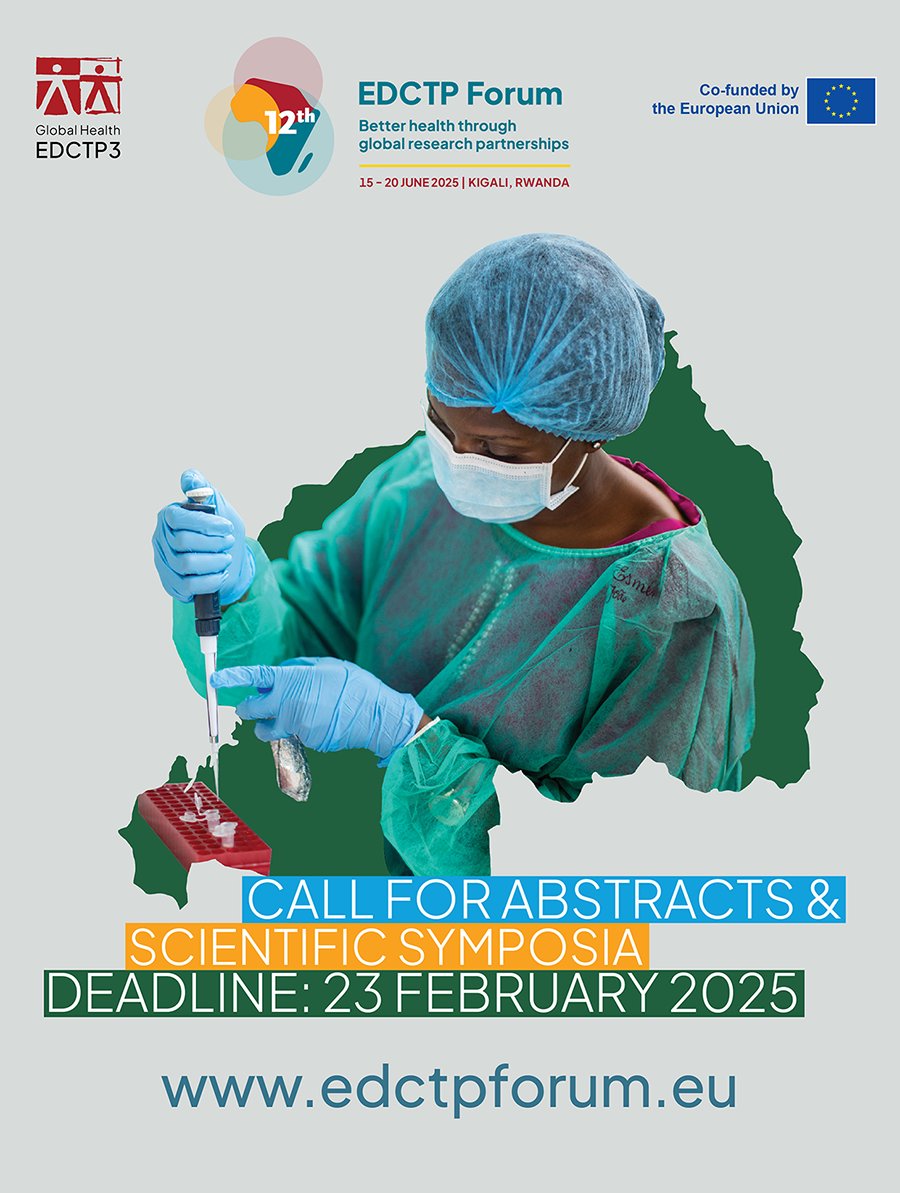
The call for abstracts and scientific symposia for the 12th #EDCTPforum is open!
📅Submit your abstract by: 23th February 2025
Read more: https://t.co/epzqpA0xx9
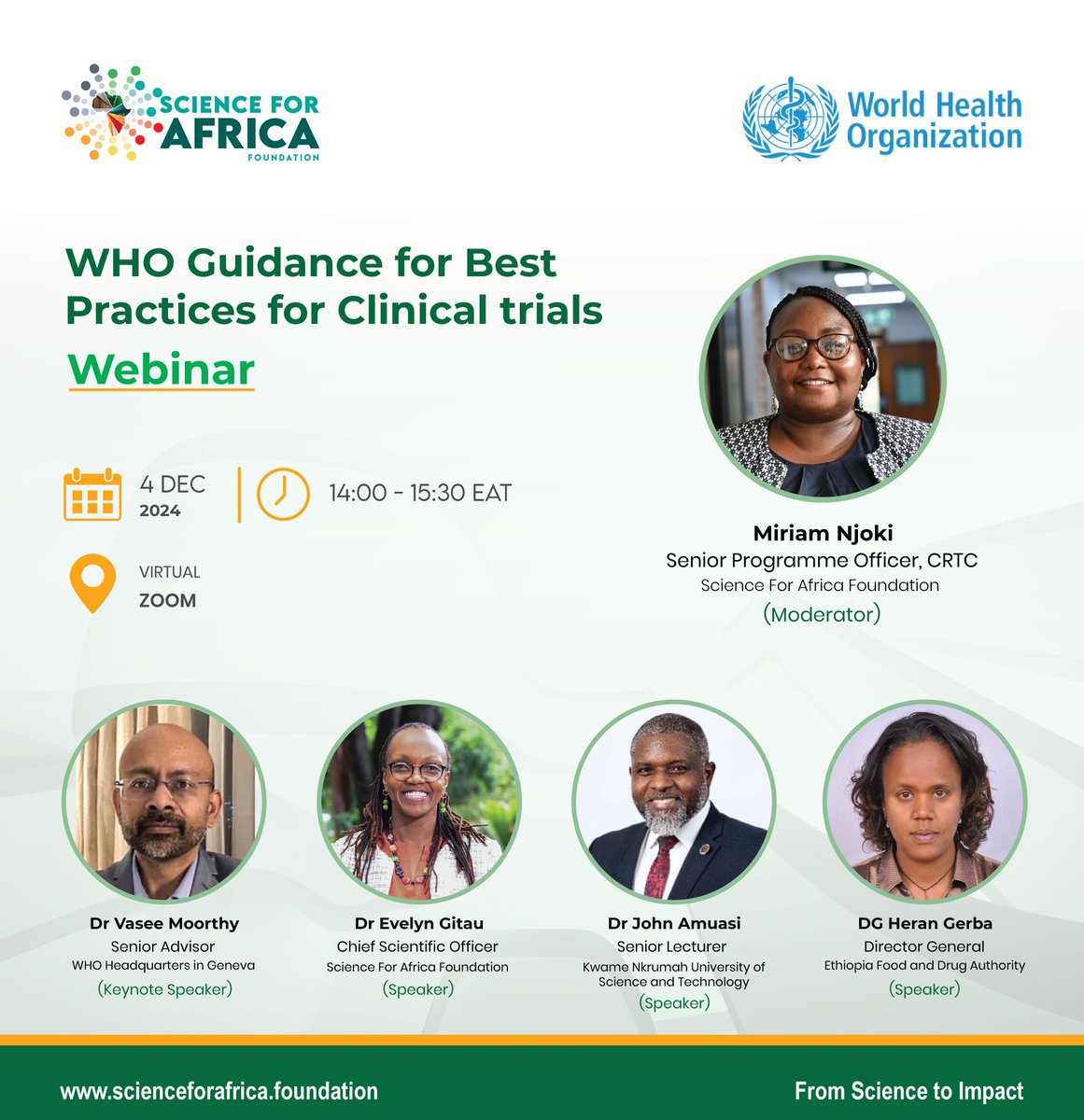
We have partnered with @WHO for a webinar targeting African clinical research stakeholders to discuss the recently released WHO guidance on best practices for #ClinicalTrials. Register here to participate 🔗 https://t.co/xB14g8yo1p