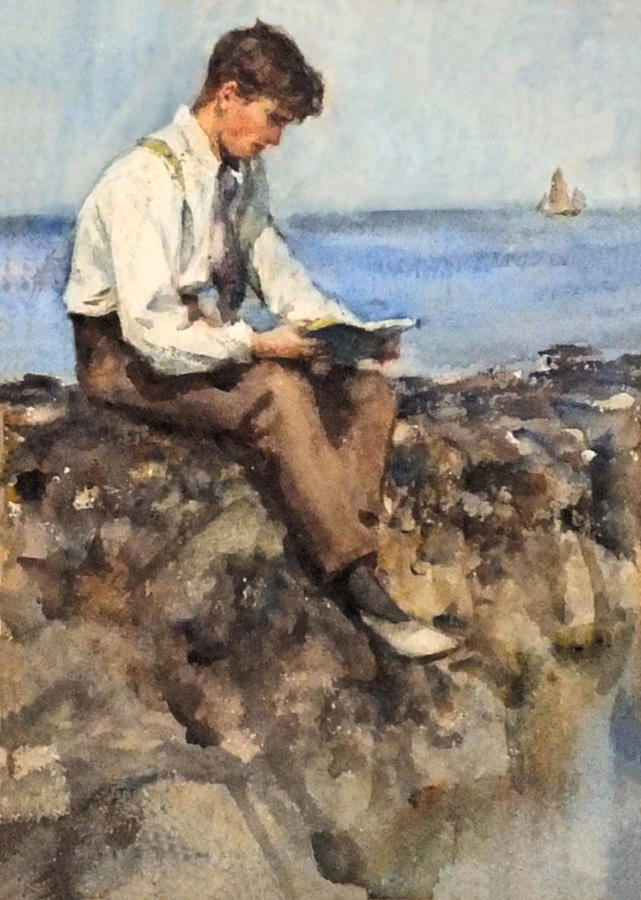
You could spend the next twelve months reading:
- Homer's Odyssey
- Plato's Apology
- Aristotle's Nicomachean Ethics
- Virgil's Aeneid
- Augustine's Confessions
- Dante's Inferno
- Shakespeare's Hamlet
- Dostoevsky's The Brothers Karamazov
Imagine how much more you would know about literature, philosophy, history, and human nature by this time next year.
The books are available. You just have to begin.
All societal ills will essentially disappear if we resolve to do three things with regularity.
1. Go to church
2. Read
3. Exercise
Do these things, start a family, (a fourth thing I suppose) and all will be well.
Medieval literature deserves so much more attention.
If you have never really explored it, here are some wonderful works:
- Beowulf
- The Song of Roland
- The Poem of the Cid
- The Nibelungenlied
- The Divine Comedy
- The Canterbury Tales
- Sir Gawain and the Green Knight
- Le Morte d'Arthur
An entire literary world of knights, kings, pilgrimages, battles, dragons, Christian symbolism, and heroic adventures awaits you.
Priest just said out loud what everyone else is afraid to say.
“Muhammad is not God. He is not the Saviour. As a matter of fact, he was a pervert and a pedophile.”
Well said, Father. 🙏
FUCK ISLAM.
If you want to get into classical literature but do not know where to start, here are 12 books we recommend:
- Homer — The Odyssey
- Sophocles — Antigone
- Plato — Apology
- Xenophon — Anabasis
- Aristotle — Nicomachean Ethics
- Cicero — On Duties
- Virgil — The Aeneid
- Ovid — Metamorphoses
- Seneca — Letters from a Stoic
- Plutarch — Parallel Lives
- Marcus Aurelius — Meditations
- St. Augustine — Confessions
Do not rush through them. Enjoy them, study them, and give yourself some time to think about what you have read.
Nobody could debate like Charlie. So many tried but couldnt. They also couldn't accept defeat so they called him all kinds of nasty stuff. When all you can do is call someone names, you've truly lost the discussion. The man is truly missed. God bless. 🙏🇺🇸
Beautiful, ain't it?
But none of this was easy.
Brunelleschi spent 16 years figuring out how to build a dome everyone said would fall.
Michelangelo was only 23 when he carved the Pietà out of a single block of marble.
Bernini, Giambologna, and all those painters spending years on their backs just to paint ceilings most people would never even see up close.
Florence and Rome are basically what happens when a whole society decides that beauty is actually worth the hard work.
"De Spiritu Sancto" is a hymn with an ancient sound, composed by Hildegard of Bingen nearly 900 years ago. It dates back to a time long before harmony, chords, or musical accompaniment developed into what we know today.
The melody is performed in a style known as monophony, meaning all the singers follow a single melodic line together. No voice rises above another, and no one tries to stand out. Instead, all the voices blend into one continuous flow of sound, creating the feeling that everyone is sharing a single breath.
@Amo54ksu@michaeljknowles@TimothyAlberino So it makes me wonder if he treats it as divine revelation. I haven’t read it yet myself but it’s interesting whether during its time being written was it some divinely-revealed secrets that were finally being shared.
@Amo54ksu@michaeljknowles@TimothyAlberino Yeah that’s true, many times there’s contextual information throughout the Bible. And to be clear, neither Christianity nor Judaism is saying don’t read the book of Enoch, it’s encouraged to read it. Tim seems to talk about it like it really happened… continued…
@Amo54ksu@michaeljknowles@TimothyAlberino Maybe it should be canonized, especially if 1 Enoch 1:9 is treated as prophecy in Jude 1:14–15. I’m curious to know if he thinks of it as Inspired/Revelatory since it was not written by Enoch but by multiple writers circa 300-100 BC.