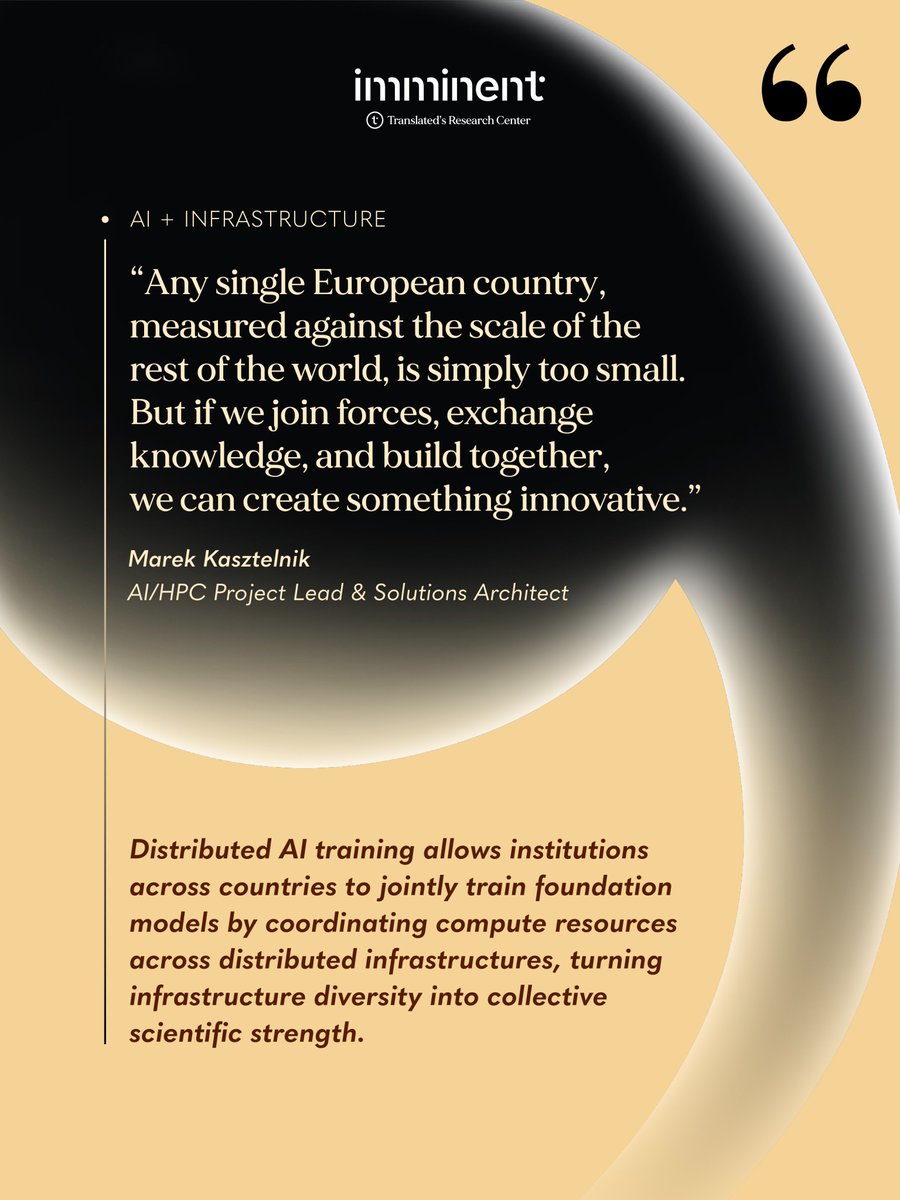
What powers European AI?
As part of the @dvps_ai project, Europe is developing next-generation multimodal foundation models designed to learn from and interact with the physical world. But training these models requires much more than computing power.
It requires a networked infrastructure that spans countries, connects supercomputing centers, and enables researchers across Europe to work as part of a single distributed environment.
And above all, it requires people.
In our latest interview, @mkasztelnik and SzymonMazurek from @Cyfronet —one of Poland's leading supercomputing centers—explain why Europe's AI infrastructure is not simply a collection of supercomputers, but a network of expertise, collaboration, and shared knowledge. It's this human infrastructure, just as much as the technical one, that will determine Europe's ability not only to consume AI, but to build it.
This conversation is part of Imminent's editorial journey through the DVPS project, exploring the technologies, infrastructures, and people shaping the future of #EuropeanAI.
Read the interview here:https://t.co/Z37C2QKjoZ
Takeaway from our #2 DVPS consortium meeting: scaling with a few modalities won’t unlock the next leap. Progress we need to push in Europe now requires grounding intelligence in interaction and real-time feedback; we’re working on building the most promising MMFM architecture.
Online meetings connect people.
They also add friction. Language. Time zones. Tools.
Meetween is an EU-funded project exploring how AI can support natural and inclusive online collaboration. People first. Real conversations.
Discover more: https://t.co/37S6w16I8u
#Meetween#AI
Weekly pick from the #MeetweenScientificWatch: "ML-SUPERB 2.0: Benchmarking Multilingual Speech Models Across Modeling Constraints, Languages, and Datasets" - A new benchmark evaluating #speech models. 🌍📊
https://t.co/tSJfQMR57D
Weekly pick from the #MeetweenScientificWatch: "Less is More: Accurate Speech Recognition & Translation without Web-Scale Data" - Canary outperforms #ASR SOTA models in English, French, Spanish, and German with much less data. Check out the breakthrough!
https://t.co/3aLCYTBLX5
🔖 Weekly pick from the #MeetweenScientificWatch: "PLLaVA: Parameter-free LLaVA Extension from Images to Videos for Video Dense Captioning" - A resource-light approach for adapting image-language models for video tasks, achieving new SOTA performance.
https://t.co/Jmj28KdFbU
@grzegorz_dyk@delanteradeoro Gorzej: od mycia ramy pękają... A poważnie to łożyska masz uszczelniane, raczej woda pod niskim ciśnieniem nic nie zaszkodzi, co innego karcher.
@rockatanescu I believe that indirect variable access has its place but for this example, I would go with:
def initialize(title:, first_name:, last_name: nil, suffix: nil)
super(salutation: "HRH #{title}", first_name:, last_name:, suffix:)
end