There’s such a clear opportunity for IT, engineering, or operations people to help companies go AI-first right now if they both understand the workflows of the organization and what’s possible with AI Agents.
AI is going to continue to advance at a rate that far exceeds most organizations’ ability to adopt all of the latest technology when it comes out. This will only continue to increase as breakthrouhs keep coming from AI labs at a faster pace.
Like it or not, the long pole in the tent on transforming workflows with AI will be the pace that change management can happen. Asking questions and getting answers back in an AI chat doesn’t require much change management.
But adjusting an entire workflow to deploy AI Agents in the background to help do real extensive work fundamentally requires quite a bit more education, hand holding, and technical integration.
And doing change management amidst a rapidly evolving space is even more complicated - one day a user will try to automate a workflow with AI and it won’t work, but 6 months later all of a sudden it’s possible.
The people in the trenches that can help align what’s possible with AI and the individual workflows in an organization are going to have a huge advantage right now and going forward. The companies that do this early will learn faster and develop much more muscle in the process.
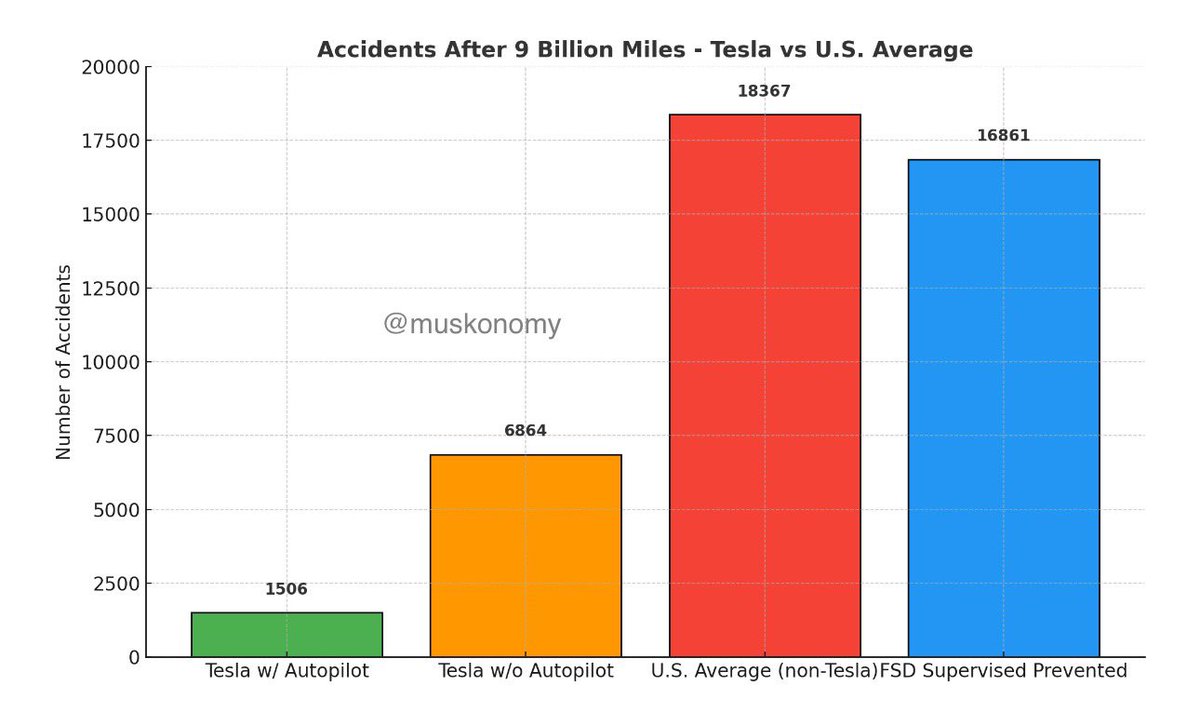
🚨 BREAKING: Tesla Autopilot crushes U.S. average in safety stats after 9 billion miles!
Accidents per system:
• Tesla w/ Autopilot: 1,506
• Tesla w/o Autopilot: 6,864
• U.S. Average: 18,367
• FSD Supervised Prevented: 16,861
Send this to your friends and family 🫶🏻
In making business decisions, I’ve been increasingly asking myself what would it mean to operate the company as if we had started in 2025 in a post-AI world. The enterprise has seen massive technology shifts over the years, from mainframe to PC or offline to online, but I don’t think there’s ever been a moment as big as the shift to AI.
Almost everything about operations will change in an AI-First Enterprise. Internally, the way we think about talent, the leverage that employees get, the kind of long tail work we can finally take on and say “yes” to instead of punt. The expectations for speed of decision making and execution go up in this new world that we’re in. It’s completely true that the employee using AI will outrun the employee not using AI. And everyone needs to be enabled to do this.
It’s also going to shift the products and platforms of most companies. In the case of Box, as a platform that helps companies work with their unstructured data, the opportunities are vast. If we were to start Box today, we wouldn’t think about having a dumb version of the product and a smart version of the product. This ripples through every component of what we build, changing our user experience and value proposition in the process.
And ultimately it has major implications on any company’s business model. Most business models will shift as a result of AI in some fashion — we see it in professional services, media, finance, and many fields. But especially anyone building directly in AI is going to be in the business of selling outcomes to their customers, not just tools. In the past, we could only sell our customer that would *enable* them to get their work done. Now our technology is actually bringing along the labor with it, which dramatically expand the TAM we’re going after, but also the nature of how we sell.
Almost every dimension of business is changing today. It’s by far the most exhilarating time to be in tech, though often it blows my mind how fast it’s moving. Pretty amazing times right now,
@evanreiser is spot on. No matter where you sit in the org, you need to be experimenting with AI now. It will either differentiate you from your peers or relegate you to the slow lane. Kind of like Bi-modal IT - Bi-Modal AI.
Every leader in every function at every level of the org chart needs to be thinking how the rise of AI needs to transform how we operate. Any leader that isn’t using existing AI tools daily today will be under equipped to envision + lead the transformation required tomorrow.
Being on the inside of the entertainment industry I remember giving presentations and being laughed at and ridiculed when I described their vision of delivering content over the internet.
“you mean the company that mails DVDs?”
“They don’t understand the entertainment industry”
“There is no way movies will be delivered over the internet”
“They could never be global”
China just dropped a new model.
ByteDance Doubao-1.5-pro matches GPT 4o benchmarks at 50x cheaper
— $0.022/M cached input tokens, $0.11/M input, $0.275/M output
— 5x cheaper than DeepSeek, >200x of o1
— 32k + 256k context
— sparse MoE architecture
AI truly too cheap to meter.
Interesting use case for AI. As an ASU fan I feel like we were robbed in the Peach Bowl against Texas where what seems like a textbook Targeting call (according to the announcers) was not called. It is a difficult call for humans to make and maybe AI would be better suited to make the determination or al least to make a recommendation to the referees.
https://t.co/IXOxeuX666
Scott Van Pelt: “I don’t care who it is. That’s targeting 100 times out of 100. It wasn’t [called] in this case.”
Dusty Dvoracek: “I thought it was targeting in the moment. I picked up the phone, made a few phone calls. I talked to Bill Lemonnier, who I think is one of the absolute best, works for us at ESPN/ABC as a rules expert, and he said verbatim: ‘It’s a defenseless player, there was an upwards thrust indicator, forceable contact to the head or neck area. It’s targeting.’”
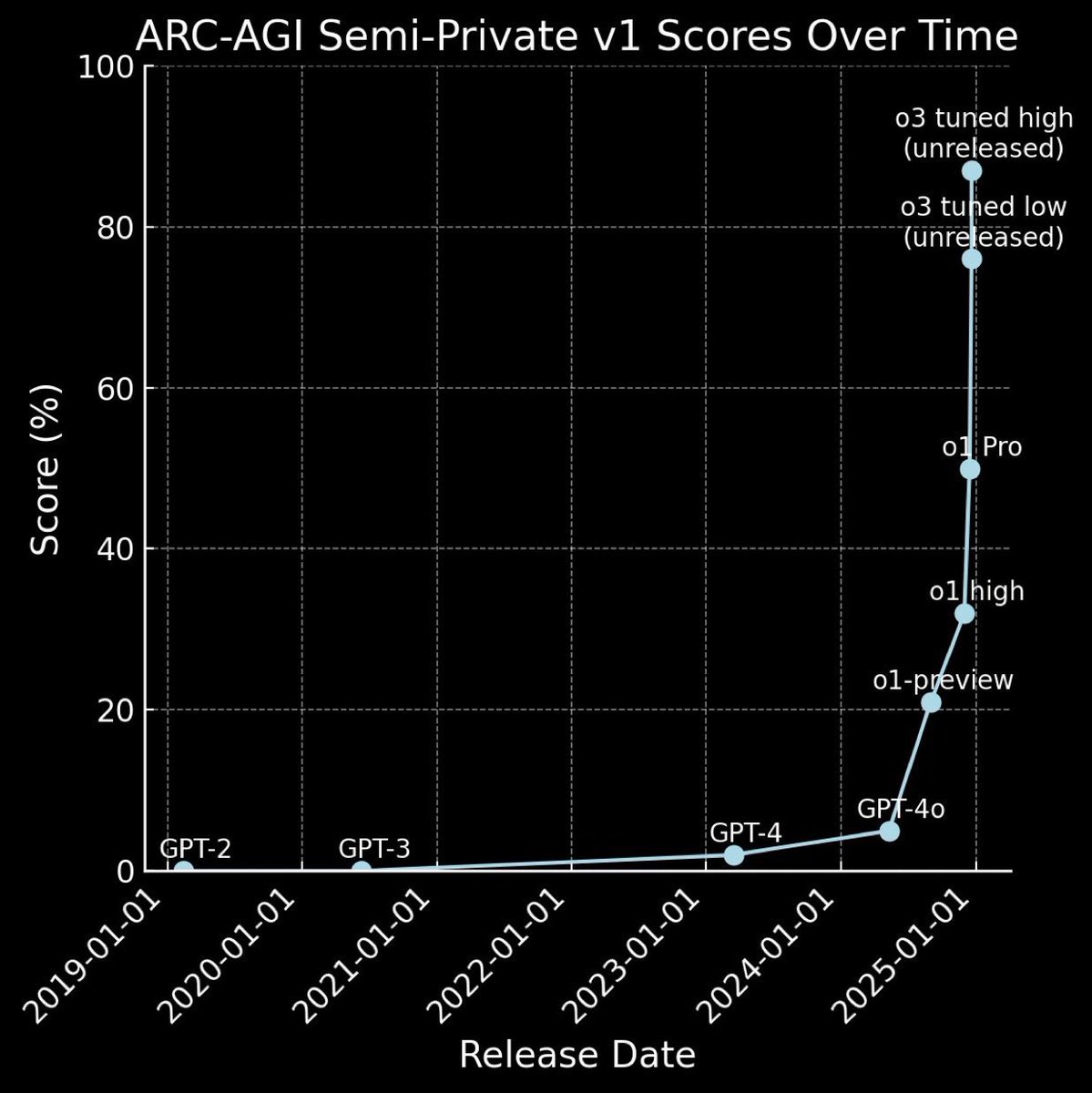
o3 is very performant. More importantly, progress from o1 to o3 was only three months, which shows how fast progress will be in the new paradigm of RL on chain of thought to scale inference compute. Way faster than pretraining paradigm of new model every 1-2 years
OpenAI’s o3 model appears to be better at reasoning than any other model out there. It costs way more to operate, but that’s irrelevant. What is expensive today is cheap tomorrow. Quality is all that matters because you know that costs will always drop.