A paper in Nature presents molecular clocks that can provide accurate estimates of both molecular age and lifespan across multiple mammalian species and tissue types. This framework may aid the development of targeted interventions to improve longevity. https://t.co/MjKyidgUG4
𝐀𝐒𝐆𝐂𝐓 𝟐𝟎𝟐𝟔: SonoThera has a unique ultrasound-mediated nonviral approach to gene therapy. It has plans to be in the clinic for DMD next year. #ASGTC2026
Full video: https://t.co/4BqInGQT8S
How interesting - remote control for gene expression!
Electromagnetic field-inducible in vivo gene switch for remote spatiotemporal control of gene expression: Cell https://t.co/G9Imsp9fgQ
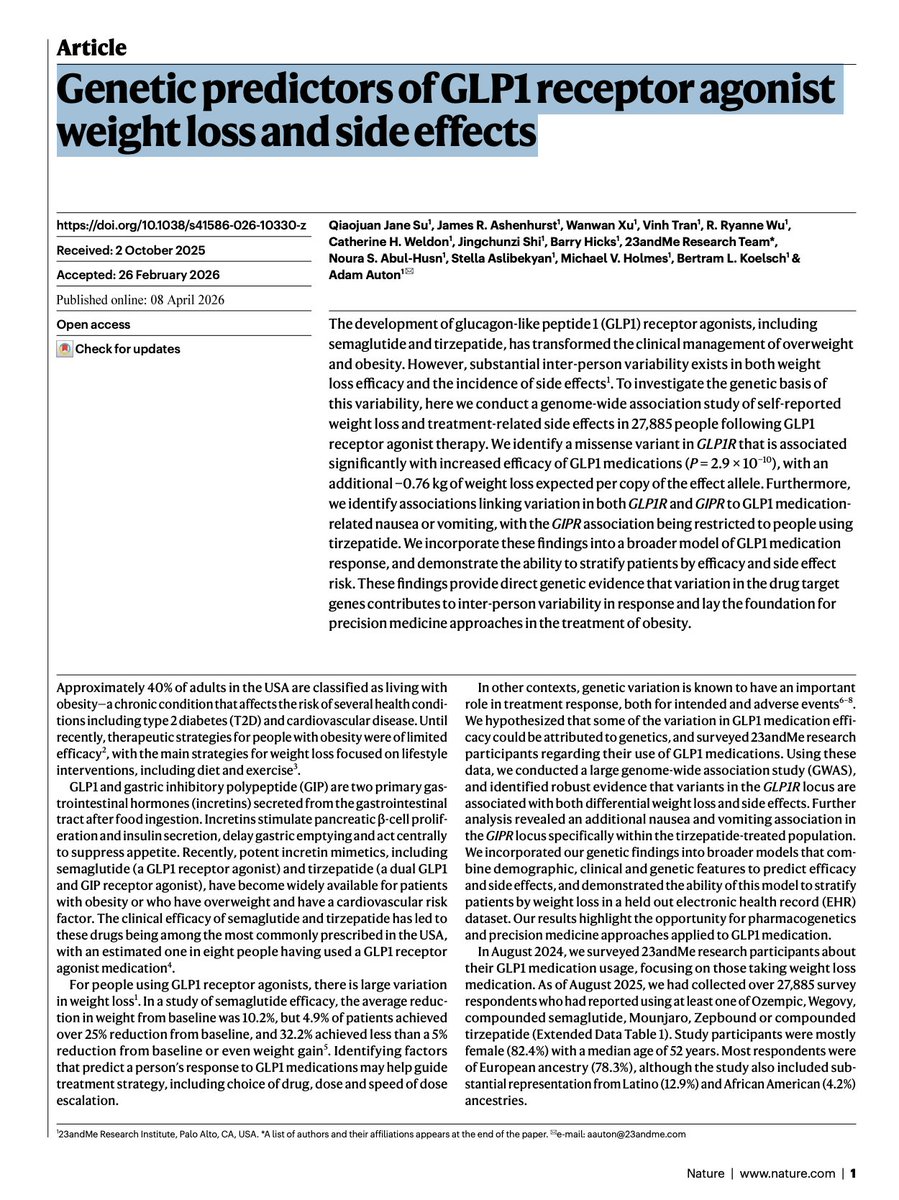
This is very cool - one can just look up the SNP in one's 23andme file and see if one will respond well to GLP1 drugs - and also see if they're likely to be nauseous
A massive Nature study of 27,885 GLP-1 users just dropped some major news about Ozempic and tirzepatide.
Your DNA determines how much weight you lose and how bad the side effects hit.
1 in 3 people see minimal results, and now we know why: (1/9)
🚨 The Human Ageing Genomic Resources Are at Risk
For over 20 years, our Human Ageing Genomic Resources (HAGR) have supported ageing and longevity research worldwide (200,000+ users per year, 1,000+ citations, widely used by academic labs and longevity biotech).
Due to shifting UK government funding priorities, our infrastructure funding was not renewed in 2024, and these databases are now at risk of going offline.
We are raising funds to cover basic server costs and secure their continuity while we pursue long-term funding.
If these resources have supported your research, your company, or your thinking, please consider helping sustain them.
https://t.co/bFryPX5vnS
The protein concentration in the cytoplasm is so high that the average protein has a water hydration shell of only ≈ 10 water molecules separating it from the adjacent protein hydration shell.
100%. And give the family members the right to work right away and not after many painful years of changing visa status to something that grants the right to be employed.
We should be giving FREE “Golden Science Visas” to every smart AI researcher, biologists, mathematicians, materials scientists, physicists, and all other top scientists. And their families. Even if they don’t apply. We need the best and brightest in USA.
🧵5 Top Free Alternatives to BioRender for Scientific Illustrations!
These five websites offer free scientific illustrations for biologists. Great for presentations, research papers and other research communication needs.
Save and share the post!
Former NCI chief and serial biotech entrepreneur raise $70 million to start companies that fail fast https://t.co/dopu2yPCh8 via @statnews Read about what Ned and Ned are doing at Jupiter 🚀
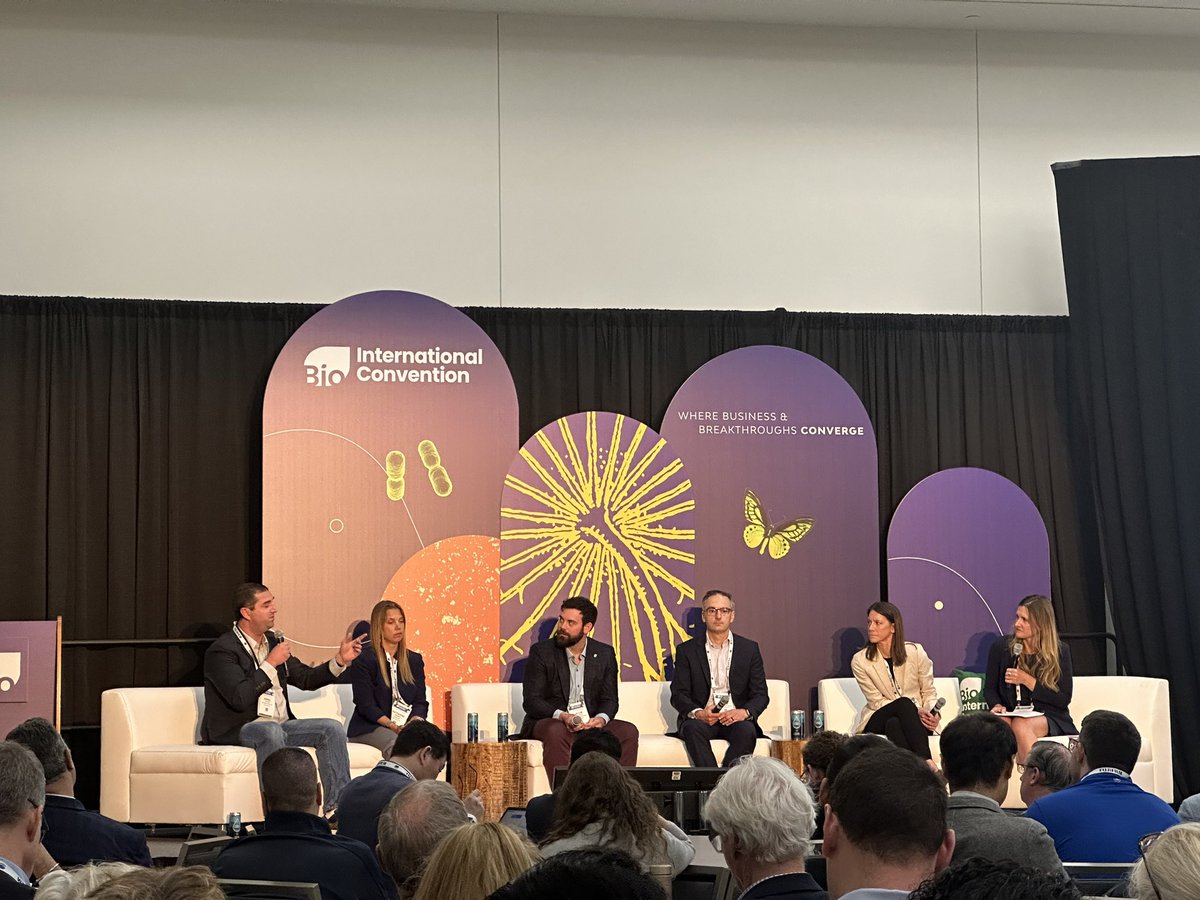
Interesting how the session on Increasing Healthspan at BIO revolves around gene therapy manufacturing and other issues. Our approach can solve most if not all of them. Makes me feel very good about what we’re doing at SonoThera.
#BIO2024#longevity#healthspan#genetherapy
1/10: We are pleased to announce that our manuscript on the nature of epigenetic aging from a single-cell perspective is now published in Nature Aging: https://t.co/y5Z9ElE4xL
Is the best yet to come for cell therapy?
I pulled together 45 companies in the space and charted the preclinical and clinical assets of each, segmented by cell source and modality
Exhibit 1: Cell Therapy Landscape
Some thoughts:
The above is just a snapshot - an attempt to capture key pivotal programs while also flagging the diversity of novel approaches. If we zoom out, it's clear that cell therapy is still in hypergrowth:
• >150 companies pursuing 650+ programs across 100s of clinical trials (mostly skewing early)
• >$200B in cumulative public / private investment since 2014
• 6 FDA approved CAR-T therapies with >$5B in aggregate sales
• Immense patient demand, with companies unable to scale manufacturing to meet it (see: BCMA CAR-Ts in MM)
And while there's been plenty of warranted criticism about whether the space is overfunded, yesterday's announcement of Regeneron acquiring 2seventybio's cell therapy assets shows that Pharma still sees a lot of upside - both within oncology, and within emerging efforts in autoimmune diseases / CNS
However, we've largely seen that enthusiasm play out via BD deals - transformative M&A has been missing from the space since 2017-2018 (Gilead / Kite, Celgene / Juno)
Exhibit 2: IPO and M&A Activity from 2013 to Today
IMO there's a few reasons for this:
(1) The pace of innovation is a double-edged sword as it seems something more promising is always coming up next (so why not wait for the dust to settle and place smaller bets in the interim)
(2) We're approaching 7 years since the first FDA approval, and the largest Pharma companies are still facing supply chain woes, proving how difficult it is to scale manufacturing, QC and distribution for these medicines (and these investments are bespoke to one modality - they don't transfer well if you pivot)
(3) A higher interest rate world and >$200B in upcoming LOEs means Pharma is much more focused on acquisitions that drive near-term revenue
(4) Access to easy capital from 2019-2021 led to an explosion of IPOs as public market demand for innovative, earlier-stage companies peaked
(5) Commercial competition from alternatives like bsAbs may impact the ability to move towards 1L setting
These points will combine to lead to some painful drawdowns in the space - more companies will continue a theme we saw the last 2 years and announce strategic alternatives, wind down programs or consolidate
So are the best days behind us? I don't think so.
The challenges are real, but keep in mind the rate of progress has been astonishing: 11 years from first trial to FDA approval (2006 --> 2017) and <20 years from that point to today. Using mAbs as a historical analog, we're just entering the first inflection in historical value and tracking well ahead in market value at the same time point
Exhibit 3: Antibody Development Over Time vs. Market Value (source: Lu et al. (2020))
The amount of intellectual and financial capital locked up in this space almost guarantees we'll see future groundbreaking milestones - which perhaps we're already seeing with (very early) data indicating outstanding CAR-T effectiveness in autoimmune diseases, for which most patients relapse on current treatments and there are no cures
Ultimately, cell therapy's potential as a one-time life changing therapy ensures it will continue to capture our attention (and investment) moving forward, even as we work through growing pains
If you found this interesting, follow @andrewpannu for more biotech analyses & commentary!
We read papers on amyloid beta and alpha synuclein acting like prions in grad school. Now this is the first confirmation in humans.
Scientists document first-ever transmitted Alzheimer’s cases, tied to no-longer-used medical procedure https://t.co/m1vi0ifN2r via @statnews
1/n: There are some academic papers that are so brilliantly and so accessibly written and so universal in scope that they transcend disciplines and stand as timeless testaments to both great thinking and great writing. Here's a short personal selection: