Re-tweeting. We need rapid policies that make USA companies more competitive and create a market mechanism that preserves patient options, while preventing harm to biotech innovation cycle.
We need an Innovation Review Voucher, where a USA innovator (not others) can apply, based on their innovation in a drug category or molecule, for super fast regulatory approval, AND a transferable and subdividable 3 year commercial exclusivity, which covers the structure and close derivatives.
Applications would be 90 day decisions, with a standard that a reasonable person would conclude that the technology was used or copied by the entity. In practice, this should prevent USA innovation from being decimated via less funding flowing in (which hurts patients in the long run), and if the commercial delay is critically important the vouchers are tradeable, and can be granted to more than one party at the discretion of the holder, so patients are protected.
Prob have like ARPA H like structure or some new DOC panel to do it.
Up until the early 1990s, raw salmon was almost never eaten in Japan, especially not in sushi.
Why?
Japanese Pacific salmon was (and still is) often heavily infested with parasites, so tradition dictated that salmon be cooked (grilled or salted). Raw salmon was considered unsafe and was not part of sushi culture.
In the 1980s, Norway faced a massive surplus of farmed Atlantic salmon and needed new markets. They launched a deliberate, long-term marketing campaign, often called "Project Japan", that lasted roughly a decade.
Norway sent trade delegations and held tasting events, worked with Japanese importers, restaurants, and sushi chefs, promoted the safety and quality of their parasite-free farmed Atlantic salmon and ultimately introduced it first to conveyor-belt (kaiten) sushi restaurants, where it was cheaper and more accessible.
The strategy worked incredibly well. By the mid-to-late 1990s, salmon had gone from virtually unknown in sushi to one of the most popular toppings in Japan. Today, salmon is often the #1 best-selling sushi item in the country, surpassing even tuna in many places.
It’s one of the most successful examples of how a targeted national marketing campaign can completely reshape a country’s culinary habits. Norway essentially created the global phenomenon of salmon sushi.
Stellar data from first-ever epigenome editing clinical trial by @tunetx_news [$COI: I own equity as a co-founder]. Invented at Sangamo by yours truly and colleagues in 2001, reduced to clinical practice 2026.
"It's been a long time coming | but now it's here" (Springsteen).
Bill Maher asks how Mississippi is kicking California’s ass in education, and Texas is “blowing them away” in green energy for “way less money.”
“Did you know that a black fourth grader in Mississippi is two and a half times as likely to be proficient in math and reading as one in California? Mississippi is kicking our ass in education and for way less money. We’re 37th in fourth-grade reading, they’re ninth.”
“Texas is kicking our ass in green energy. The average time to get solar panels connected there is three to four months. About 1,000 days faster than it took me. Remember when I was trying to get my solar hooked up? It would have been quicker to build a windmill.”
“Texas has passed California in solar and blows away California when it comes to wind and energy storage. How does a state with no pro-climate policies produce better climate results than a state where here, even though we have so much better bumper stickers on our Priuses?”
“I’ll tell you why. Because you’re allowed to build there because every third person in Texas isn’t someone whose job it is to make sure nothing gets done.”
“Democrats, these are your issues: education, race, the environment.”
“And I say this with love: you’re losing to the Waffle House, car-on-the-lawn states.”
@RealEmirHan Rudd . . . Paul Rudd, in this scene from Anchorman regarding the cologne Sex Panther.
Love the quote/line/delivery of
“60% of the time it works every time”.
The p-tau217 breakthrough blood test replicated again, predicting Alzheimer's disease in a large cohort mean age 61. The cover of the new issue is telling @TheLancet https://t.co/Qre6mCkpMV
For 63 years, medicine couldn’t lower lipoprotein(a). Now everyone is trying at once.
Three Phase 3 trials. Over 32,000 patients. 35+ countries. Drugs hitting 80 to 94% Lp(a) reduction. The first results from 8,323 patients land this summer.
But that’s the injectable chapter. Behind it:
-> @EliLillyandCo is testing the first oral Lp(a) pill. No needle. Daily dose. 86% reduction in Phase 2.
-> And behind that: gene editing. One infusion. Potentially permanent.
-> @CRISPRTX cut Lp(a) by 73% in humans with a single dose (CTX320, Phase 1).
-> @editasmed just showed ~90% reduction in primates by editing LDLR regulatory regions instead of the Lp(a) gene itself.
-> @EliLillyandCo is developing its own one-time gene edit through Verve.
1 in 5 people carry elevated Lp(a). It’s over 90% genetic. Diet and exercise don’t touch it. 0.1% of Americans have ever been tested (Cleveland Clinic, 71 million records).
One blood draw. $25. Once in your life.
An effort to criminalize the killing of animals for food in Oregon is a step closer to being on the November ballot.
IP-28 would make it illegal to injure or kill animals and would effectively ban hunting, fishing and the breeding of animals. https://t.co/Je1Z43xKAm
ARCH founded Vaccine Company because we believed better vaccines could be created. Almost no one believed in the vision except the amazing Vaccine Company and ARCH team who stayed with it, and Luma Group, Pfizer Ventures, Wellcome Trust, and GHIC.
We need an Innovation Review Voucher, where a USA innovator (not others) can apply, based on their innovation in a drug category or molecule, for super fast regulatory approval, AND a transferable and subdividable 3 year commercial exclusivity, which covers the structure and close derivatives.
Applications would be 90 day decisions, with a standard that a reasonable person would conclude that the technology was used or copied by the entity. In practice, this should prevent USA innovation from being decimated via less funding flowing in (which hurts patients in the long run), and if the commercial delay is critically important the vouchers are tradeable, and can be granted to more than one party at the discretion of the holder, so patients are protected.
Prob have like ARPA H like structure or some new DOC panel to do it.
The paradox of biotech protectionism: Why walling off China biotech weakens America
US ban on Chinese biotech/trials would return pharma leadership to Europe, slow US patient access to new meds, & lead to US dependency protectionism claims to prevent.
https://t.co/DJAkWQfd5X
Human genetics has long supported the principle that the earlier, longer, and deeper we reduce LDL-C, the more atherosclerosis we can prevent.
Now, Lilly/Verve report phase 1 results of a PCSK9 gene-editing therapy offering substantial long-term LDL lowering with a single infusion.
Petraeus: The U.S. has not remotely learned the lessons it should from Ukraine.
This is the future of war: Ukraine alone uses 10,000 drones a day, and 90% of Russian casualties are caused by drones. That should force institutional change. 1/
A slick compilation of the interesting parts of today's second USG UFO file drop. The videos are obviously the part of the drop that is making the news. And for good reasons. Hope we get some even better videos in a couple weeks.
h/t: @DuelingGroks once again on this edit.
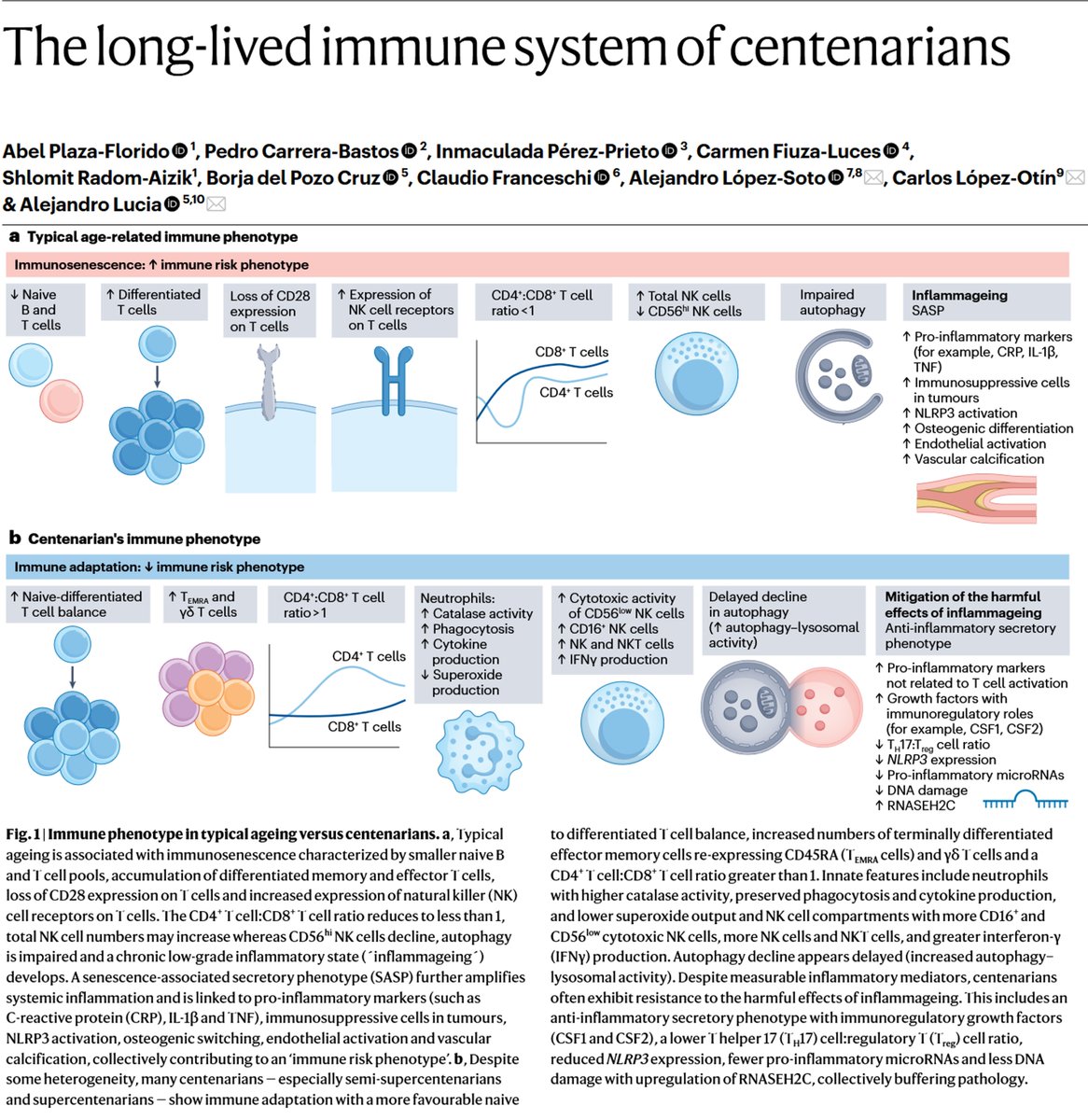
Centenarians show immune function found in younger individuals.
Their immune system show reduced inflammatory signaling, enhanced autophagy, and controlled cellular senescence. They have low or no autoimmune disease, robust immunity against cancer and a distinct immune cell profile. Together, these adaptations help maintain immune balance and may offer clues for extending healthspan.
https://t.co/9NN4XjRwSR




![UrnovFyodor's tweet photo. Stellar data from first-ever epigenome editing clinical trial by @tunetx_news [$COI: I own equity as a co-founder]. Invented at Sangamo by yours truly and colleagues in 2001, reduced to clinical practice 2026.
"It's been a long time coming | but now it's here" (Springsteen). https://t.co/Nm7Y0dnvIC](https://pbs.twimg.com/media/HJqiiDOacAArETa.jpg)