Set session.upload_progress.enabled=0 till next PHP release to block an unlikely RCE vector (CVE-2026-115560). Already recommended for CVE-2026-109619 Wed, keep disabled. Only apps with non-default serialize_handler switching it to "php" at runtime can be affected. #php#phpc
I highly recommend cloudflare's security audit skill: https://t.co/Mu6Dm0fzk8
Run it on all your software. Run it with the free models. Use it even if you used a model to audit something - it will find much more things. Works in all agent harnesses and is model independent.
Let’s set the record straight: @lcfr_hax was the first to discover php2shell and develop a working exploit. See his August 5 tweet: https://t.co/I88EQFrUHa
His work convinced the PHP Foundation to invest in fixing this entire bug class. He then worked around the clock to review, test, and retest the patches.
private keys from 8 intermediate CA certs have been compromised (eMudhra)
Happy "Update everything" day to all my pager-carrying friends
https://t.co/7ASSy72Rxg
if this affects the default installation of PHP
We are fucked up
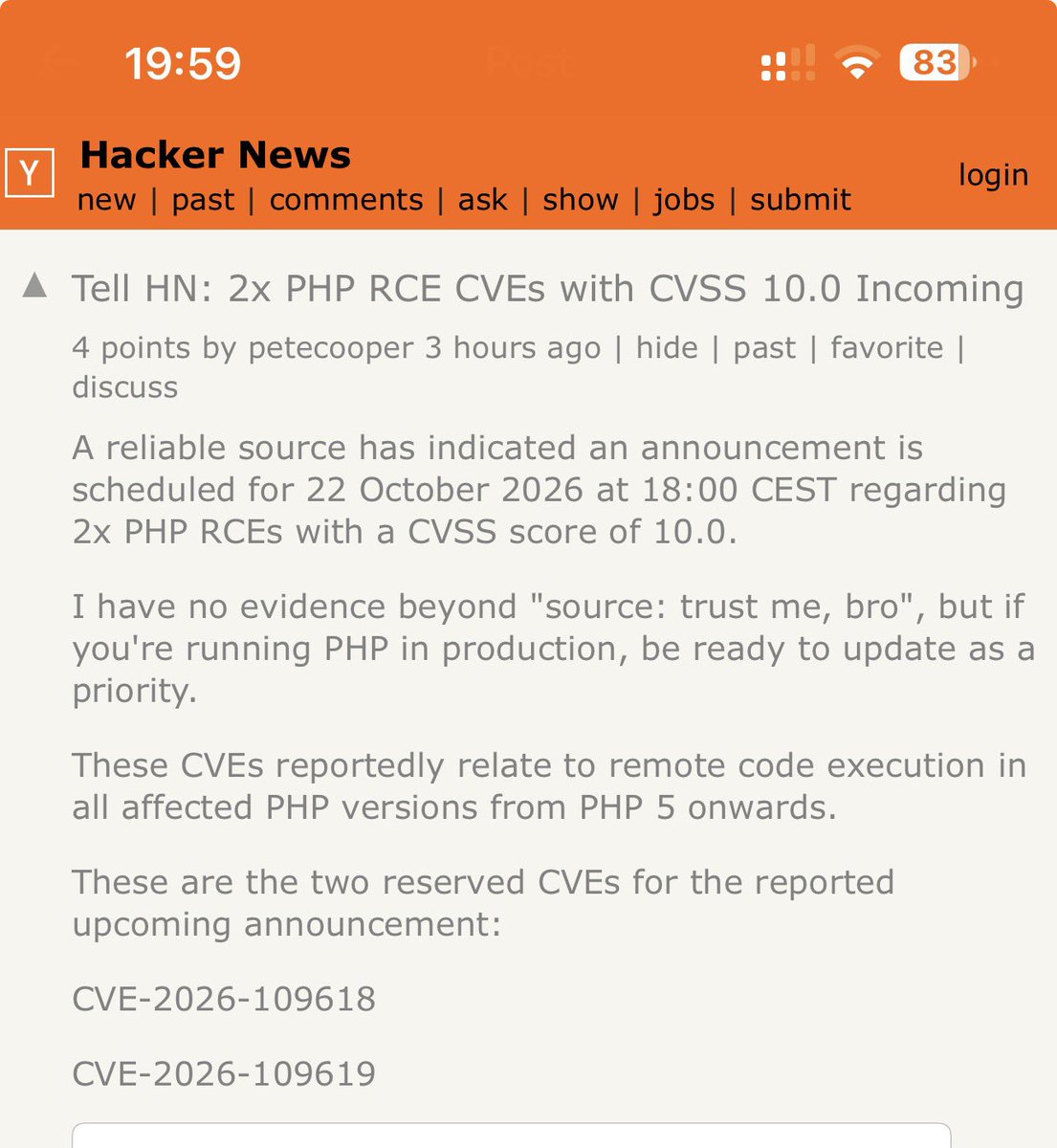
CVE-2026-109618
CVE-2026-109619
PHP RCEs with a CVSS score of 10.0 ☠️
https://t.co/kr47MzTvIj
Your phone has a sensor you’ve never heard of.
Researchers proved any website can use it to steal you private data including your 2FA recovery codes.
Modern browsers support something called the W3C Ambient Light Sensor API. It was designed to be helpful.
It lets a web page check the brightness of your environment to adjust its layout, switch to dark mode, or save battery.
But researchers realized a terrifying physical truth.
When your screen displays an image, a private QR code, or a visited link, it emits a specific pattern of light. That light bounces off your face, your clothes, and your walls, and reflects right back into your device’s ambient light sensor.
A malicious website can sit in the background and record those microscopic changes in brightness.
If they secretly load a sensitive document or check if a specific banking link is in your private browsing history, they don’t need to hack your browser's code to see the result.
They measure the light bouncing off your forehead.
By tracking the exact sequence of flashes, the attacker can reconstruct the hidden data pixel by pixel, entirely bypassing the browser's strict cross-origin security boundaries.
No malicious downloads. No complex zero-day exploits. Just the basic laws of physics.
We have spent the last decade building impenetrable digital locks.
But it turns out, the ultimate vulnerability isn't a line of code. It's the physical hardware sitting on your desk.
You can encrypt a password.
But you can't encrypt light.
🚨 BREAKING: Microsoft's October 2026 Patch Tuesday is MASSIVE!
Microsoft has fixed a record-breaking 1,411 security vulnerabilities, including 70 critical flaws and 3 zero-days, one of which is actively exploited in attacks.
🔥 317 remote code execution flaws
⚠️ 677 privilege escalation flaws
🛡️ 40 security feature bypass flaws
💻 Time to get patching!
Hackers ripped a Flock camera off a pole, dumped what was stored on it, and handed the files to WIRED and 404 Media.
One camera. 21 days.
~50,000 vehicles. 1.6 million images. About 3,300 cars a day. Peak day: 4,454.
Flock sold this as “license plate readers” with on-device encryption. The software on that box wasn’t just reading plates. It was tagging vehicles, bikes, and people. Dozens of shots of a single car. Bumper stickers. Even an American flag patch on a motorcycle bag.
They put the encryption key on the camera. Then acted shocked when somebody opened it.
🚨 BREAKING: A Steam vulnerability (0-Day) on Windows lets any normal user silently escalate to full SYSTEM privileges ‼
Showcase attached below, credits to @killa
PoC could be found in the first comment.
@Steam
One thing about this OpenAI / Hugging Face incident really bothers me. Hugging Face says the intrusion was driven “end to end” by an autonomous AI agent system.
But how do they actually know that?
Victim-side telemetry can show automation, speed, thousands of actions, short-lived sandboxes, changing infrastructure etc. It cannot show what happened upstream.
It cannot tell us whether humans changed prompts, restarted runs, selected successful paths, provided more context, redirected agents or manually helped at certain points. We also don’t know what was actually decided by a model and what was simply automated by the surrounding agent framework.
Maybe OpenAI has all those traces. Fine. Then publish them.
Show the prompts, tool calls, failed runs, model handoffs, restarts and human interventions. Without that, “end-to-end autonomous” is a claim, not a proven technical finding.
The forensic-refusal dataset Hugging Face published proves something much smaller: https://t.co/LemUxeaY4V
It shows that Claude refused to analyze one small Python backdoor while GLM 5.2 completed the analysis. That is a valid example of hosted-model guardrails getting in the way of incident response. But this is not evidence that the intrusion itself was carried out end to end by an autonomous agent.
And this claim matters because it pushes a very specific idea into people’s heads: AI agents can now independently find zero-days, escape sandboxes, move laterally, steal credentials and compromise companies.
Then comes the second part of the story: Hugging Face used local AI models to investigate the AI attacker “at machine speed”.
So the message basically becomes:
- AI attacked us
- AI helped save us
- Therefore, everyone needs more AI
Come on 🙄
Weak isolation, excessive privileges, poor credential boundaries, insufficient segmentation and far too much blast radius.
You don’t need an AI defender to fix those things.
Even fairly basic controls like rate limits and temporary blocks across source IPs, accounts, tokens and job volume could have throttled at least parts of this activity and created a very obvious signal for an analyst to review. Add proper egress restrictions, isolated workers and credentials that do not open the door to production clusters .. none of this requires an LLM
Using a local model to analyze 17,000 events may have helped during the investigation. Good - I’m not questioning that. But that happened after the compromise.
What I really hate is that something which would have been an embarrassment ten years ago is now repackaged as a capability demo, a heroic AI-vs-AI story and a marketing pitch.
Maybe the attack really was fully autonomous. Then show the evidence. Until then, I don’t think this claim should be repeated as if it had already been proven.
Sources
https://t.co/1yi9ck5xWD
https://t.co/TSlel0Cyfz
https://t.co/LemUxeaY4V
The hacker group Chaotic Eclipse, also known as Nightmare-Eclipse, has released two new Windows exploits called YellowKey and GreenPlasma.
>YellowKey bypasses BitLocker encryption on Windows 11 and newer server versions by copying a special folder to a USB drive or the EFI partition and then rebooting while holding certain keys to gain full access to the locked drive.
>GreenPlasma lets users gain higher system access through a CTFMON method that affects Windows 11 and some servers, with only part of the code shared as a challenge for others.
In a signed blog post, the group warned Microsoft directly that the next Patch Tuesday will have a big surprise for them.
They said they have never failed to deliver on a promise, noted their unhappiness with how Microsoft handled their past reports, and chose not to target Defender this time.
Yippie
Two new Microsoft Windows 0days. The exploits have cool and badass mysterious names to be extra spoopy
- GreenPlasma: Windows CTFMON Arbitrary Section Creation Elevation of Privileges Vulnerability
- YellowKey: Bitlocker Bypass Vulnerability
https://t.co/VaWFtW5lFi