Interested in how this research can help you to manage your own risk?
Feel free to reach out to me via Twitter or speak to our Catastrophe Analytics team today to learn more: https://t.co/lMBScSre08
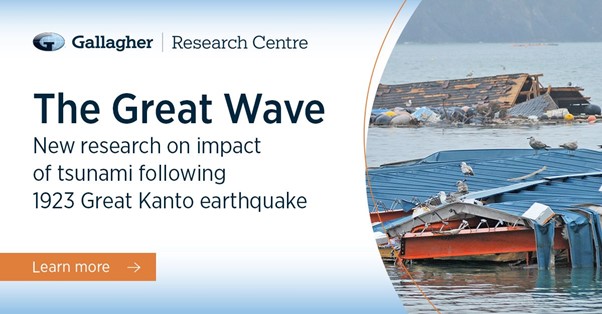
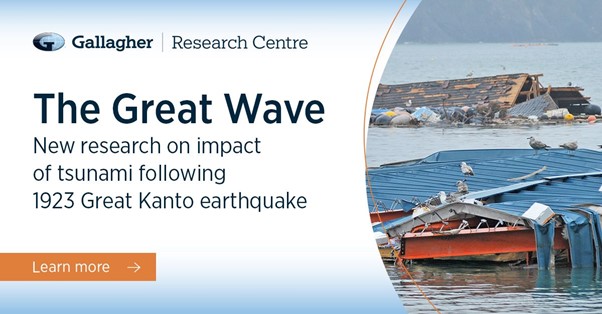
In a report from our #GallagherResearchCentre partnership with @Tohoku_univ, researchers present new analyses of the 1923 Great Kanto earthquake’s tsunami impacts, with tsunami-related loss and damage less documented by the industry.
Read it here: https://t.co/rjvM8NjEEO
If you’re interested in how this work can help you manage your own risk, feel free to reach out to me via Twitter or speak to the Strategic and Financial Advisory services team today to learn more: https://t.co/EuwuftQeqj
The @GallagherGlobal#GallagherResearchCentre is working with Prof @R2Rsquared of @LSEecon to understand the impact of macroeconomic changes on (re)insurance.
Prof Reis has written a series of initial reports on inflation risk – read each of them in the thread below:
#AI takes the lead in #bushfire detection in South #Australia's Green Triangle. This high-tech solution by Pano AI promises to protect our $680M forestry industry and ensure rapid response.🌳🔥
#AIForGood#BushfireSafety#GreenTriangle
https://t.co/sMvznlO6PP
@US_Stormwatch As the Earth's climate warms, the oceans are also absorbing a large portion of the excess heat. Not good news for marine life and coral reefs due to potential algal blooms, ocean acidification, etc.
In Forbes survey of Americas best employers for women, insurance represented about 9% of the overall list. Not sure if to feel disappointed or to see it as a starting point. #WomeninBusiness
https://t.co/63xfDBMzZp
Has human-caused climate change contributed to the fires in Rhodes?
Yes
"prevalence and extremity of fire weather has already emerged beyond its pre-industrial variability in the Mediterranean due to climate change"
- our paper led by @Jones_MattW
https://t.co/Htgjbqdqv5
Interesting, ML for model emulation and general forecasting purposes. Will this progress beyond traditional numerical weather and climate prediction workflows that are based on physics-based emulations?
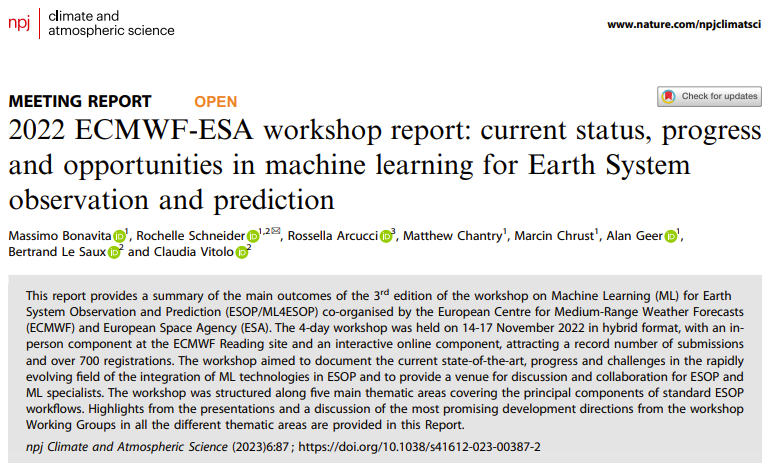
Interested in the latest trends in #MachineLearning for Earth System Observation and Prediction?
Have a look at ECMWF-ESA recent report published at #Nature’s Climate and Atmospheric Science. Very pleased to lead this work from #philab.
Open Access: https://t.co/ASAdSCdYxQ
@WHUT Indeed, indices indicate different climate patterns that influence the occurrence and frequency of events. Different model views of risk can reflect these phases, e.g. NAO+ or - index values, La Nina vs El Nino etc. I am curious how your approach can be applied beyond this.
🤔 Interesting concept relating the Earth to a topological insulator (drawing similarities to how electrons behave) to understand large-scale weather patterns, or maybe even lead to new geophysical discoveries #quantum#physics#climatechange
Brad Marston, IBES Fellow and @brown_physics Professor, has found that some features of fluid flow on Earth can be explained by principles that traditionally apply to quantum systems. You can read more about the new study in @QuantaMagazine. https://t.co/UZpPe6wJw8
@WHUT Interesting that you have been able to model the major climate indices (apart from QBO) and how this links with LOD. I am not an expert but curious in the application to climate modelling and deriving more relfective event sets (e.g., for TCs) for catastrophe modelling.
Be a speaker at RISKWORLD and showoff your expertise and connect with global risk management leaders. There are more opportunities than ever with new programming additions this year. The deadline is August 18. Get started at https://t.co/m0xboXGGQh #riskmanagement#RISKWORLD
How AI can help you in your career:
👉 Help draft messages to hiring managers
👉 A credit score for your career
👉 Let AI help you interview prep
👉 Cover letter copilot
👉 Resignation letter generator
🤔 feeling dubious. Has anyone used these?
https://t.co/5fL1xZlUl3
Unsurprisingly, sectors like technology, pharmaceuticals, automotive, aerospace, and electronics tend to have higher R&D investments due to the constant need for innovation and competitiveness in these industries.
The need for R&D to solve today's challenges is ever increasing. Only by investing more and accepting the unpredictable nature of scientific projects and their outcomes can we reap the potential rewards #research#Innovations#investment
https://t.co/Qjf2cLB3UE
Yet R&D investment can vary significantly by sector and depending on the country, region, and specific industries based on their priorities, technological advancements, and economic conditions.