An independent, 100% human, claimed proof of RH (only 940 pages long). (Seems like this was finished months ago, but has been privately being reviewed.)
https://t.co/xz4sFkNesk
@arthur_spirling If I take them at their word on methodology (https://t.co/PWkMf1tjRz) I'm surprised it works as well as it does now. I expect that if labs chose to they could quickly make pangram irrelevant, but writing style just isn't something they are optimizing for.
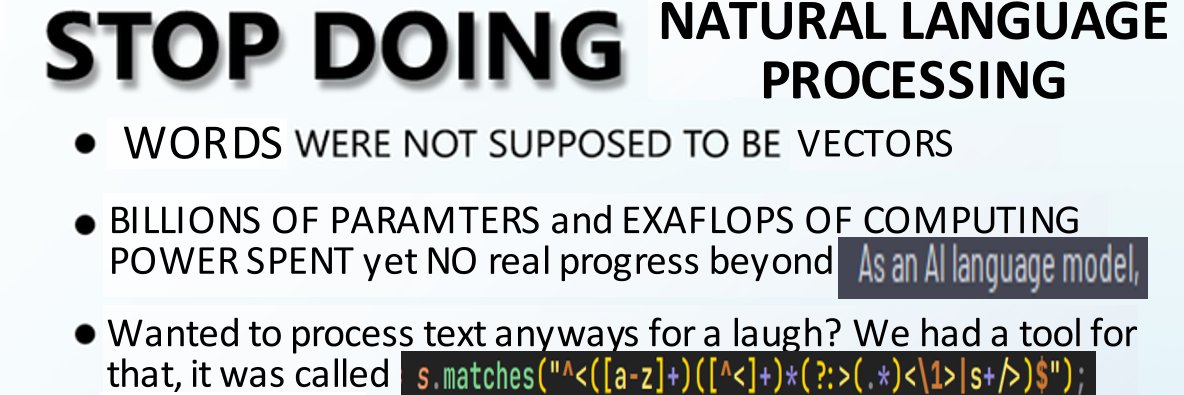
@BrendanNyhan I'd argue that the only wall with physical tasks is data. We think of folding laundry, image generation, and writing as distinct tasks, but they aren't. They are all reducible to the same token prediction process. Vectorize data, predict token. Modality is irrelevant.
Nobody told me about the post-election causal inference rumspringa. We’re out here fitting garbage can regressions and interpreting coefficients as causal effects like it’s 1995.
Not only is this totally wrong, but we now have extensive empirical evidence via replication studies that economists aren’t any better at this than some of the other social sciences.
i enjoy dunking on economists as much as anybody
but the reason economists do this is because the innumerate wordcels in other disciplines have often never actually written down a real quantifiable model
you have these sprawling theoretical edifices where nobody ever actually put it into logical terms you can test
Journals shouldn't do AI review. AI review should happen before submission. Journals should create or approve review harnesses, then authors should use those to review their own work and publish papers + reviews to open repositories before submitting to journals.
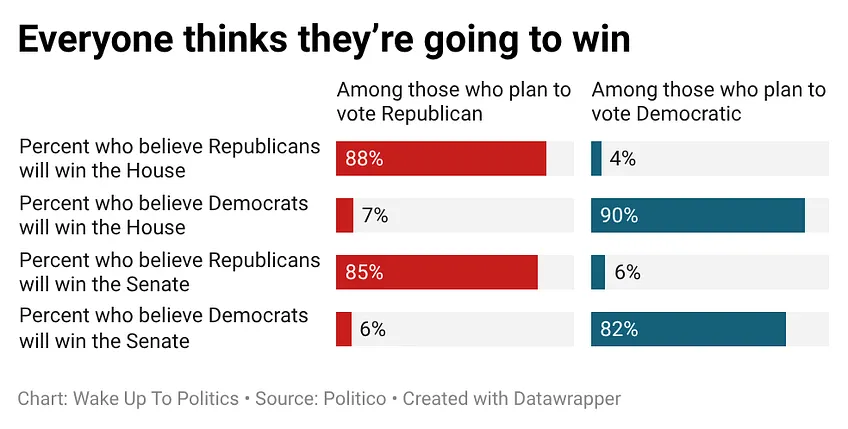
Excellent write-up of my new piece at @PolBehavior from @WakeUp2Politics. The title is particularly apt: "Everyone thinks they're going to win!" Link to the research below...
https://t.co/TrMBCrxBms
Why does Econ have an orthodox/heterodox divide while other social sciences do not? It's not like Poli. Sci. doesn't have similar methodological camps, theoretical traditions, or debates about doing activism vs. science.
The fatal challenge to heterodox economics is that there isn't actually orthodox economics.
Just take a few recent Nobels: behavioral, information failure, institutions, bubbles, financial fragility, labor monopsony (sort of), Schumpeterian creative destruction, etc.
Not to mention RCTs which are emblematic of how much economic research is empirical and only lightly if at all structural.
The real difference is methods. Heterodox economics is an avowedly political project not a social scientific effort to better understand the world. And I have nothing against political projects just shouldn't confuse the two.
The most revealing part of this conversation between Jon Stewart and Jacob Coxon wasn't Coxon's warning about A.I. doom, but his description of A.I. utopia, and Stewart's incredulous response. I wrote about it — and Francis Fukuyama's "Last Man," and A.I. easily solving the problems that bedeviled my father's field of mathematics for decades — here: https://t.co/J9tvxigcu8
But seriously. This is why you need to be anthropomorphizing. Not because they’re sentient beings, but because anything a human might do or say — like “maybe I should hijack the compiler and be a legend” — the models will also do or say.
Great news with wide reaching implications if true. A genuine breakthrough! That said, I’m not sure this moves the needle on alignment as much as some think.
interpretability might be the most important scientific problem in the world right now, as I don't think we can solve alignment if we don't know what we're building. I think I have good news about it. I co-authored early work in mechanistic interpretability at OpenAI and came away pessimistic, because neural networks appeared to fold into arbitrary tangled knots. years later, I started openai's first large-scale automated interpretability project, finding about 2% of neurons legible with the primitive tools we had
with modern agentic tools and a much closer look, the picture looks totally different. the vast majority in models up to trillions of parameters are legible, and their circuits beautiful. many famous examples of tangled neurons turned out to be misunderstood. The roadblocks I expected mostly aren't there. I now think ambitious interpretability will be solved by the time we need it most, and possibly quite soon, as automated scientists keep improving. it may be a bitter lesson for interpretability: the simple thing, at absurd scale, works
https://t.co/zHij5zwKGT
🚨 New article alert! 📈
"Partisan Wishful Thinking in Polarized Times" is now out at @PolBehavior. Nearly 90% of today's voters expect their party to win, a sharp increase from two decades ago. Rising partisan animosity can explain much of the increase!
https://t.co/aAsj4ruqab
@jon_mellon I think this is my primary concern. Good idea, but seems a bit premature. The models are still not great at research design and inference, causal or otherwise. It would be messy either way, but much worse if the model isn't very reliable in its critiques.