We've built a coding agent that runs entirely on your own machine.
No account. No API key. Your code never leaves the laptop.
https://t.co/vP6mrv7fbe
Our ternary 35B-A3B model resolves 55.8% of SWE-bench Verified in 9GB — on a 16GB Mac or a gaming PC with 4GB of VRAM.
macOS + Linux
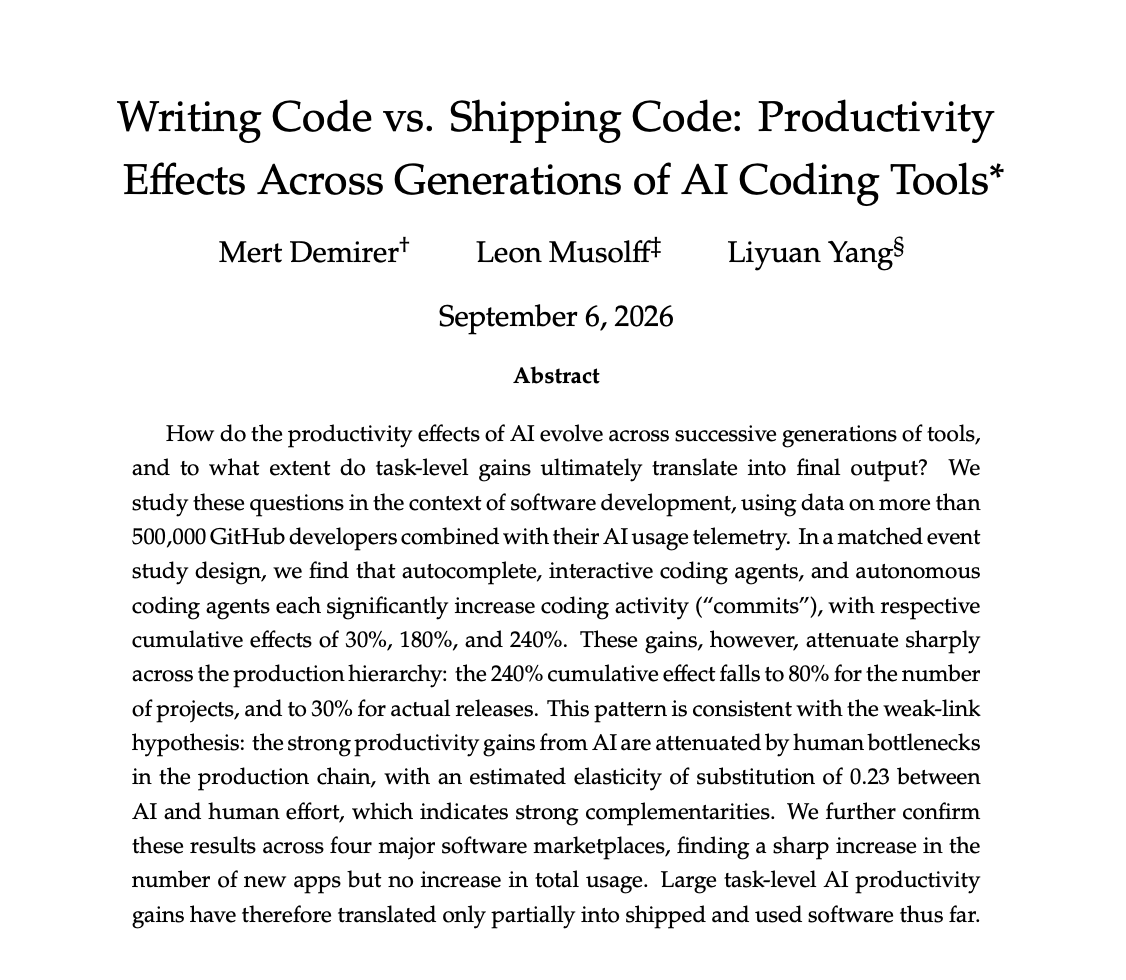
MIT published the most uncomfortable paper on vibe coding.
They tracked every new app that dropped on the app store, play store and chrome web store after coding agents showed up.
And the findings are brutal.
devs who started using autonomous agents wrote 25.5x more code. commits up 240%. repos touched up 80%. actual releases? +30%.
So like... where's the other 95% going?
In the trash.
After adopting tools claude code, devs wrote 7x more lines and deleted 12.2x more. repos abandoned within 30 days went from 60% to 69%.
and the storefront side is where it gets kinda bleak. new apps launching across the app store, play, chrome web store, sourceforge - roughly doubled since early 2025.
user engagement? didn’t move.
that's the part that messed with me honestly. twice as many apps shipping into the void. nobody downloading more, nobody using more. just... more noise on the shelf.
I’ve been thinking about this bc i felt it myself. i shipped three "projects" last month with claude code and im pretty sure zero humans used any of them.. its so easy to start something now that finishing stopped meaning anything.
writing code was never the real bottleneck. shipping something coherent, reviewing it properly, building a thing anyone wanted - that was.
@empowwerr The ones that you want to be private or use confidential data, or if you run out of quota/want to save money, or if you want to work without internet
Looking to #connect with builders who are active on X.
People who reply, support others, share what they learn, and actually engage — not just collect followers…
I built Psyfy app from 0 to 30k users mainly from organic traffic, with 5k+ monthly activations.
Interested in:
•SaaS
•LLM
•Building in Public
Drop a “HI” if that sounds like you 🤝 Ask me any questions about growth and marketing
Unpopular opinion: local models don't need to beat frontier models to win. They need to be good enough for 80% of daily tasks and free. That bar was crossed this year and almost nobody noticed.
Open-weight releases this month, sorted by where they’re practical to run: laptop (≤16 GB), phone (≤4 GB), or desktop GPU. “Small model” doesn’t always mean small enough for the laptop or phone you own.
The most important number for a local model isn't total parameters, it's active parameters per token. 35B total, ~3B active is why Millie feels fast on a laptop. Dense 7B models are doing more work per token for less. Check out more at https://t.co/fsmHxmr8z3
"Private AI" means the data never leaves the device. Not "encrypted in transit." Not "we don't train on it." Not "enterprise tier." If there's a server, it isn't private, it's trusted.
8/ Grumble of the week from the community: the Qwen 3.8 open weights are text-only and stripped of the Max features (no vision, no 1M context). Open-weight ≠ the API model. Read the model card.
https://t.co/6At2A3xSRx (see the discussions tab)
6/ The local-hardware story: Qwen3.8-Flash-Next is 177B parameters, and an 85 GB quant runs on an M5 Max with 64 GB, with vision, at 36 tok/s. The file is bigger than RAM; 39 GB of it (the n-gram table) never enters memory. Bigger-than-RAM models via mmap paging is the 1/2