The University of Maryland Center for Machine Learning uses powerful computing tools to tackle challenges in big data, computer vision, health care and finance.
Led by Mohammad Hajiaghayi (@MTHajiaghayi) and Reza Ghanadan, researchers from @UofMaryland & @MIT will develop AI-driven “co-authors” capable of helping mathematicians break down extremely complex problems and uncover new insights.
https://t.co/7AGMZSy3nB
Can we make AI forget harmful data without erasing its entire intelligence?
Researchers @UofMaryland and the Max Planck Institute for Software Systems (@mpi_sws_) have developed a new AI “unlearning” method to address this hurdle in LLMs. The method can selectively remove sensitive data—like private information, copyrighted text or misinformation—without damaging the model’s reasoning abilities.
Led by @FeiziSoheil and @RezaeiKeivan, the team’s method works like a precision rollback tool for AI memory, allowing developers to reverse the influence of specific data instead of retraining massive models from scratch.
The research was presented at #ICLR2026 (@iclr_conf) in Rio de Janeiro. Read more: https://t.co/IWLcpGNPi6
AI can write code, pass exams, and generate videos.
But ask a robot to pour almonds into a bowl, and it may still fail.
Why?
One reason: robots are often using visual encoders trained for the internet — not for action.
Our new work asks: do robots have the wrong eyes?
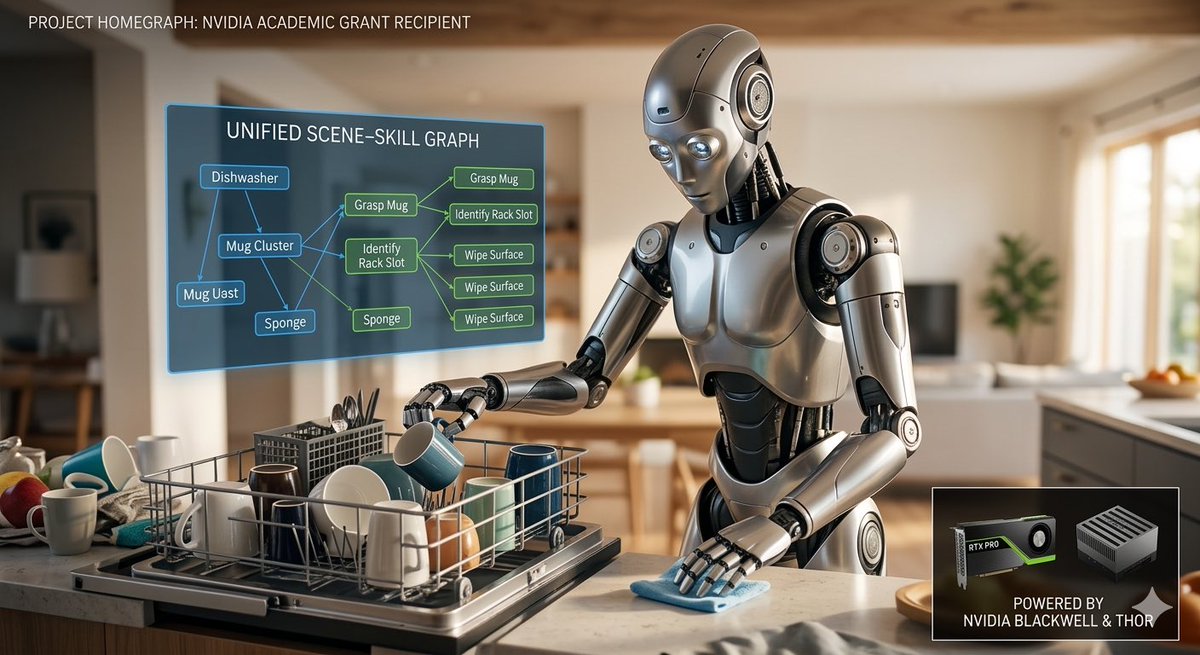
Researchers @UofMaryland are advancing robotics with a new initiative designed to enable humanoid systems to perform complex, real-world household tasks with greater autonomy and reliability.
Built on @NVIDIAAI infrastructure, the project integrates breakthroughs in trustworthy machine learning, sequential decision-making and generative AI to create robotic systems that can reason, adapt and act in dynamic home environments.
The effort is led by Furong Huang (@furongh) and Tom Goldstein (@tomgoldsteincs) of @umiacs, which will install and maintain the new computing infrastructure in its high-performance data center.
Learn more: https://t.co/IO46sBESgX
Excited that our project HomeGraph in collaboration with @tomgoldsteincs has been selected for the NVIDIA Academic Grant Program!
We’re building tool-native GR00T humanoid robots using a unified scene–skill graph for long-horizon household autonomy.
Grateful for NVIDIA’s support with RTX PRO 6000 Blackwell GPUs and Jetson AGX Thor to push this research forward.
Special shoutout to @ruijie_zheng12, now at NVIDIA’s GEAR Lab, who played a major role in early GR00T work while in my lab. Excited to continue collaborating.
Looking forward to building on our partnership with @DrJimFan and @yukez and advancing the future of generalist robotics.
Research supported by the NVIDIA Academic Grant Program.
#NVIDIAGrant @NVIDIAAIDev
My 21st Ph.D. student, Suho Shin, just defended his thesis Game Theory & joins Stanford and MIT for postdocs. All 21 of my students’ theses focus on challenging deep theoretical foundations applied to auctions, games, big data, networks, algorithms, distributed & intelligent sys
Tom Goldstein (@tomgoldsteincs) was honored at the 2026 Maryland Research Excellence Celebration for his influential work in machine learning and AI security. With more than 9,000 Google Scholar citations annually and an h-index exceeding 90, he ranks among the most highly cited scholars in his field. Read more about the event: https://t.co/8DT78rHN2g
TRAILS is launching 11 Broader Impact Awards to expand access to trustworthy AI. These grants—up to $25K apiece—support projects @UofMaryland, @MorganStateU and @GWtweets to empower diverse stakeholder communities to engage with and influence the future of AI. https://t.co/qyKkTa6w6m
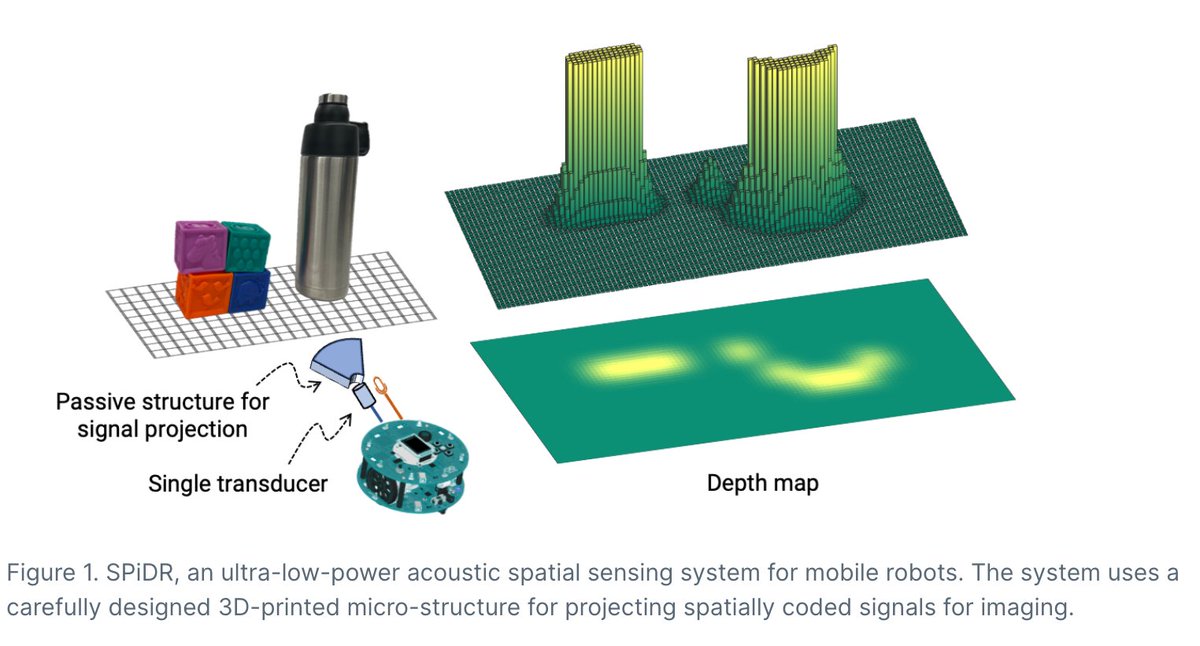
An ultra-low-power spatial sensing system designed for miniature mobile robots, developed by @umiacs-affiliated researchers, was recently featured @CACMmag: https://t.co/wZs11Mw3ab
Co-authored by Yang Bai (@FighterYangbai8), Nakul Garg (@nakulgarg22) and Nirupam Roy(@NeeeRooo9), the paper explains how they designed the system to meet the strict power and hardware constraints of micro-robot platforms.
Bai completed her Ph.D. @umdcs and is now a machine learning scientist @Apple. Garg, who also earned his Ph.D. @umdcs, is now an assistant professor @RiceECE. Roy is an associate professor @umdcs with an appointment @umiacs.
Research by computer science Ph.D. student Seungjae Lee (@JayLEE_0301) will enable robots to learn not only from their own physical experiences, but also from the vast reservoir of human activity captured online.
https://t.co/pfMrVZj6xM
Today is #GivingDayatUMD! Gifts to the UMD Center of Machine Learning support the center’s activities, enabling cutting-edge developments in machine learning research and realizing the world-changing application of those discoveries.
👉Give here: https://t.co/P67YhgxAy8
It's not too late to register for #TRAILSCon2026 at George Washington University on Wednesday, March 4. This year, TRAILSCon will explore real-world approaches to evaluating AI performance, risk, and impact. Learn more: https://t.co/rNoAAgUWc6
#GivingDayUMD is just two days away! Help #ScienceTerps move fearlessly forward—save the date for March 4.
Gifts to @ml_umd will enable cutting-edge developments in machine learning research.
https://t.co/5odAndnHag
How do we measure AI’s performance, risk & real-world impact? 🤖
Find out at TRAILSCon 2026, March 4–5 at GW. Panels, roundtables & workshops focused on responsible AI design & governance.
🔗 Register: https://t.co/HK1IPjQrqw
#TRAILSCon2026#AI#ResponsibleAI#FutureOfTech
Back when working on FLARE: Robot Learning with Implicit World Modeling
📄 https://t.co/ekqFw5fF4X
We realized something important:
👉 Co-training is not just a trick. It’s a scaling law for robotics.
By aligning latent future representations, FLARE showed that mixing robot demonstrations with human egocentric video unlocks surprising generalization — even to unseen objects with minimal robot data.
That insight stayed with us.
Now Ruijie has graduated from our lab and joined NVIDIA GEAR Lab — one of the frontier labs in modern robotics.
And they’re taking this idea further.
Why is co-training powerful?
• Robot data provides precise action grounding
• Human video provides massive visual diversity
• Latent alignment bridges embodiment gaps
You don’t need perfect action labels.
You need the right representation.
The next generation of VLAs will not just react — they will anticipate.
Proud former advisor moment 🚀
#Robotics #WorldModels #VLA #EmbodiedAI #DiffusionModels
"I think we are entering into a new era of security," Tom Goldstein, a professor of computer science and director of the Center for Machine Learning at the University of Maryland, told Yahoo Finance.
https://t.co/RMFRIGla63
A multi-institutional team—which includes @UofMaryland researchers Yiannis Aloimonos and students Aadi Palnitkar and Arjun Suresh—has created a rhino-detection system that pairs satellite data with AI to boost conservation efforts.
https://t.co/NVKC99IXAh
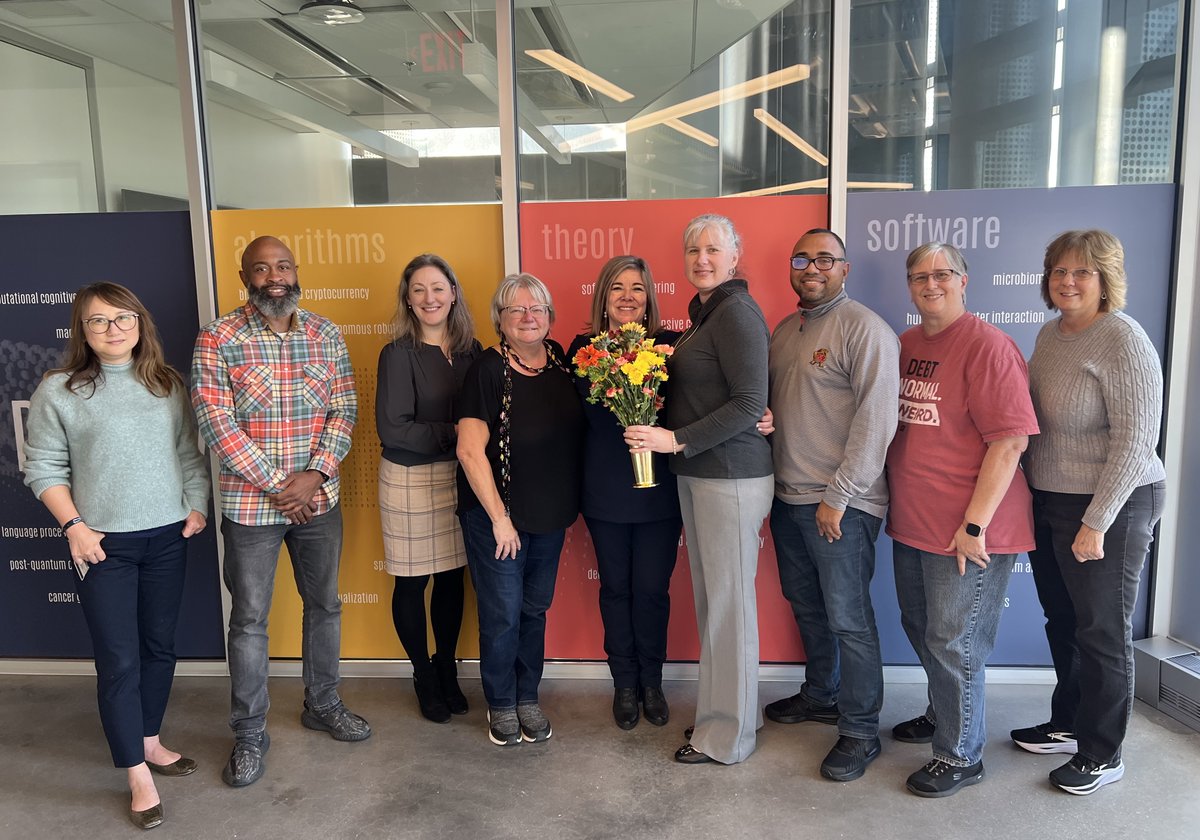
After nearly 30 years of working in the @umiacs business office, Yerty Valenzuela is retiring. As director of research program administration, Yerty has been a cornerstone of UMIACS operations, supporting research programs and managing key accounts with dedication and expertise. Congratulations to Yerty on her retirement!
Professor Uzi Vishkin Receives 2026 IEEE Computer Society Charles Babbage Award: Recognized for his seminal contributions to the parallel random-access machine theory and as the inventor of fundamental work-efficient parallel algorithms. https://t.co/6gS3WvcW0a
Presenting today at #NeurIPS2025 : Can explainability help with model compression? — A new strategy of few-shot distillation of LLMs that cleverly use counterfactual explanations as boundary pegs.
Achieves superior performance using only half the original samples + Theoretical guarantees using Hausdorff distance
📄 Paper: https://t.co/I1jC2EnIWK
Code: https://t.co/bxeDl5hi05
For more details, feel free to stop by our poster:
🗓 Wed, Dec 3, 2025
⏰ 11:00 AM – 2:00 PM PST
📍 Exhibit Hall C,D,E — # 2711