Today we are releasing ether0, our first scientific reasoning model.
We trained Mistral 24B with RL on several molecular design tasks in chemistry. Remarkably, we found that LLMs can learn some scientific tasks more much data-efficiently than specialized models trained from scratch on the same data, and can greatly outperform frontier models and humans on those tasks. For at least a subset of scientific classification, regression, and generation problems, post-training LLMs may provide a much more data-efficient approach than traditional machine learning approaches. 1/n
Thrilled to announce The Engine Ventures’ Fund III! With $398M in new capital, we now manage over $1B. We’ll keep backing visionary founders to turn groundbreaking discoveries into impactful solutions in climate, health, and advanced systems. https://t.co/Hg5CeqVe8a
I’m very excited to share my final first author paper from my postdoc now in @NatureEnergyJnl. In it we uncover how surface treatment of perovskites with HABr enabled two world-record solar cell efficiencies. https://t.co/4fBBncsslw. These were the first devices with >25% -@NREL.
Today, we are announcing Future House, a philanthropically-funded moonshot focused on building an AI Scientist.
At Future House, our 10-year mission is to build semi-autonomous AIs for scientific research, to accelerate the pace of discovery and to provide world-wide access to cutting-edge scientific, medical, and engineering expertise. We have chosen to focus on biology because we believe biology is the science most likely to advance humanity in the coming decades, through its impact on medicine, food security, and climate. We also believe that biology research is set to scale, and AI will help us get there.
Future House is an independent, non-profit research organization, headquartered in San Francisco. At Future House, biology researchers and AI researchers will work together to build AI Scientists and to use those AI Scientists to make research 10x to 100x faster than it is today. We are fiercely committed to a flat structure, team science and individual contributions. We are also hiring, for AI researchers, wet lab biology researchers, and other roles. If this mission and these ideas are exciting to you, get in touch. Join our mailing list, follow us at @FutureHouseSF, and reach out to us at [email protected].
For more information, read our blog post here: https://t.co/drN0rY5WU2
and check out the @Bloomberg feature here: https://t.co/jIjela6b9L
People need me time; quasiparticles need to 'relax' too. To use exciton-polaritons (hybrids of light and matter) in applications similar to lasers, you need to bring polaritons down to their lowest energy state. @MIT scientists found a way to control them: https://t.co/dmchqsts6B
So excited about this work out now in @NatureComms! Congrats to @mlaitz for spearheading this project- revealing the inner workings of polariton relaxation in perovskites. Also thanks to @GiuliaGrancini,@andrewhproppe, + the rest of the twitter-less team. https://t.co/WQteyHZLTQ
Semiconductor energy transport can be affected by many sources including photon recycling, grain boundaries, & nonlinear recombination. @DanedeQuilettes @brenesrob @mlaitz develop new ways to model & understand these competing processes. @RLEatMIT
https://t.co/x5lsdp1rFa /#PHAR
Ayyyy my dept has a seriously awesome new program pairing underrepresented grad applicants with current MIT EECS PhD students. (Shoutout to GAAP to organizing this!) Apply by Nov 8 @black_in_ai@BlkInComputing@AiDisability@_LXAI@QueerinAI
Grad students at @MITEECS have launched an ambitious new program to pair underrepresented applicants for graduate admission with current PhD student mentors! Proud to be a part of this effort alongside many other committed grad students
Interested in applying to @MITEECS for grad school? Check out the new graduate application assistance program: https://t.co/aVkssrSnl5 #EECS#gradschool@MIT
We just had our 3rd annual External Advisory Board meeting! Thanks to @SarahKurtz14@joeljean9 @lidija_sekaric @SnaithGroup@Harishhande and Dirk Weiss for taking the time to guide our efforts and support our team!
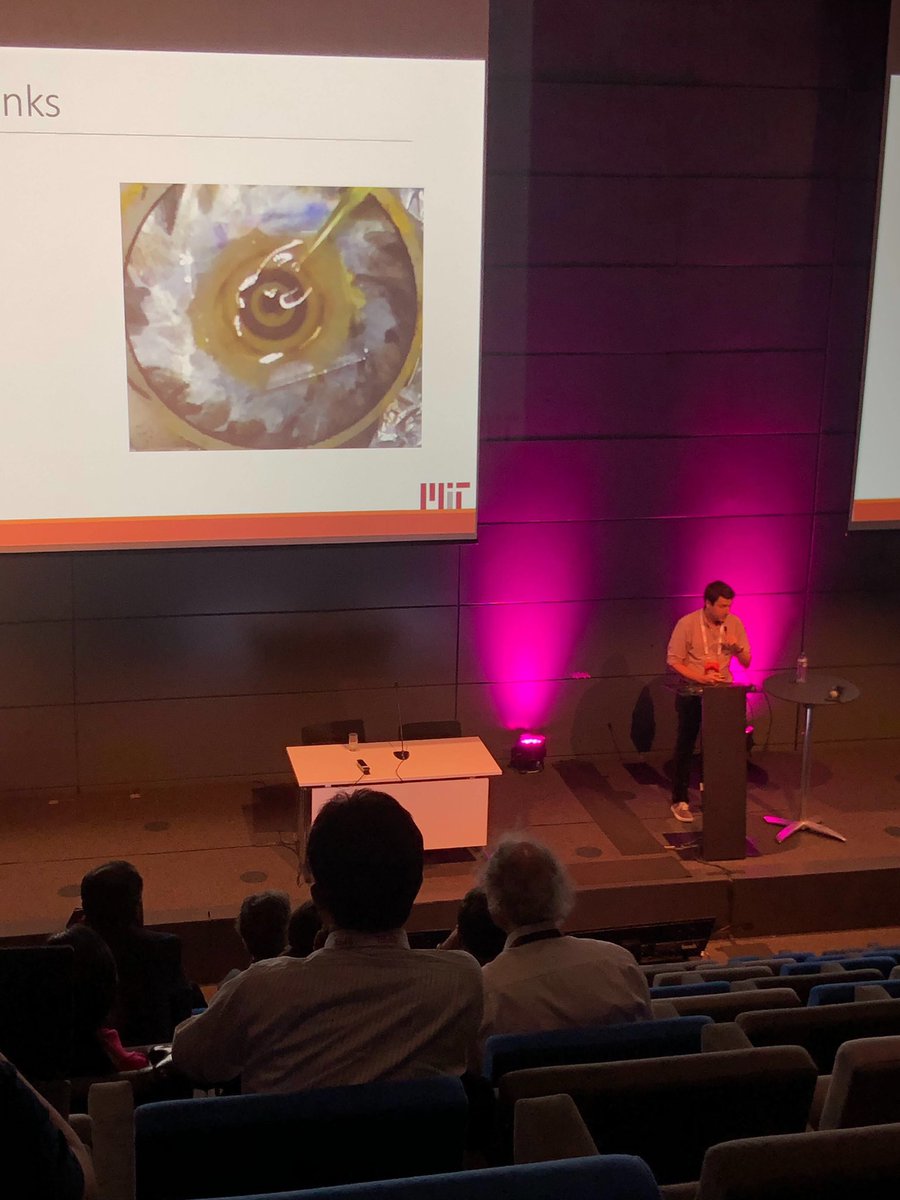
Really interesting talk from @MIT researcher Madeleine Laitz on strong coupling on MHPs in low Q cavities in #EN09#F19MRS with contributions from @NREL @RASEI_CU alumi @dak_bdou (sorry no pick #twitterfail)