At @IFP, we’ve spent the past 3 years thinking about all the different ways the US government & philanthropy fund R&D.
Until now, R&D funders haven’t had a systematic way to match the innovation problem to the right funding tool.
We built THE ATLAS OF INNOVATION to fill that gap.
https://t.co/XZshJ7pr1f
Alongside @UChi_MSA, we’ve boiled down thousands of hours of research into a handful of questions covering how much the R&D funder knows about:
- the problem they want to solve
- the solution it should have
- the team that should build the solution
Why the Atlas matters:
The US government spends close to $200 billion every year on R&D. And after the Anthropic and OpenAI IPOs, there will be hundreds of billions of dollars in new philanthropic giving.
Choosing the correct funding approach to the social problems they’re trying to solve will mean the difference between success and failure.
For example, NSF research grants have helped seed breakthroughs from MRI machines to search engines, but grants aren’t built to deliver the kind of industrial speed and scale that a project like Operation Warp Speed required.
Picking the wrong funding approach can leave programs behind schedule, over budget, or without anything to show for all the money they spent.
How we built the Atlas:
1. We began by creating a matrix of dozens of considerations that a thoughtful policymaker or funder would ideally weigh before deciding how to fund a project.
2. We looked at every major funding approach, from grants to R&D tax credits to advance market commitments, analyzing when they work well and when they fail to meet the mission.
3. We spent months deep in the weeds of contract theory and incentive design, looking at historical examples and the state-of-the-art research in innovation economics.
4. We then worked to turn that research into a tool that time-strapped policymakers and philanthropic funders could rely on at the start of an innovation funding cycle.
5. Three years later, we are launching just that: a new (and visually stunning) website to help funders decide how to best incentivize innovation. And all they have to know… is what they currently know about their innovation goal! The Atlas takes care of the rest.
How to navigate the Atlas:
Answer questions about your goal to find the funding approach aligned with the information you have.
Each funding mechanism has its purpose for particular technologies and specific moments in development.
There shouldn’t be an ARPA for every field, just like we don’t need a prize or AMC for every innovation. The Atlas helps you navigate those tradeoffs.
“I want to persuade other high-net-worth individuals to invest in an innovative, ROI-focused public safety strategy — one that focuses on impact over ideology.”
Cool
This is embarrassing. And fixable.
But I still hear and receive a lot of negative feedback from senior folks who just don't seem to see a need for change. Until we do, we own this collectively as a discipline.
The Government of Ontario is committing to a corporate #BeneficialOwnership registry.
We're proud to have worked with @scaldron to communicate the successes the #EndSnowWashing Coalition has had in #Canada.
More:
https://t.co/4QL46puYs0
New from me: I’ve been appointed to lead the Canadian Tax Observatory, dedicated to rigorous research, collaboration and public education on tax policy -- with an eye to furthering economic growth and combatting inequality. Here’s more: https://t.co/bbtAUyOCPL
How can open, verifiable data power the public good? On Oct 14–15, GLEIF India’s Vikas Panwar joins @CDPG_IISc’s Symposium on Data for Public Good in Bengaluru, speaking on data spaces, digital product passports, & governing verifiable ecosystems. #LEI
More info 👇
We've updated a paper on the 3-year, $1000/month U.S. guaranteed income study.
New results, in 3 figures: 🧵
1) Subjective well-being significantly improved in the treatment group in year 1, but there were no sig differences between the treatment & control group after that. 1/
Re-listening to @deankarlan’s interview on @statecraft and it’s (still) depressing. After reading his book I was super excited to hear about his appointment but it seems clear that he didn’t have a real mandate.
https://t.co/9RqmXF2JAr
Canadian Federal Government has released draft legislation for previously announced enhanced reporting by non-profits that are not charities from the 2024 Fall Economic Statement https://t.co/hAZFhqOEzv
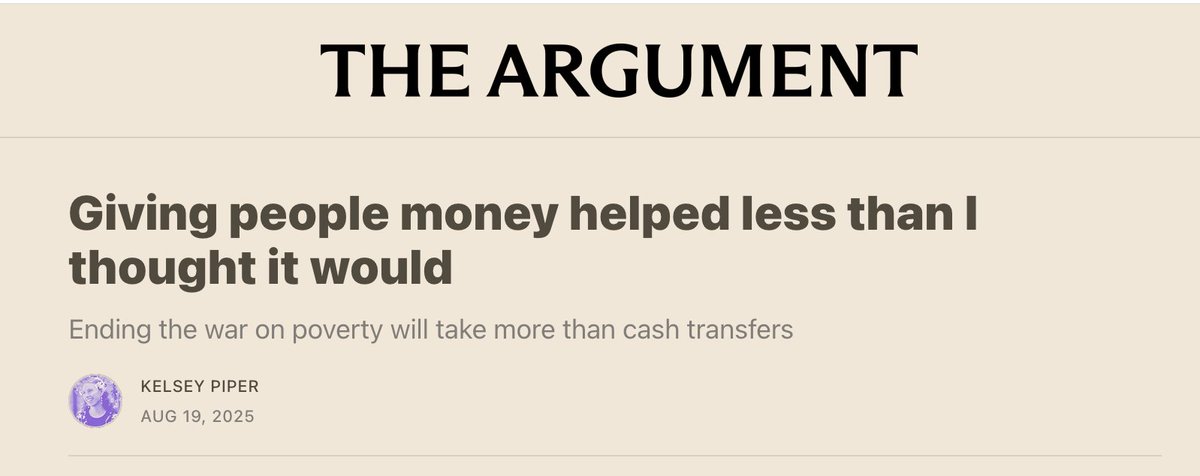
It's a bit painful for me to share this, but I respect @KelseyTuoc (and @evavivalt) a lot, and I think they're basically right: the most rigorous recent studies on basic income and cash transfers (in rich countries) have yielded pretty disappointing results.