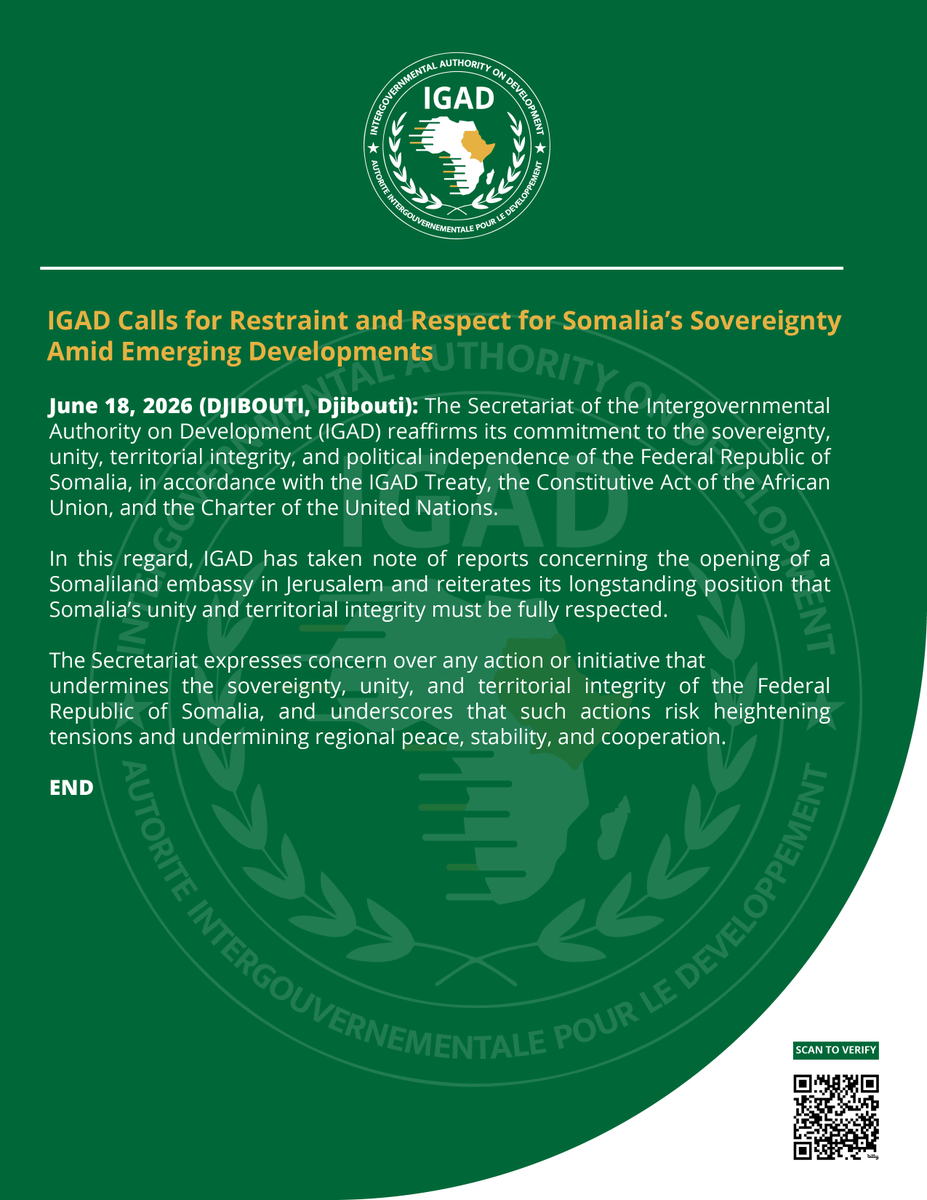
The Council of Ministers’ approval represents an important step in the implementation of the Joint Declaration between the Republic of Somaliland and the State of Israel.
It is a paradox and dishonesty at the same time to use Somaliland Constitution in an argument that fundamentally fights its existence and everything it embodies.
Hate Somaliland, but hate it all!
Abdirahman ciro lacks the legal and political authority to sign such any agreement. Opposition is growing even within Somaliland, where many residents argue that his actions are a direct violation of Somaliland’s constitution. By acting outside the constitutional framework, he is undermining the very institutions he claims to defend.
According to facts, the Regional Peace would be far much better with Somaliland having the batch of Recognized Sovereign State because that is what it has been for over 3 decades & has always lived up to its role in maintaining the stability in an otherwise volatile region.
@Knowledge_iii@somalilandmfa Ofcourse we do not intend to bring anyone to Somalia, we understand that is another country and we don't get to do that, but in Somaliland, the Israelis are already here.
Mohamed Hassan
Your mimicry of morale and the false grandeur stain the words you used: pride, dignity, & loyalty. For 3 years, your gates remain closed to starved Gazans. Anyone of your ilk shouldn't, in their right mind or with a shred of conscience, make such an statement.
The new governor of Akka betrays once again!
History is being rewritten with the ink of concessions, and a rush toward suspicious alliances in pursuit of a missing international recognition,even if the price is shaking hands with those who have shed the blood of brothers and innocents.
The Somali people, across all spectrums, have built their history on pride, dignity, and loyalty to the causes of the Arab and Islamic nations.
Today, this announcement by the president of the separatist Somaliland region, Abdirahman Cirro, regarding his arrival in Israel on a first-of-its-kind visit, comes as a shock to all steadfast principles. It exposes a readiness to fall into the embrace of the occupation under the pretext of "seeking hope and existence," as if existence cannot be achieved except by selling out principles and denying a shared history.
Israel, which has failed to bring peace and stability to itself, will never be a lifeline for any nation. Instead, it remains a tool for deepening divisions and sowing discord within the same body.
Anyone who believes that their legitimacy can be derived from Tel Aviv, or through a recognition that passes over the blood of the vulnerable, is chasing a mirage. History will record that this step was not a "new chapter of friendship," but rather a stab in the back of brotherhood, and a chapter of compromise over the nation's awareness and fundamental principles.
The choice to ally with the occupier will remain a stigma, no matter how much it is shrouded in terms like "diplomacy" and "shared future."
@khaledmahmoued1 Your mimicry of morale and the false grandeur stain these words pride, dignity, and loyalty which you have used. For 3 years, your gates remain closed to starved Gazans. Anyone supporting the Egyptian regime wouldn't, in a right mind & shred of conscience, make such an statement.
@ace_qatabi@Isaac_Herzog@Abdirahmanirro We have been very good, upholding good morale for 35 years & courting the world, the Muslim ummah in particular to at least consider our case. They didn't even glance, left us to the mercy of Somalia. We didn't need to chase Israel, they accepted us with grace. That is all.
@shambuushka@TiborPNagyJr@abdi9998 There is no fragmentation as you put it and seem to be criminalizing it, It is only acknowledging what is real and works - That is to say the Republic of Somaliland.
@Osint613 Actually the deal was never ratified, Somalia should have no sovereignty over Somaliland. You should have watched by episode on Somaliland. 👇
https://t.co/wzB7l7vEkL
📰 Response to Faisal's Opinion :
June 26, 1960 – The Legal and Historical Case for Somaliland’s Sovereignty.
A Date That Stands on Its Own.
June 26, 1960 is not just a historical milestone , it is the day Somaliland became a sovereign state. This fact is documented in historical records and diplomatic recognition practices at the time (Lewis, 2002; Bradbury, 2008). Yet its significance continues to be debated, often overshadowed by competing political narratives.
At its core, the issue is simple:
Can a people who achieved recognized independence reassert their sovereignty based on that same legal foundation?
In the case of Somaliland, the answer is yes.
Sovereignty Was Achieved , Not Imagined
On June 26, 1960, Somaliland ended British colonial rule and emerged as an independent state, receiving recognition from multiple countries (Bradbury, 2008). This met the widely accepted criteria of statehood outlined in international law.
According to the Montevideo Convention (1933), a state must possess:
a.Defined territory
b.Permanent population
c.Government
d.Capacity for international relations
Somaliland fulfilled these conditions at independence (Shaw, 2017).
Once achieved, sovereignty creates a legal precedent that retains significance in later disputes.
Restoration, Not Separation.
The claim that Somaliland represents “secession” overlooks a key legal distinction.
Secession involves the creation of a new state from an existing one. Somaliland, however, bases its claim on restoration of prior sovereignty, having existed as an independent state in 1960 (Pegg, 2008).
As scholars note, cases of restored sovereignty differ from traditional secession movements, particularly when prior recognition existed (Crawford, 2006).
The Misunderstanding of Borders.
Critics often argue that Somaliland’s borders are colonial constructs. While historically accurate, this argument conflicts with established African legal practice.
The principle of uti possidetis juris, endorsed by the International Court of Justice, affirms that:
Former colonial administrative boundaries should be preserved after independence (ICJ, 1986; Shaw, 2017).
This principle has been consistently applied across Africa to maintain stability. Somaliland’s borders, based on the former British Protectorate, align directly with this rule.
Statehood Is Measured by Reality, Not Perfection.
Statehood does not require internal unanimity. Instead, it depends on effective governance and control (Crawford, 2006).
For over three decades, Somaliland has demonstrated:
Stable governance
Institutional continuity
Electoral processes
Scholars such as Bradbury (2008) and Hoehne (2011) have documented Somaliland’s relative stability compared to the region, reinforcing its practical statehood.
Self-Determination Is a Continuing Right
The right to self-determination is a core principle of international law, enshrined in:
UN Charter, Article 1(2)
UN General Assembly Resolution 1514 (1960)
These affirm that:
All peoples have the right to freely determine their political status (UN, 1960).
Somaliland exercised this right in 1960 and continues to express it through sustained governance and political organization.
Unity Must Be Voluntary, Not Assumed
Shared culture, language, and history do not automatically require political unity.
Modern international relations demonstrate that:
States with shared identities can coexist independently.
Political legitimacy depends on consent and sustainability
As noted in international law scholarship, state formation is ultimately shaped by political will and effective governance, not cultural uniformity (Crawford, 2006; Shaw, 2017).
The Core Question.
The debate is not about whether Somaliland meets the criteria of statehood , it clearly does. The real question is:
Will historical facts, legal principles, and ground realities be consistently recognized?
Somaliland’s case rests on:
A documented moment of independence
Compliance with legal criteria of statehood.
Long-term effective governance.
Conclusion: Recognition of Reality
June 26, 1960 represents lawful sovereignty grounded in international law.
Somaliland’s claim is supported by:
Historical independence
Legal principles (self-determination, uti possidetis)
Practical state-building
Final Line
Somaliland’s independence is not a question of possibility, it is a matter of acknowledgment.
📚 References
Bradbury, M. (2008). Becoming Somaliland. Indiana University Press.
Crawford, J. (2006). The Creation of States in International Law (2nd ed.). Oxford University Press.
Hoehne, M. V. (2011). “No Easy Way Out: Traditional Authorities in Somaliland.” Journal of Eastern African Studies.
ICJ (International Court of Justice). (1986). Frontier Dispute (Burkina Faso/Mali), Judgment.
Lewis, I. M. (2002). A Modern History of the Somali. Ohio University Press.
Pegg, S. (2008). “Somaliland: The Process of State Formation.” African Affairs.
Shaw, M. N. (2017). International Law (8th ed.). Cambridge University Press.
United Nations (1960). General Assembly Resolution 1514 (XV).
@cnnbrk@tomweg@siciidSL@musebiihi@FaisalAliWarabe@faisalroble19@somalilandmfa@sldc01@FahimaAli49@SomalilandChro1@France24_en@AP_Fashion@IsraelenFR@IsraeAfricaOrg