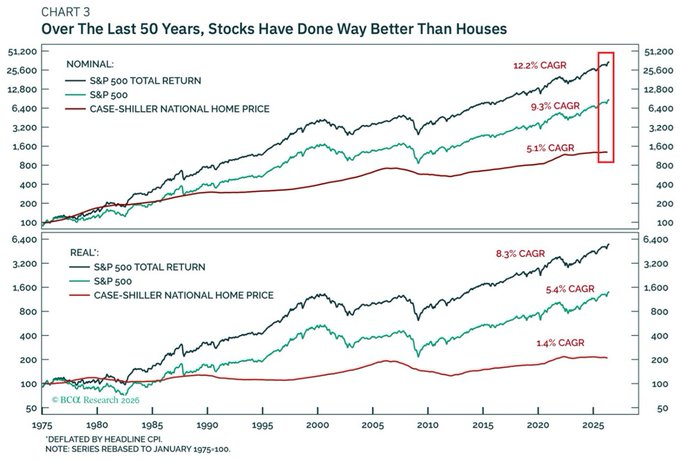
Stocks are significantly outperforming housing over the US over the long run:
Since 1975, the S&P 500 has delivered an average annual total return of +12.2%.
This is more than double the +5.1% annual gain in US home prices over the same period.
Even without reinvesting dividends, the S&P 500 has still returned an average of +9.3% per year, outperforming house price appreciation.
After adjusting for inflation, the gap is even wider, with the S&P 500's real total return at +8.3% over the last 50 years, nearly 6 times the +1.4% real annual return of US home prices.
At the same time, the S&P 500 excluding dividends and adjusted for inflation has returned +5.4% per year, on average.
Stocks have been a far more powerful driver of wealth creation than housing.
TRUMP HALTS PLANNED IRAN STRIKES
Trump reportedly ordered the U.S. military not to carry out planned strikes on Iran on Friday, despite having previously approved attack plans, according to Axios.
The decision came hours after Oman-mediated talks resumed over reopening the Strait of Hormuz, with reports suggesting negotiations have made progress.
IRANIAN OIL MINISTRY SAYS IT SOLD $11.5 BLN OF OIL DURING WAR AND $6.5 BLN DURING CEASEFIRE PERIOD
IRANIAN OIL MINISTRY SAYS IT HAS REALIZED MORE THAN 60% OF ANNUAL OIL REVENUE FORECAST IN BUDGET DESPITE WAR AND SANCTIONS
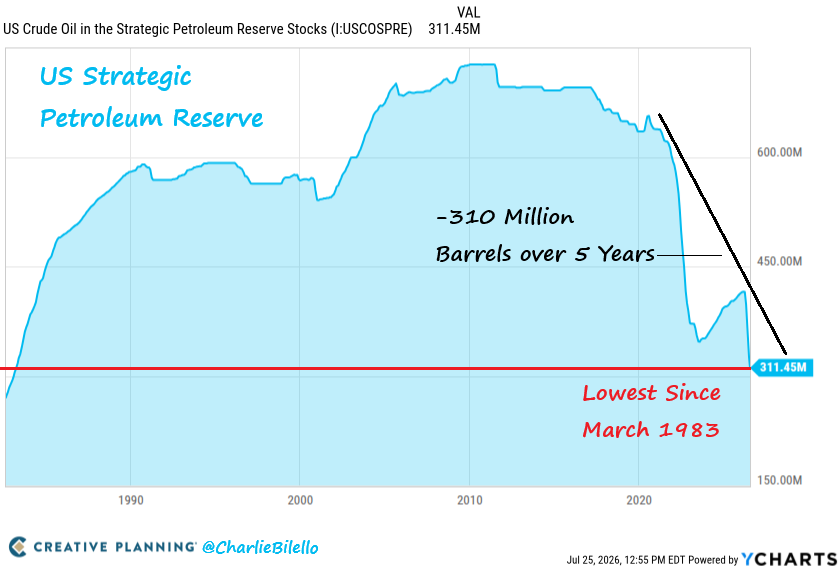
The US Strategic Petroleum Reserve is now at its lowest level since March 1983. Over the past 5 years we've seen a drawdown of 310 million barrels, a 50% decline.
Walmart $WMT forms a Death Cross ☠️ for the first time since June 2022 👀 The last one marked a bottom before the stock ripped higher by 165% over the next 2.5 years 📈 📈
Those who follow QQQ
Bulls look away.
Bears take a look.
Keep it simple.
Major breach of its symmetrical triangle top.
For one’s private perusal.
Enjoy.
She's beautiful.
🚨 AI Bubble vs. Dotcom: The Semiconductor Mirror Is Getting Uncomfortably Exact
History doesn’t repeat exactly but right now the semiconductor index is tracing the Dotcom bubble’s path with almost surgical precision. Same parabolic ascent. Same timeline. Same late-stage euphoria.
The only difference? The foundation underneath today’s version is far more fragile. Look at the chart overlay. The SOX (and its peers) has followed the late-1990s semiconductor/tech trajectory nearly candle for candle, including the multi-year duration of the advance. The projected path I’m showing isn’t a forecast carved in stone it’s simply history’s guidance applied to the present. And that guidance is flashing caution in bold red.
What makes this unwinding potentially more brutal is the cocktail of headwinds that simply didn’t exist (or existed in far milder form) during the Dotcom era:
-Oil rocketing higher amid escalating geopolitical conflict
-Bond market erosion accelerating, yields breaking multi-year patterns
-Sticky, 1970s-style inflation pressures re-emerging
And the deepest structural issue of all: years of central-bank recklessness that inflated multiple bubbles simultaneously from groceries and housing to regional banks and, of course, AI/tech.
In the late ’90s we had one primary excess: technology valuations. Today we have a system saturated with excess. The air is already leaking out slowly. God help us if that hole widens. A disorderly deflation across these interconnected bubbles is no longer a fringe scenario it’s a real possibility.
The semiconductor complex remains the clearest mirror of the previous cycle. Watch how it behaves relative to that historical path over the coming weeks. The time factor is aligning. The technical structure is aligning. The macro backdrop is worse.
Yours truly,
The Great Martis✨
Money supply is significantly outpacing economic growth across major economies:
Canada's M2 money supply has grown +368% since January 2004, the largest increase among G7 economies.
By comparison, the Canadian economy has expanded +159% over the same period.
The US follows, with M2 growth of +279% versus a +171% increase in nominal GDP.
Meanwhile, M2 in France has surged +258% and +211% in the Euro Area, both outpacing nominal GDP growth of +84% and +102%, respectively.
In Japan, M2 has grown +90% since 2004, while its economy expanded just +25%, the slowest pace among G7 economies.
The gap between money creation and economic growth is widening.
🚨 BREAKING
🇨🇳 CHINA HAS DUMPED $663 BILLION IN U.S. TREASURY HOLDINGS.
IT NOW HOLDS JUST $659 BILLION - THE LOWEST LEVEL SINCE 2008.
MEANWHILE, CHINA'S GOLD RESERVES HAVE PUMPED FOR 17 MONTHS IN A ROW, TO $303 BILLION - A NEW HIGH.
IT HAS ALREADY BOUGHT NEARLY TWICE AS MUCH GOLD THIS YEAR AS IT DID IN ALL OF 2025.
THEY’RE EXITING THE SYSTEM...
VIX📈📉
A diamond bottom has formed.
Most would say the VIX can’t be charted, yet the Great One keeps nailing its every move.
Brace for volatility..something ominous is brewing, and it ain’t my Aldi kettle that was bought on special last week.
Stay vigilant, remain disciplined, and above all, stay informed. ✍️
Yours truly,
The Great Martis✨
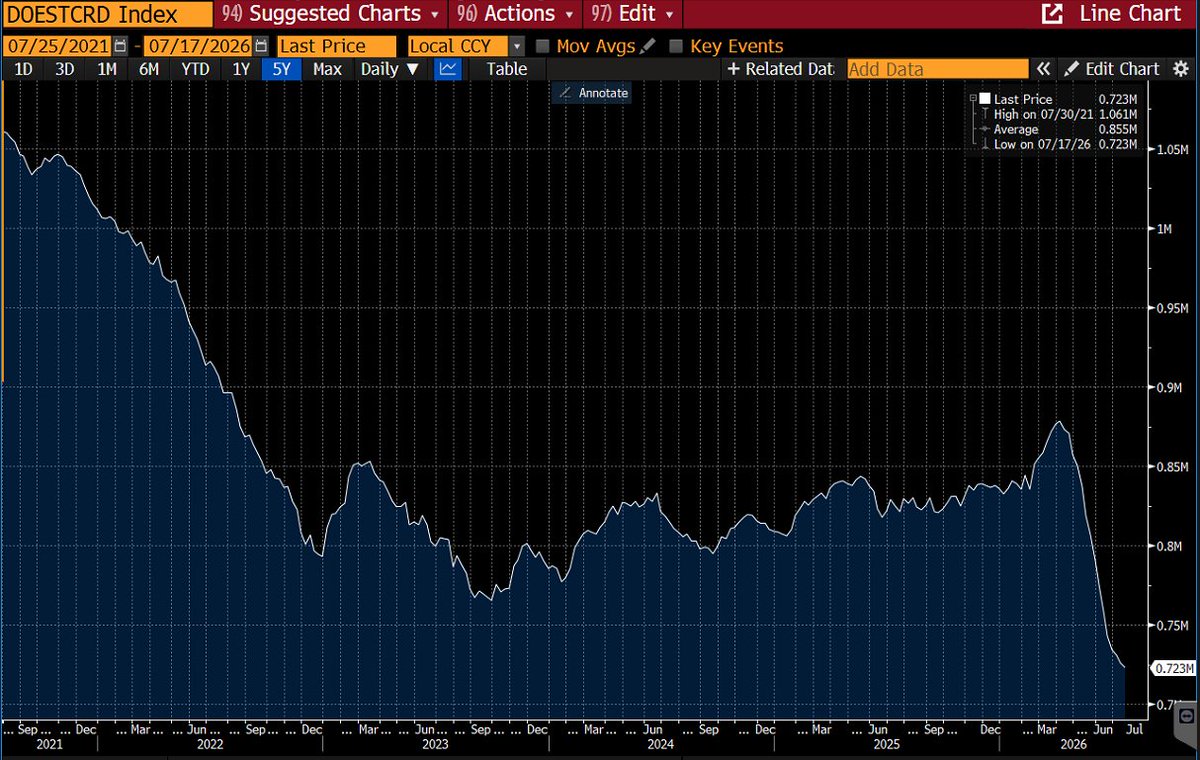
The chart shows total US oil inventories held by commercial companies and the US government. Last week, inventories fell by another 3 million barrels.
Remarkable, because quite a lot of oil left the Persian Gulf in June. And still, US inventories keep falling.
This Bloomberg reporting underlines how GCC states are evolving from massive suppliers of global capital, including heavy backing for tech, to also active borrowers to fund domestic strategic infrastructure.
(For a deeper look at this change, please see my FT column from last March: https://t.co/UefZGBDNo2 )
#economy #markets #capitalmarkets @FT
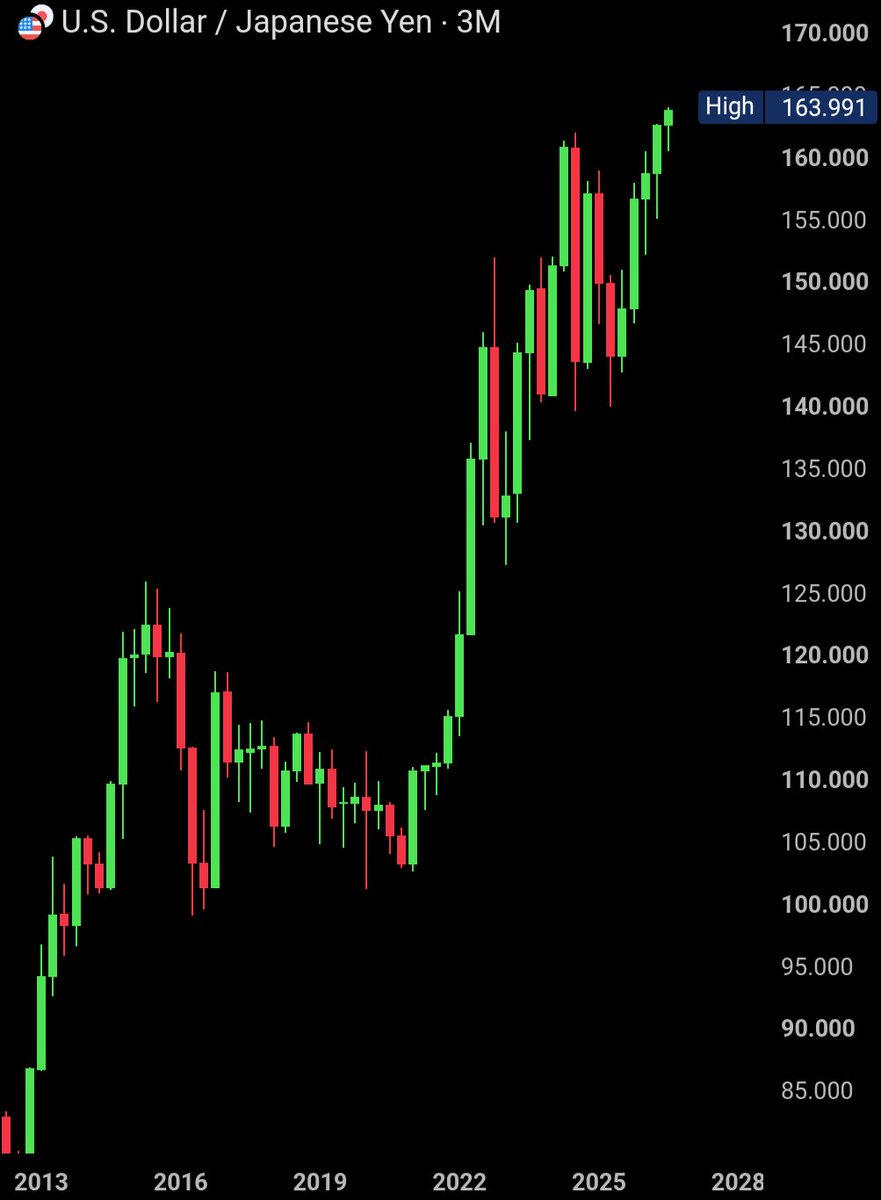
🚨 JAPAN MAY SOON BE FORCED INTO ANOTHER MASSIVE CURRENCY INTERVENTION.
USD/JPY hit 163.991 today, very close to 164, a level considered very critical for the Yen.
Earlier this year, Japan spent a record ¥11.7 trillion ($73 billion) defending the yen.
The intervention triggered a sharp drop in USD/JPY, but the relief lasted only a few days before the pair resumed its climb to fresh 40-year highs.
Japan still holds around $1.09 trillion in foreign currency reserves.
But if history repeats itself, the next intervention may need to be much larger than the last to have any lasting impact.