@Coventry_City Football Club is officially promoted to the Premier League. 🏆
And just like that… a FinTech sponsorship changed overnight.
Their main shirt sponsor?
👉 @monzo
This is why I keep saying sports sponsorship in FinTech is massively underestimated:
• Championship deal: ~£500K
• Premier League exposure: up to £8M+
• Promotion value: up to £200M
Nothing changed in the deal itself. But everything changed in what it’s worth.
This is the part most people miss:
These sponsorships are not static assets.
They are leveraged bets on:
• Performance
• Visibility
• Timing
And when it hits… The upside is enormous.
Now add what’s coming next:
From the 2026/27 season, gambling sponsors disappear from the front of shirts.
Clubs will need new categories to fill that gap.
And FinTech is one of the few that can:
→ Afford it
→ Activate it
→ Scale it globally
So what you’re looking at here is not just a promotion story.
It’s a preview of what’s coming:
👉 More FinTech logos on shirts
👉 Bigger deals
👉 Smarter partnerships (beyond just branding)
I’m spending more and more time in this space, connecting FinTechs with sports properties.
Because opportunities like this are starting to show up everywhere.
And when they work…
They really work.
Congrats to Monzo and Coventry City, this is what a high-upside sponsorship looks like when everything comes together!
Europe’s top 10 FinTechs are worth over $200 BILLION 🤯
And most of that comes from one country..
From the top:
• 🇬🇧 @Revolut — $75B
• 🇳🇱 @Adyen — $36B
• 🇬🇧 @Worldpay_Global — $24B
• 🇬🇧 @SumUp — $15B
• 🇩🇪 @traderepublic — $15B
• 🇬🇧 @Checkout — $12B
• 🇬🇧 Admiral Group Plc — $12B
• 🇬🇧 @Wise — $12B
• 🇬🇧 @FinastraFS — $10B
• 🇬🇧 ION — $9B
A highly concentrated landscape, with a few standout players across Europe.
📷 Source: https://t.co/NrPJKolnVG
Which of these do you think will break away even further from the pack?
And, what is going to be the next European FinTech to break into this top 10?
Revolut is launching AIR (AI by Revolut) in the UK.
"AIR is a sophisticated financial assistant deeply embedded into the Revolut ecosystem. It’s designed to turn complex financial management into a simple, natural conversation. "
Money intelligence can:
• Instant clarity: "How much did I spend on subscriptions last month?"
• Real-time interventions: "Freeze my physical card and order a new one."
• Lifestyle companion: "I’m in Tokyo next week. Set up my eSIM and check my insurance."
Revolut says that personal data will not be stored by third parties.
"AIR is a native part of the Revolut interface, accessible with a single gesture. Just swipe down from your Revolut home screen to meet AIR."
Other countries launching soon.
#RevolutAIR
Is your company currently hiring for a role that includes using Rust?
Reply with a link to the opening and any relevant context.
If you're not, we'd appreciate a repost for visibility
#rust#rustlang#programming
Europe’s 🇪🇺 ten largest Tech companies include four (‼️) from The Netherlands 🇳🇱, even though the country represents just 4% of Europe’s total population 🤯
📷 Source: https://t.co/IaahNs6Atl
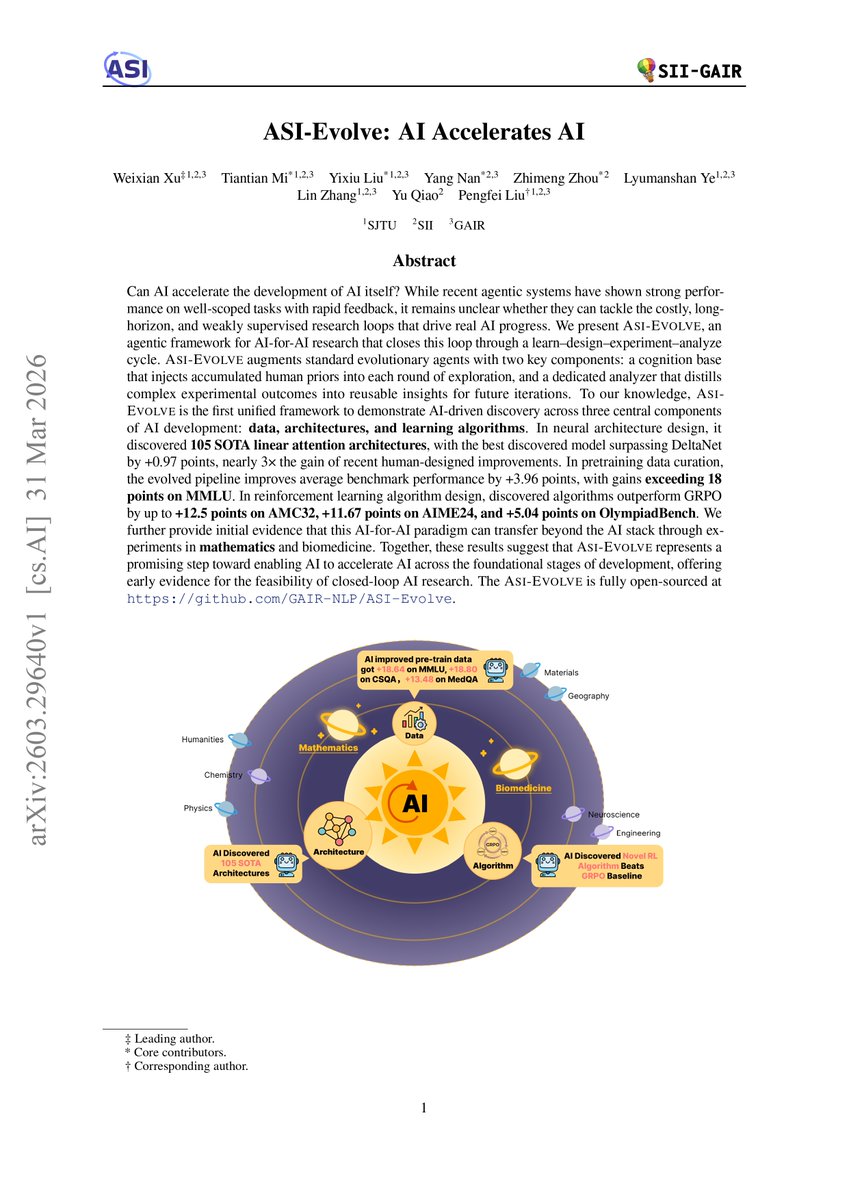
🚨BREAKING: Researchers built an AI that designs better AI than humans can.
It discovered 105 new architectures that beat human-designed models. Nobody guided it. It taught itself.
The paper is called "ASI-Evolve: AI Accelerates AI." Published this week by researchers at Shanghai Jiao Tong University. Fully open-sourced. And what it demonstrates should stop every AI researcher cold.
They built a system that runs the entire AI research loop on its own. It reads scientific papers. It forms hypotheses. It designs experiments. It runs them. It analyzes the results. Then it uses what it learned to design better experiments. Over and over. Without human intervention.
They pointed it at neural architecture design first. Over 1,773 rounds of autonomous exploration, the system generated 1,350 candidate architectures. 105 of them beat the best human-designed model. The top architecture surpassed DeltaNet by +0.97 points. That is nearly 3 times the gain of the most recent human-designed state-of-the-art improvement.
Humans spent years to get +0.34 points. The AI got +0.97 on its own.
Then they pointed it at training data. The AI designed its own data curation strategies and improved average benchmark performance by +3.96 points. On MMLU, the most widely used knowledge benchmark, the improvement exceeded 18 points.
Then they pointed it at learning algorithms. The AI invented novel reinforcement learning algorithms that outperformed the leading human-designed method GRPO by up to +12.5 points on competition math.
Three pillars of AI development. Data. Architecture. Algorithms. The AI improved all three by itself.
Then they tested whether what the AI built actually works in the real world. They applied an AI-discovered architecture to drug-target interaction prediction. It achieved a +6.94 point improvement in scenarios involving completely unseen drugs. The AI designed something that works better than human experts in biomedicine.
This is the first system to demonstrate AI-driven discovery across all three foundational components of AI development in a single framework.
The recursive loop is now closed. AI is building AI. And it is already better at it than we are.
Private FinTech is trading at a completely different reality than public market 🤯
FinTech has two markets right now:
1. Private: priced for perfection.
2. Public: priced for survival.
Ramp at 32x vs PayPal at 1x tells you everything..
📷 Source: Forbes
I had dinner once with a top physicist and a top computer scientist and asked what they thought the probability was that we were in a simulation.
They answered simultaneously at 0% and 100% respectively. It was like a double-slit experiment, but with humans.
Your company is probably leaking margin.
Not because growth is slowing.
Not because marketing isn’t working.
But because your finance stack is quietly broken.
Here’s the reality 👇
⸻
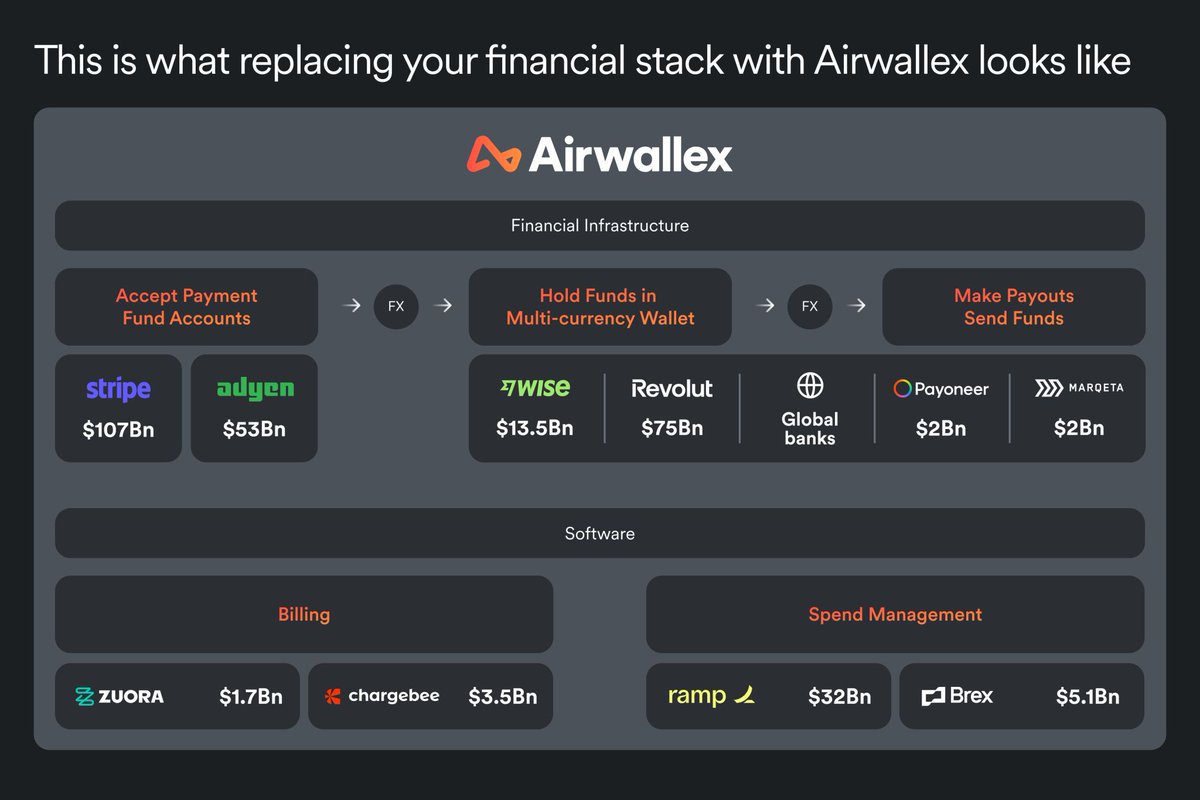
How most “global” companies actually operate:
• Stripe or Adyen for payments
• Wise or Revolut for FX
• Ramp for cards
• Separate billing tools
• And a spreadsheet holding it all together
It feels modern.
But it’s inefficient.
And expensive.
⸻
💸 The hidden FX tax
This one hurts more than people realize:
You sell in USD
It gets auto-converted to EUR
You pay USD costs
You convert back again
Same money.
Two conversions.
You didn’t design this flow — your stack did.
And it quietly eats your margins over time.
⸻
🧾 Checkout is where revenue disappears
Up to 15% of revenue is lost at checkout.
Not because users don’t want to buy.
But because something breaks:
• False declines
• Missing local payment methods
• BNPL not available cross-border
• A checkout that feels “foreign”
Every failure = lost revenue.
⸻
🌍 Scaling globally = operational headache
Expanding with most PSPs still means:
• Setting up local entities
• Opening bank accounts
• Waiting months
• Adding complexity
So growth slows… even when demand is there.
⸻
What players like @airwallex are trying to fix:
• Hold funds in the original currency
• Convert only when you decide
• Multi-currency wallets by default
• Local rails instead of SWIFT
• AI to simplify operations
⸻
The outcome isn’t hype.
It’s simply:
• Fewer tools
• Less FX leakage
• Higher conversion
• Better global scalability
⸻
If you operate locally, this is a nuisance.
If you scale globally, it’s a real profit problem.
⸻
The real question:
Why are we still accepting this level of friction?
Curious — where is your biggest margin leak today? 👇