This week, I learned about the Bradford Hill criteria, nine principles that Austin Bradford Hill proposed in 1965 to evaluate epidemiological evidence of a causal relationship between an exposure and an outcome.
I imagine that many economists are familiar with them, but I was not, so I thought sharing them here might be useful. The idea is to have a few principles to evaluate empirical evidence when we lack a sharply identified research design whose results are easy to generalize (that is, nearly always). This is particularly true in my own subfield, macroeconomics, and what I believe are the fundamental questions in economics (e.g., what makes a miracle like South Korea’s economic growth possible).
I reproduce them here, slightly adapted to economics:
1) Strength: large associations are more likely to be causal than small ones, because a confounding factor would need an even larger effect to explain them away.
2) Consistency: the same finding across different samples, countries, periods, and research designs is more likely to be causal.
3) Specificity: causation is more likely if the cause moves the outcome that theory predicts and leaves unrelated outcomes alone (the logic of placebo tests).
4) Temporality: the cause predates the outcome. In economics, date the cause when agents learn about it: with forward-looking agents, prices and decisions move when a policy is announced, not when it takes effect.
5) Treatment gradient: a stronger treatment (a higher tariff, a larger transfer, a longer exposure) leads to a larger effect.
6) Plausibility: a mechanism between cause and effect based on standard economic theory makes causality more likely.
7) Coherence: the causal claim does not conflict with other known facts (for instance, a micro estimate that, once aggregated, implies large movements in macro data that we do not observe).
8) Experiment: evidence from experiments (RCTs, lab experiments, or natural experiments) increases the likelihood of a causal relationship.
9) Analogy: if a similar cause has a known effect in another environment (another tax, another market), a causal relationship here is more likely.
Now, before you leave a comment: yes, I can think of counterexamples for each of the nine. So could Hill, who called them “viewpoints” and wrote that none of them is a sine qua non. But, taken together, Hill’s criteria seem a reasonable rubric to score many empirical papers and their claims. In fact, without being fully aware of it, I was probably already using a similar rubric as an editor and referee.
Was I exceptionally ignorant not to know Hill’s criteria? Do other researchers employ analogous criteria? I’d love to hear your thoughts.
Paper: Hill, A. B. (1965), “The Environment and Disease: Association or Causation?” Proceedings of the Royal Society of Medicine, 58(5), 295–300.
A few hours ago, INEGI, the Mexican National Institute of Statistics and Geography, a government agency, published its Encuesta Intercensal (EIC) 2025 (intercensal survey 2025).
Here is the press release:
https://t.co/o08abDMiUW
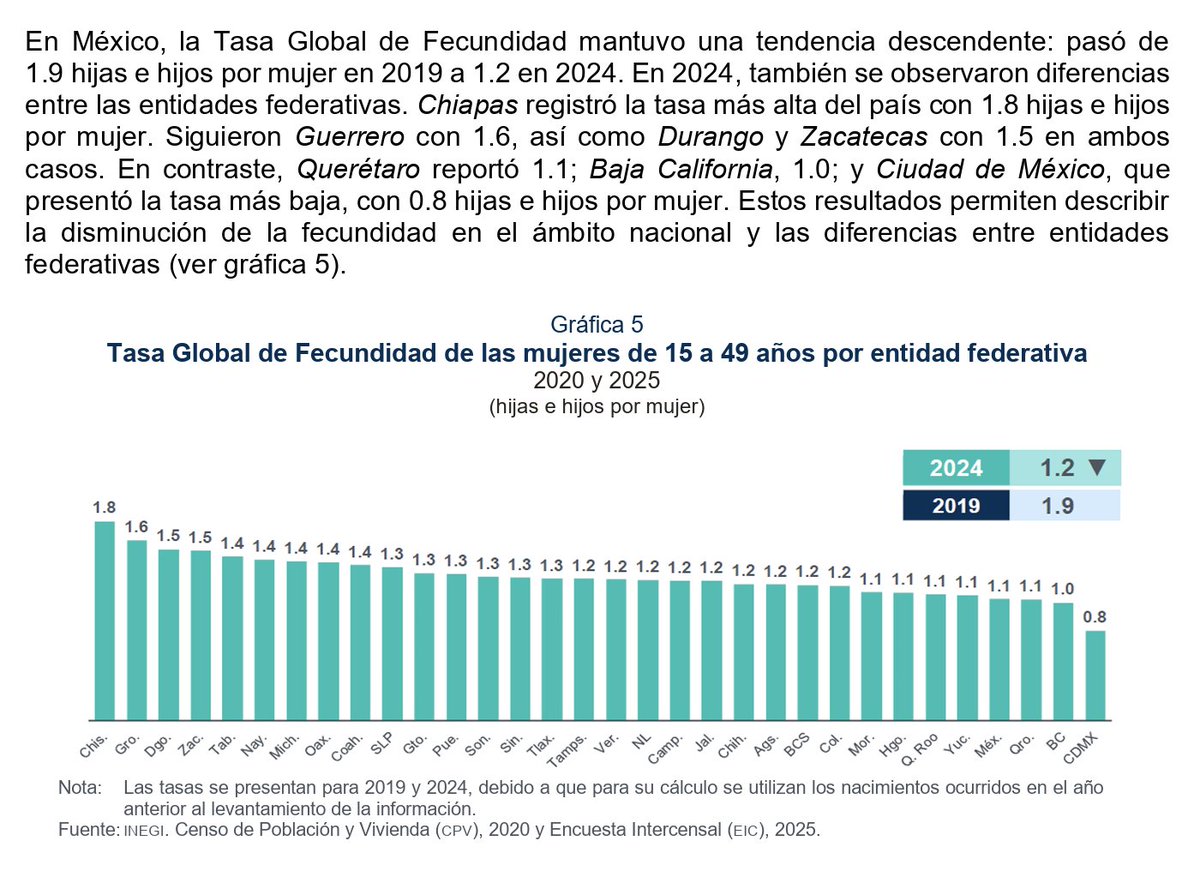
Page 9 reports the total fertility rate (TFR). INEGI estimates Mexico’s TFR for 2024 at 1.2 (screenshot in Spanish below). Yes, 1.2, only slightly above Japan’s level in the same year (1.15). By 2026, Mexico’s TFR could fall below Japan’s.
I don’t find words to describe this.
La tasa de informalidad laboral en México llevaba años bajando. Pero desde mediados de 2024 cambió la tendencia y se estabilizó cerca de 55%. ¿Qué está pasando? Un hilo con lo que encontramos siguiendo a las mismas personas trimestre a trimestre 🧵
Les comparto esta película en formato 16mm, carrete de 120mt, y con duración aproximada de 14 minutos, filmada en el año de 1955 que muestra un recorrido histórico por el paseo central más importante de la Ciudad de México: la Alameda Central.
Este documental dirigido por Adolfo Fernández Bustamante, habla de las transformaciones que ha sufrido, así como lo que ha significado para México y sus habitantes este sitio que ha ido de la mano de la evolución y crecimiento de la capital mexicana.
De hecho "La Venus de la Alameda Central", generó disgusto a varios sectores de la sociedad porfiriana que en aquel tiempo acudieron a los periódicos para solicitar su retiro por considerarla obscena y de mal gusto. Son algunas de las películas recuperadas de aquel devastador incendio del año 1982 en la Cineteca Nacional.
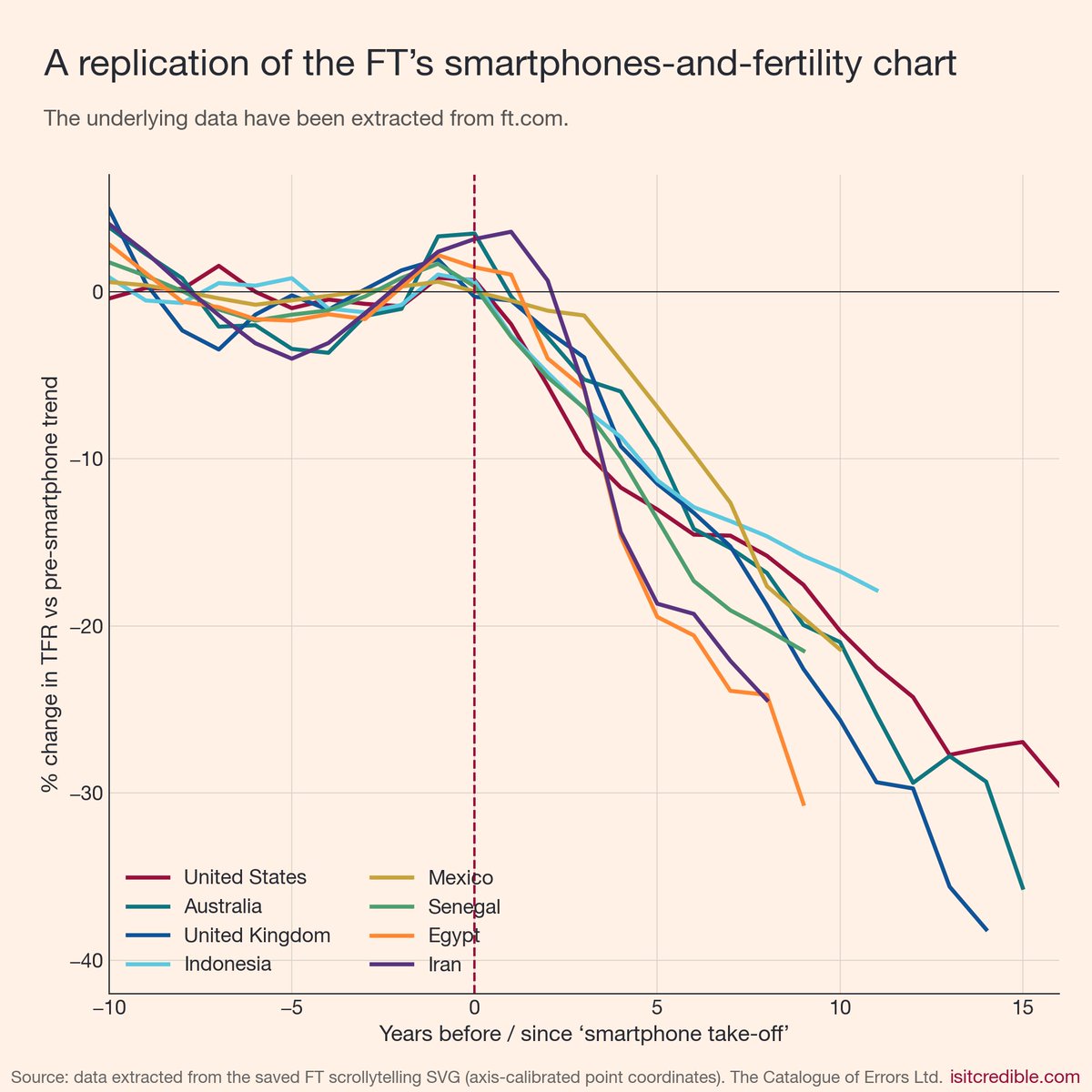
By extracting the data from the @FT's smartphones-and-fertility chart, I was able to replicate it and reverse engineer how @jburnmurdoch may have calculated it.
Seatbelts on. 1/7