An interesting contrast.
In response to a tweet (in english) on the California tax on super rich, a tsunami of responses, nearly all on the same theme: Do not take money from the super rich: they put it to better use than the state.
In response to an article in Le Monde (in French) on the need to reduce the budget deficit, a large number of comments, nearly all on the theme: Take the money from the super rich. They don't deserve it.
Fascinating difference.
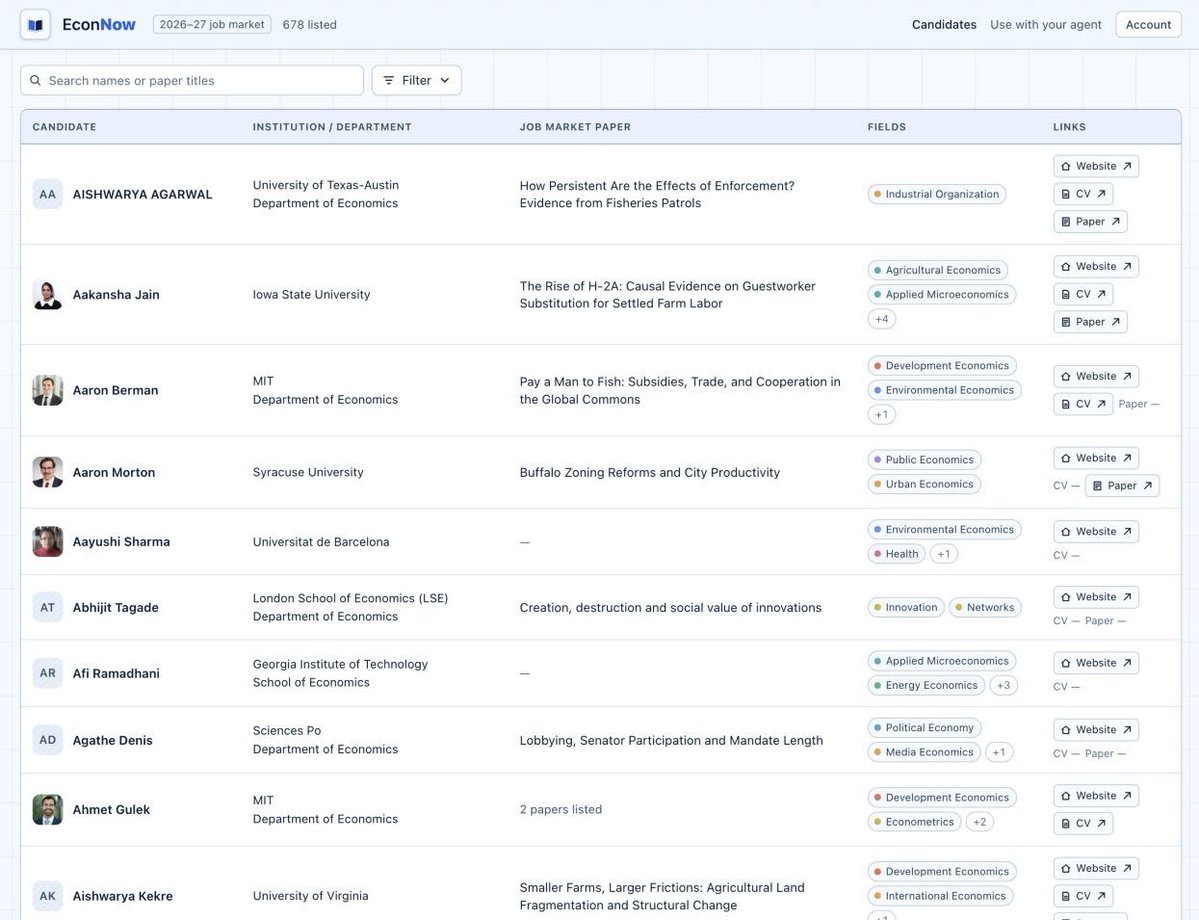
Econ PhD job market candidate database is live for 2026-2027
- 678 candidates from 86 institutions so far
- this year aiming to add all Bschool Econ adjacent PhDs
- filter by field/institution and JMP title/abstract
- JMCs can update their own records
- connect Codex/Claude Code to the database as you please
Dm/comment as new schools post their JMCs and I’ll add them, or if you have issues
https://t.co/lqWNerE1b3
I’m very opinionated. So it’s nearly impossible for me to hear someone’s arguments and *not* find something I disagree with. (This includes reading things I myself wrote years - or weeks - ago.) And yet the amazing Grant Sanderson @3blue1brown has put out a long, detailed video on the future of mathematics, in which I cannot find a single flaw. I’ll be sending this to every PhD student and postdoc I know, and strongly recommend everyone watch it.
https://t.co/m7tRGyGzip
(Of course I tried to say many of the same things in my conversation with Thomas Koberda. But Grant’s version, unsurprisingly, does an infinitely better job at communicating those ideas!)
Formalized textbooks:
Dynamic Programming: Sargent & Stachurski (Vol 1 & 2); Stokey, Lucas & Prescott
Monetary: Gali (NK); Woodford (interest & prices); Cochrane (fiscal theory).
International: Obstfeld & Rogoff
500+ corrections (mostly tiny or typo)
https://t.co/8CMrnPFO3C
The fatal challenge to heterodox economics is that there isn't actually orthodox economics.
Just take a few recent Nobels: behavioral, information failure, institutions, bubbles, financial fragility, labor monopsony (sort of), Schumpeterian creative destruction, etc.
Not to mention RCTs which are emblematic of how much economic research is empirical and only lightly if at all structural.
The real difference is methods. Heterodox economics is an avowedly political project not a social scientific effort to better understand the world. And I have nothing against political projects just shouldn't confuse the two.
Some reflections on AI in math. I found it helpful to simply list out the various parts of what a mathematician does, why math is valuable, and where the funding comes from. From there, what happens if AI gets more capable?
https://t.co/H5T1WdIBzw
Big announcement to the Labor Econ Community: We have created the "Labor Hub" - a platform to exchange relevant info (events, jobs, visits, SI, papers...) - Apply to become a member! Job market candidates especially encouraged to apply! Link: https://t.co/MPalJTiupY Please share!
A wonderful reminder of the lasting impact of academic mentorship. Congratulations to @TimTkehoe on his role in shaping the academic journey of Michael Woodford, the 2026 Nobel laureate in Economics, as his primary thesis advisor at MIT (1983).
BREAKING NEWS
The Royal Swedish Academy of Sciences has decided to award the 2026 Sveriges Riksbank Prize in Economic Sciences in Memory of Alfred Nobel to Robert E. Hall and Michael Woodford “for microeconomic foundations of macroeconomic stabilisation.”
#NobelPrize
Deep learning can make high-dimensional dynamic equilibrium models tractable by learning useful state-space representations. The paper explains the methods and illustrates them in a standard growth model.
https://t.co/iJ9F5jKqMd
Yes, Prime Minister at its best. The subject is a smoking ban using high taxes and an advertising ban. But the govt is addicted to tobacco taxes and with a packet of 20 being £20, we have a thriving black market.
KPMG estimates that illicit or counterfeit products are over 50% of the UK market, driven by a steep 52% drop in legal sales between 2021 and 2025.
https://t.co/gUxyBUy8jR Attention Macro researchers. Tomorrow (July 10) is the last day to register for the annual MN Workshop in Macroeconomics Theory at UMN. Hope to see you there! @afogli001
Great paper discussed by Cheryl below on the role of technology in science. Finds that, in the case of computer technology:
-- Diffusion of gains from tech was much faster in science compared to in the general economy (i.e., productivity, growth numbers).
-- Computers allowed for new research paths for scientists, paths that were previously bottlenecked by computational limits rather than ideas.
In the case of AI, I think the first point will hold: we will see the benefits of AI faster in science than in the broader economy. This is already the case, e.g., AlphaFold.
But I think we'll see something quite different in the second case. Computers were a general purpose tech, but intelligence was still fairly domain specific. AI is a general purpose *intelligence*. This allows scientists to access ideas and methods in domains potentially quite distant from their own. Research questions they might be interested in but didn't have the full understanding to pursue, or weren't trained in the methods, are now wide open.
My own prediction is that we will see ambitious scientists tackle a much broader set of questions, broader collaboration across groups. The sort of specialization that has emerged as fields matured will start flattening again; we'll see much more generalists.
Thrilled to have @BasilHalperin join the podcast. Three big points discussed: (1) AI could supercharge growth, but bond markets aren’t buying the hype as evidence by real interest rates; (2) inflation targeting not an optimal response to AI supercharged growth... (1/2)
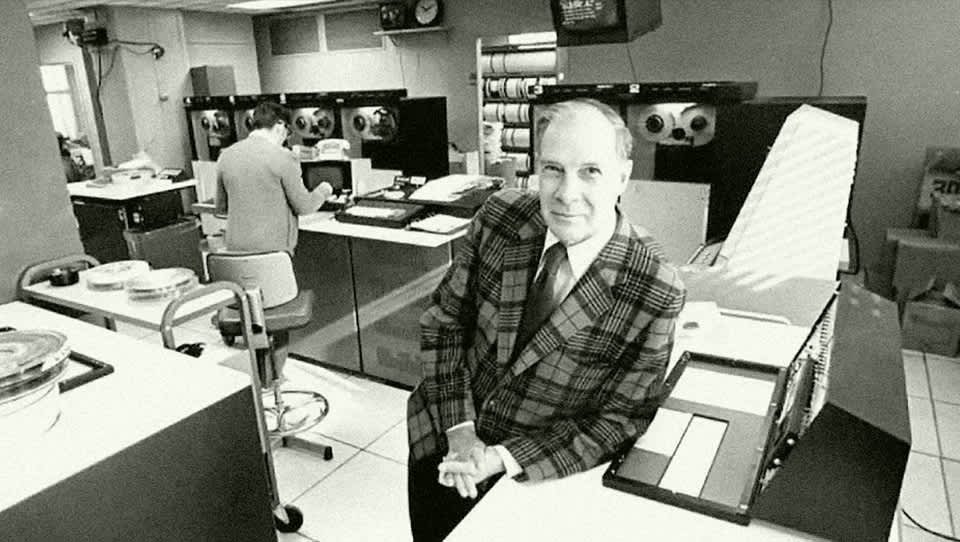
A mathematician who shared an office with Claude Shannon at Bell Labs gave one lecture in 1986 that explains why some people win Nobel Prizes and other equally smart people spend their whole lives doing forgettable work.
His name was Richard Hamming. He won the Turing Award. He invented error-correcting codes that made modern computing possible. And he spent 30 years at Bell Labs sitting in a cafeteria at lunch watching which scientists became legendary and which ones faded into nothing.
In March 1986, he walked into a Bellcore auditorium in front of 200 researchers and told them exactly what he had seen.
Here's the framework that has been quoted by every serious scientist for the last 40 years.
His opening line landed like a punch. He said most scientists he worked with at Bell Labs were just as smart as the Nobel Prize winners. Just as hardworking. Just as credentialed. And yet at the end of a 40-year career, one group had changed entire fields and the other group was forgotten by the time they retired.
He wanted to know what the difference actually was. And he said it wasn't luck. It wasn't IQ. It was a specific set of habits that almost nobody is willing to follow.
The first habit was the one that hurts the most to hear. He said most scientists deliberately avoid the most important problem in their field because the odds of failure are too high. They pick a safe adjacent problem, solve it cleanly, publish it, and move on. And because they never swing at the hard problem, they never hit it. He said if you do not work on an important problem, it is unlikely you will do important work. That is not a motivational line. That is a logical one.
The second habit was about doors. Literal doors. He noticed that the scientists at Bell Labs who kept their office doors closed got more done in the short term because they had no interruptions. But the scientists who kept their doors open got more done over a career. The open-door scientists were interrupted constantly. They also absorbed every new idea passing through the hallway. Ten years in, they were working on problems the closed-door scientists did not even know existed.
The third habit was inversion. When Bell Labs refused to give him the team of programmers he wanted, Hamming sat with the rejection for weeks. Then he flipped the question. Instead of asking for programmers to write the programs, he asked why machines could not write the programs themselves. That single inversion pushed him into the frontier of computer science. He said the pattern repeats everywhere. What looks like a defect, if you flip it correctly, becomes the exact thing that pushes you ahead of everyone else.
The fourth habit was the one that hit me the hardest. He said knowledge and productivity compound like interest. Someone who works 10 percent harder than you does not produce 10 percent more over a career. They produce twice as much. The gap doesn't add. It multiplies. And it compounds silently for years before anyone notices.
He finished the lecture with a line I have never been able to shake.
He said Pasteur's famous quote is right. Luck favors the prepared mind. But he meant it literally. You don't hope for luck. You engineer the conditions where luck can land on you. Open doors. Important problems. Inverted questions. Compounded hours. Those are not traits. Those are choices you make every single day.
The transcript has been sitting on the University of Virginia's computer science website for almost 30 years. The video is free on YouTube. Stripe Press reprinted the full lectures as a book in 2020 and Bret Victor wrote the foreword.
Hamming died in 1998. He gave his final lecture a few weeks before. He was 82.
The lecture that explains why some careers become legendary and others disappear is still free. Most people who could benefit from it will never open it.
According to University of Minnesota economist Ellen McGrattan, many US fims have assets that don’t show up on any balance sheet. She has spent her career trying to measure these intangible investments. Find out more in her interview with #EconFocus: https://t.co/alAi1jGdQ1.