NEW PAPER:
Can AI make firms more productive but leave us poorer? In a new @cepr_org paper, @SedlacekPe and I study how AI changes the incentives to develop new products, and why those incentives matter for long-run living standards.
I posted the materials for my second-year PhD course, broadly on "Identification in Macroeconomics" -- basically a back-and-forth between structural models and data, both time-series and cross-sectional, with a focus on business-cycle questions.
@FlorianOswald To be clear. Authors could use this script on their machine to get to the needed info. Also if a rep package is non python but has a master script, it’s easy to write a python code that executes exactly that master script
@FlorianOswald Wouldn’t it be possible that you (and other editors) write a python script that takes as input the master py script from a rep package, runs it and your script measures the things you need and compiles a report? Seems a more efficient solution than yet another manual for rep pack
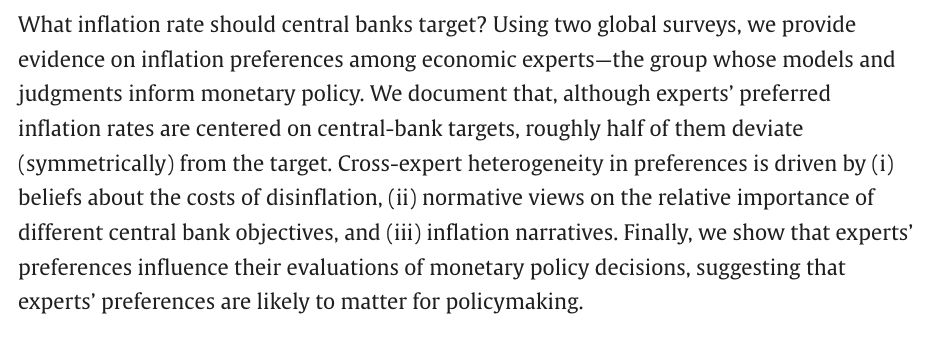
New at JIE: "Expert inflation preferences and the evaluation of monetary policy" by Timo Wochner (@TimoWochner), Lukas Hack (@LukasHack_) and Niklas Potrafke (@ifo_Institut)
https://t.co/ShhvJXC3Kk
We are hiring! The University of St Gallen invites applications for a tenure-track Assistant Professor position in macroeconomics (https://t.co/5ibnl3r1gC). Candidates working on applied topics and with a few years of post-doc experience are particularly encouraged to apply. 1/2
Facts to confront.
I’ll reiterate my view that it would be great if we had a norm of announcing and committing to human writing, for those who want to choose that. Readers would benefit and the return to writing would rise. I called it Dogma-26 and it would be a first footnote.
Update to this thread from the NBER SI: our paper is now out as CEPR DP21913. And it has grown: the paper now combines a method, a measurement, and a “new” model of household debt. https://t.co/FdcRoqr8Sf
🚨 I just started a new job as assistant professor at @uni_tue joining a great macro group with Gernot Müller and @RalphLuet.
I am very grateful to everyone who made this possible!
Watch out for many great macro papers coming from the southwest of Germany in the future!
What’s the optimal inflation rate? We know surprisingly little. Structural models provide a relatively wide range of estimates, with various channels playing a role.
We asked econ. experts, who may be able to aggregate various channels and model predictions into a final number
Accepted at @JIntlEcon!
What’s the optimal inflation rate? We know surprisingly little. Structural models provide a relatively wide range of estimates.
In our new paper (w/ @LukasHack_ & N. Potrafke), we ask economic experts globally what inflation rate they consider optimal. 🧵
Today @nberpubs there is great stuff on the solution of HANK models by @GregWKaplan@JavierBianchi7 and @a_auclert@ludwigstraub Rognlie Rigato in the session of @ChristianKWolf@JesusFerna7026@luigi_bocola.
This is exactly one of the questions of my ERC project: how far can we push perturbation HANK?
So let me share some thoughts and a simple new method that is as fast as a linear solution, but almost as accurate as the fully nonlinear transition.
Paper: https://t.co/f1tty3kEc6
Code:
https://t.co/w2ajgKqkzU
🚨 PhD position in Public Finance 🚨
I'm looking for a PhD student to work with me at @KOFETH_en/@ETH on international taxation: profit shifting, labor market effects of tax competition, and the political economy of international tax rules.
Deadline: 30 Sep 2026 ⬇️
Slides for a new paper are now on my site (and below).
"Shockingly simple monetary shocks".
Joint work with Mu-Chun Wang.
Abstract: We identify monetary policy shocks by imposing that they produce a positive, monotonically declining path for nominal rates. We impose no restrictions on other variables, nor do we rely on external information. Nonetheless, this produces IRFs closely resembling those produced using high frequency instruments, with no price puzzle. We justify these restrictions by showing both that they are satisfied in a benchmark medium-scale DSGE model, and by showing that they are satisfied under optimal policy in simple models. Our shocks produce a large, immediate drop in the price level. Thus, the rapid response of prices to monetary shocks observed in recent studies is not an artefact of high frequency identification.
@t_holden Agree that this is a consistent finding in the literature (also in my own work). But it’s surprisingly fast. I am genuinely wondering on your take: what’s the most plausible channel for this fast transmission to actual pricing decisions?
It was a pleasure to present my paper „Loanly Governments“ (with Lukas Diebold) at the @nberpubs ISOM
Next stop SED in Athens, where I will present new work with @isaacbaley , Lora Pavlova, @almostcertainly and @javier_turen on frictional forecasts: July 2, 15:00-16:30, Alpha 32
Now that I have your attention : )
Gernot Müller and I are looking for a Ph.D. student to work on
"Heterogeneous Expectations in HANK Models: Empirical Evidence, New Solution Methods, and Macroeconomic Implications.” For details check the Link.
Deadline is July 31, 2026.
https://t.co/DEef1MPYqc