MMTLP Trending again on X News
Biden’s SEC and FINRA made a huge mistake by breaking their own rules
Lara Logan’s full interview with Next Bridge Hydrocarbons CEO Greg McCabe airs this Friday 👊🏼🇺🇸
WE CAUGHT THE GOVERNMENT🚨
FOIAS SHOW THE SEC COLLUDING WITH WALL STREET TO PROTECT BROKERS NOT RETAIL INVESTORS
In 1 day, Ann Vandersteel will join $MMTLP investors at a press conference at the SEC, calling for accountability and transparency
Get this! @FINRA says that "While AI can strengthen supervision and compliance, human accountability remains essential." (it's the quote post below)
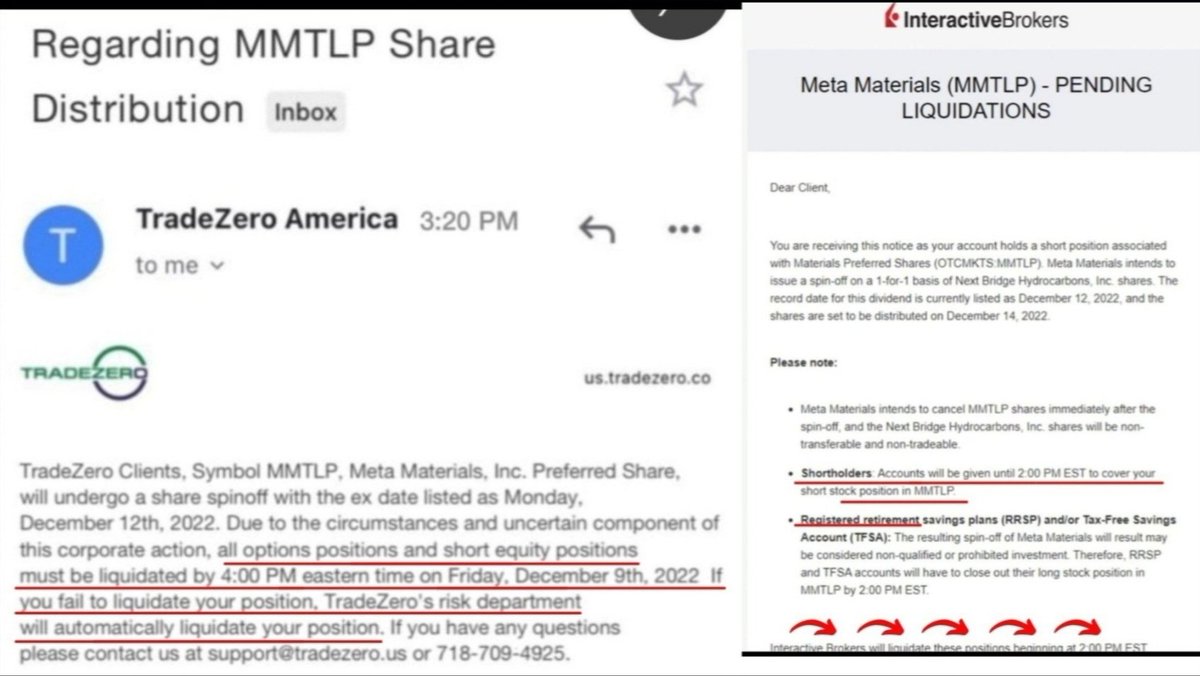
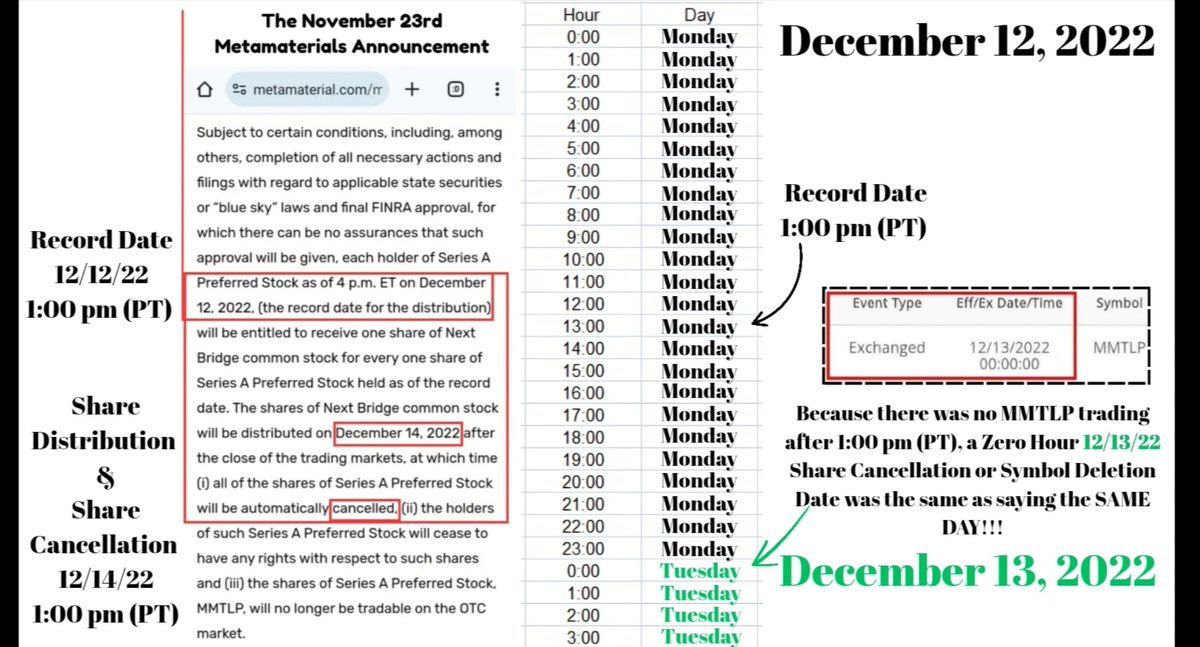
Meanwhile, FINRA hijacked the MMTLP Corporate Action, shrinking the settlement window by 40 hours, while also ignoring the fact that brokerages communicated to investors that only Position Close/Closing Transactions Only trading would occur after 12/8/22, because the one of the only things consistent in both MMTLP Corporate Actions was the message that Purchases after 12/8/22 wouldn't be entitled to the Next Bridge Hydrocarbons distribution. (images 1 & 2)
But directly before the 12/9/22 trading day when Forced Liquidations and PCO trading was set to begin, FINRA all of sudden decided to retroactively perform their Rule 6490 review a third time, miraculously discovering an issue relating to settlement and clearance AFTER two failed opportunities. (image 3)
Then, if that wasn't sketchy enough, instead of just working with the issuer to adjust the dates, the halt notice said the halt would end concurrently with FINRA deleting the trading symbol in 4 days (effective 12/13/22). December 13 was very special to FINRA. It was the main focus of both MMTLP Corporate Actions and it was the main focus of the halt notice. So much so that even after they allegedly added clarity in the revised 12/8 Corporate Action, brokerages were still calling 12/13 the MMTLP share cancellation date.
(image 4)
So all the short positions that obviously hadn't been reconciled, FINRA just allowed them to transfer to a security that wouldn't be tradeable, creating an issue relating to settlement and clearance that has lasted nearly 4 years.
This is the exact opposite of accountability!
This is why FINRA stopped posting on X for months after the MMTLP U3 halt, and this is why they currently don't allow comments.
Please prove me wrong! @SECPaulSAtkins@HesterPeirce
Love the analogy! I’ve used a similar analogy (see below) in the past to explain the hole in FINRA’s justification for the U3 halt.
Imagine an airline submits a flight plan to the airport. One of the airport’s rules says:
If the flight plan creates significant uncertainty about whether passengers and baggage can reach their destination properly, the airport can reject it as deficient.
The airport reviews the plan. It knows the flight’s schedule, destination, baggage-transfer arrangements, and when the connecting system shuts down. It processes the plan and posts it publicly—not once, but twice, including an updated notice explaining what happens to passengers who arrive after a particular cutoff.
Then, the morning the flight is supposed to depart, the airport suddenly grounds it, saying:
“We’re stopping this flight because there’s significant uncertainty about whether the passengers and baggage can be properly transferred.”
The natural question isn’t necessarily “Why did you ground the flight?” Maybe grounding it was appropriate.
The more important question is:
“If the transfer problem was already built into the flight plan you reviewed, why wasn’t the plan considered deficient when you processed it? What changed between processing the plan and grounding the flight?”
That’s the MMTLP issue in simple terms.
Rule 6490 = the flight-plan review.
The Daily List notices = the airport publishing the scheduled flight.
Settlement and clearance = getting the passengers and baggage where they’re supposed to go.
The U3 halt = grounding the flight at the last minute.
The central question becomes very easy to understand:
If the reason for grounding the flight was already apparent when you reviewed the flight plan, why did you process the flight plan in the first place?
🚨FAMOUS SHORT AND DISTORT HEDGIE IN THE NEWS
Anson Funds’ own investors deserve answers.
A new investigation says Anson’s master fund booked $18.2 million in “Research” expenses from 2020 through 2022. The SEC separately found that Anson failed to tell investors it shared trading profits with short publishers and recorded some payments as research for services the invoiced intermediary had not performed.
How much of that $18.2 million went to publishers? What did investors’ statements show? And will the fund provide a full accounting?
Lastly, was Viceroy one of the publishers? Or the ONLY publisher helping facilitate short and distort?
Those are questions Anson’s unitholders should be asking now. Read the investigation in comments below
I know #MMTLP would like to know.
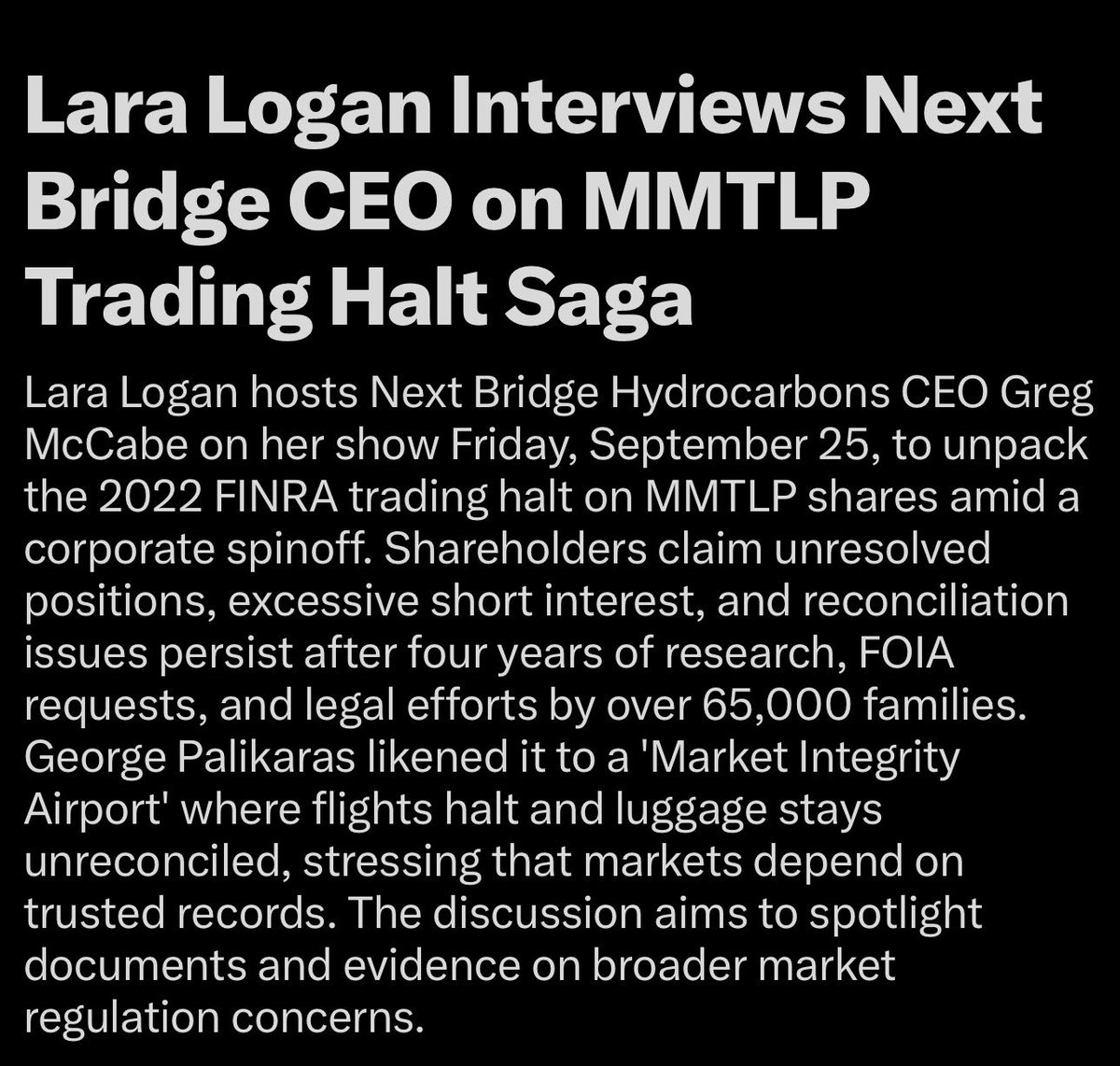
Going Rogue - #LaraLogan interviews Next Bridge Hydrocarbons CEO Greg McCabe this Friday 9/25/26
Hear the truth about the MMTLP Fiasco directly from the man himself!
This video is also different than what I usually put out. I tried something that allowed me to finish quicker but I wasn't able to make as many edits as I wanted, not without spending more money.
The message is clear though...
Just like the MMTLP Corporate Actions, @FINRA didn't follow uniform practices when they produced the UPC Advisory notice for MMTLP.
The examples in the video show that as early as a few months before MMTLP, there was a similar issue related to settlement and clearance but FINRA handled it very differently.
Why? @TheJusticeDept@FBI
🚨 🚨 🚨 NEW VIDEO 9/23/26 🚨 🚨 🚨
Ahead of the highly anticipated Going Rogue sit-down with award-winning journalist Lara Logan and Next Bridge Hydrocarbons CEO Greg McCabe, catch up on the crucial context and backstory. $MMTLP #LaraLogan
https://t.co/rNSLG92kH4
So after all of that, what is the point?
It is not that every short seller is bad, McCabe even said so on yesterday's call and I completely agree.
It is not that every regulator is corrupt. It is not that every journalist is bought.
It is not that every anonymous account is part of some coordinated operation. And it is certainly not that every disagreement proves wrongdoing.
The point is much simpler...
Markets only work when people trust the record.
Investors need to know that ownership can be reconciled.
Issuers need to know that the market around their securities can be understood.
Regulators need enough visibility to identify anomalies before they become multi-year forensic exercises.
And when something does go wrong, the documentary record has to survive long enough for somebody to reconstruct what happened.
That should not be controversial.
For more than 65,000 families, #MMTLP stopped being an abstract market-structure debate a long time ago.
It became personal.
And for me, helping bring some resolution to those families has become very personal too.
But the bigger issue now extends beyond MMTLP.
Because the next generation of markets will be much faster.
More automated. More fragmented. More international. More tokenized. More AI-driven...and increasingly 24/7.
If the existing plumbing has blind spots, adding speed does not eliminate them, it will magnify them.
That is why Congress should care.
Not because Congress needs to choose a side in an internet argument.
Congress has to ask whether the infrastructure governing modern markets is capable of protecting confidence in those markets as they evolve.
The American Dream depends on something surprisingly basic:
-An entrepreneur should be able to build a company.
-An investor should be able to invest in it.
And both should have confidence that the rules, the records and the referees work the SAME way regardless of who is on the other side of the trade.
That is the gold standard. Nothing more exotic than that.
So after four years of arguments, FAQs, FOIAs, hearings, research, litigation and now discovery, my view is simple:
Follow the documents and reconcile the records. Separate allegation from fact and let the evidence lead wherever it leads. In the NWBO case the market makers and trying everything to keep things under a seal, same thing happened with MMAT...
Assuming each of these defendants have a story, the record has to reconcile them. Documents don’t care who you know. Metadata doesn’t recognize the velvet rope. Discovery doesn’t care which entrance you used.
It just wants the passenger manifest.
Markets can survive short sellers. They can survive bad trades. They can survive bad companies.
What they cannot afford to lose is confidence that the same rules apply to everybody.
Read the MMAT/NWBO/QNTM etc filings... and please tune in on Friday's podcast, share it with colleagues, friends, family, as well as your congress representatives & staffers... and i would like to thank media investigative reporters like @laralogan and @annvandersteel who cared enough to dig, and continue to uncover how this all went down.
The rest is commentary.
Once somebody finally opens the service door and gets the records, the next question becomes almost embarrassingly simple:
Does the manifest/ledger reconcile?
Forget personalities for a minute. Forget narratives. Forget who shouted loudest on social media.
Forget who had the better lawyer, the bigger fund, the better PR firm or the nicer suit.
At the end of the day, the airport has to answer some very basic questions.
Who boarded? Who was supposed to board? Whose luggage were checked in? Which luggage actually arrived? Which luggage changed hands?
Which records agree? Which records don’t?
And if the numbers do not reconcile... where exactly did the gap appear?
That is really the heart of market integrity too.
Who owned what? Who reported what? Who traded what? Where was it traded? How was it cleared? How was it settled? How and who got it trading? What happened around the corporate action?
What did the transfer agent record? What did the brokers record? What did the clearing system record? What did the trading venues record?
And do all of those ledgers actually tell the SAME story?
Because if they don’t... that IS the problem.
Not X/Twitter, personalities, whether you are long or short. Not whether you like the company or the management.
#Reconciliation.
That is the part I think has been missing from this entire discussion for years.
Extraordinarily sophisticated markets have been built around the globe, capable of routing orders across venues from milli- to microseconds...
but when something goes wrong, issuers and investors can still find themselves trying to reconstruct the truth from fragmented systems, different intermediaries, delayed records and jurisdictional blind spots.
Imagine running an airport where:
-the airline has one passenger list,
-security has another,
-the luggage system has another,
-the international terminal has another,
and the airport authority cannot immediately tell you which one is correct!
Nobody would call that a MINOR administrative problem, right?
They would call it a control failure.
The future of market integrity cannot depend on reconstructing the flight AFTER the wreckage is already cold.
It should begin with knowing whether the passenger manifest balanced BEFORE takeoff.
This is where MIA stops being an airport analogy.
Because eventually somebody did open the service door... enter Rule 2004 discovery by the MMAT Trustee with special Counsel Wes Christian.
In airport language, somebody finally walked downstairs and said:
Enough with the announcements. Show us the CCTV. Show us the access logs. Show us the invoices. Show us the emails. Show us the research. Show us the counterparties. Show us who had access to which corridor, and when. Show us what moved through the system. And show us the timestamps.
That changes things, right? Because people can disagree, lawyers can argue, PR teams can polish. Commentators can comment, anonymous accounts and trolls can scream into the void...
But documents are considerably less emotional.
And metadata has an annoyingly good memory 😎
That is why I keep telling people:
Read the #MMAT Trustee filings. Actually READ them, please and not my interpretation of these or someone else's tweet.
Not the recap from whichever side of this argument you already agree with (except the wonderful @kimkep4796 who posts detailed summaries and is fair to all sides)
The filings!
The complaint now contains serious allegations involving Anson, Citadel and Virtu. Those allegations are not findings. They have to survive scrutiny. Evidence has to support them. Defendants get to answer them. That is how the system is supposed to work.
But here is what makes the 2004 discovery so interesting:
- The evidentiary trail was not manufactured yesterday.
- Much of it already exists because modern markets generate records simply by operating.
-The trustee was able to penetrate the corporate veil and get unprecedented access to data, triangulate them and about a month ago bring fwd a first-of-a-kind complaint against these named defendants.
That is the beauty, and occasionally the inconvenience, of a digital market.
Everybody leaves footprints. So the question becomes much less:
“Whose story do you believe?”
And much more:
“Whose story MATCHES THE RECORD?”
That is a very different game.
And when court pressure increases, subpoenas start flying and individual and corporate exposure starts becoming rather less theoretical...
old alliances can become very flexible 🤣
Funny how loyalty works when the temperature rises. First you short the company. Then, when things get uncomfortable... you short the partnership.
Again, joke aside, that is precisely why the documentary record matters more than personalities.
Who knew what? When did they know it?
What happened next? What do the timestamps show?
What relationships existed? What was disclosed? What was not?
And does everybody's version of events still work when all of those records are placed on the same table?
That is what discovery is for.
The trap was never really about catching one mouse (Anson).
The interesting possibility is that parts of the trap may ultimately be assembled from records generated inside the very ecosystem now being examined.
There is something almost elegant about that.
Caught... by their own metadata.
And suddenly the airport's VIP lounge feels a little less comfortable... documents don't care who you know... metadata doesn't recognize the velvet rope.
Discovery doesn't care which entrance you used...it just wants the passenger manifest... and once you have the manifest (e.g. MMAT trustee)... you can finally start reconciling the flight.
That is where the next part gets really interesting.
Now let’s check the basement...
Because the really interesting part of any airport operation is NOT the VIP departure lounge.
It is the infrastructure passengers never see.
-The service corridors.
-The baggage tunnels.
-The access rooms.
-The logistical machine.
-The contractors.
-The handlers.
-The control systems.
The people who know which keycard opens which room.
The people who know exactly where the cameras point.
And the people who have been moving through those corridors for years.
In our MIA airport analogy, this is where the sophisticated operators sit. Not literally, obviously... But this is where the relationships live.
-Prime brokers.
-Market makers.
-Research shops.
-Media relationships.
-Counterparties.
-Consultants.
-Lawyers.
-Trading desks.
-Distribution networks.
And yes, the people helping shape the narrative outside the terminal too. They are not obscuring their faces with balaclavas.
They have Bloomberg terminals.
-Compliance departments.
-Law firms.
-Research notes.
-Invoices.
-Cross-border relationships...
...and very nice suits.
Think less Goodfellas... with baseball bats.
More Goodfellas with... compliance departments.
That line is a joke but the questions underneath it are not.
Did the market’s oversight architecture give regulators, issuers and investors ENOUGH visibility to understand what was happening in real time?
Then there is the information environment. Because every airport also has screens, announcements, signs etc.
Airport people telling passengers where to look.
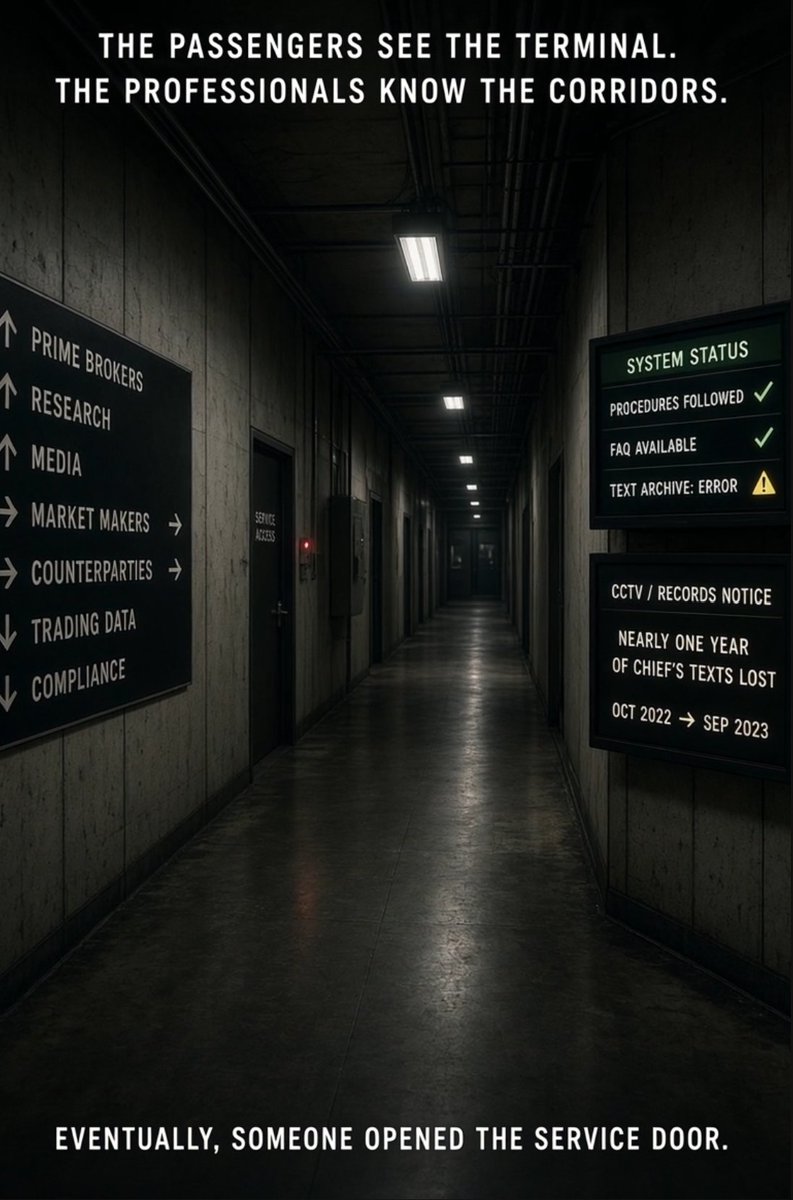
So in MIA, while passengers, employees and even the airline itself are still asking what happened to the luggage and the flight plan, some monitors keep flashing:
“TECHNICAL ISSUE”
“PROCEDURES WERE FOLLOWED”
“PLEASE REFER TO THE FAQ”
“NOTHING TO SEE HERE”
And then one airport monitor suddenly has a rather more awkward announcement...
“RECORDS UPDATE: NEARLY A YEAR OF THE AIRPORT CHIEF’S TEXTS WERE LOST.” 🙈🙉🙊
(SOURCE: House Committee on Financial Services https://t.co/TD1NSJo7es and OIG 2025 review https://t.co/MsDuoAZ89M)
Unfortunately, that missing-record window includes December 2022... when Flight MMTLP was halted!
To be absolutely clear, that does not tell us what those missing messages contained. But it makes preservation of the documentary record rather important, doesn’t it?
And the @SECGov Inspector General found something else worth reading carefully.
- Some closed FOIA requests used language such as “all emails or other communications” or “any communications” ... yet Gensler’s text messages were not searched in those instances.
- The OIG also found that recovered texts included substantive, mission-related SEC communications.
So perhaps the better question is not:
“What do we imagine was in the missing texts?”
It is:
“What records existed, what was preserved, what was searched, and what can now actually be reconstructed?”
There is also a comical irony here....
While Gensler was Chair, the SEC brought recordkeeping cases against financial firms for failing to preserve electronic communications.
In fiscal 2023 alone, according to the House Financial Services Committee, the SEC collected more than $400 million in settlements involving recordkeeping violations!!!
And Gensler himself said firms “must maintain and preserve those communications”
MIA AIRPORT POLICY:
EVERYBODY MUST PRESERVE THEIR RECORDS.
AIRPORT MANAGEMENT UNDER GENSLER: ...about that. 🤣
And somewhere in the corner, the social-media noise machine is doing what noise machines do best:
Distract. Redirect. Mock. Confuse. Exhaust.
That does not mean every journalist, commentator, critic or anonymous account is part of some coordinated scheme. It means narratives matter.
And sophisticated market participants understand that very well.
Which is why the serious question, in my opinion, is not:
“Who is the villain?”
It is:
“What does the documentary record show?”
Because eventually somebody has to stop listening to the airport announcements...
...and open the damn service door.
Luckily, somebody did.
That is where Rule 2004 discovery comes in.
Next they look upstairs.
While the passengers are still standing beside the carousel asking what happened to their bags, the airport establishment is already discussing a brand new "Airport of the Future".
New technology. New market structure. Tokenization. 24/7 trading. Digital assets. Crypto. Faster settlement.
All important conversations.
But there is something almost absurd about designing the new system of tomorrow while tens of thousands of passengers are still asking what happened to their luggage from the last flight.
That is the part I cannot get past.
Downstairs:
“Where are our bags?”
Upstairs:
“Welcome to our symposium on the future of luggage”
Let me make it real for you and look at what "upstairs" looks like:
The 2026 Financial Markets Quality (FMQ) Conference is being held today, Wednesday, September 23, 2026, from 8:00 a.m. to 5:00 p.m. EDT at @Georgetown University’s Lohrfink Auditorium in the Rafik B. Hariri Building.
It is hosted by Georgetown’s Psaros Center for Financial Markets and Policy: https://t.co/LvkyJN9HMt
This year’s theme is “Innovation and Integrity in Financial Markets”, the program centers on how technology, policy, and market design are reshaping finance, especially prediction markets, tokenization, private markets, trading infrastructure, and digital-asset regulation... how interesting, right?!
Agenda Highlights:
-Prediction Markets and the New Economics of Information (Rostin Behnam, Amanda Fischer, Brian Quintenz; moderated by Guy Adami).
-Conversation with Terry Duffy, CME Group CEO (Moderated by former House Financial Services Chair Patrick McHenry)
-Conversation with Sen. Bill Hagerty (Moderated by POLITICO’s Victoria Guida)
-Digital-assets policy conversation (Tyler Williams and Patrick Witt)
-Growth and Evolution of Private Markets (Leaders from Edward Jones, Churchill Asset Management, Lincoln International, and Kirkland & Ellis)
-Conversation with SEC Commissioner Mark Uyeda (Moderated by World Federation of Exchanges CEO Nandini Sukumar)
-Conversation with Tradeweb CEO Billy Hult (Moderated by former NYSE President Stacey Cunningham)
-Conversation with NEC Director Kevin Hassett (Moderated by Psaros Center Executive Director Michael Piwowar)
-Market Infrastructure in the Age of Technological Innovation (Broadridge, Nasdaq Private Market, Optiver, and former CFTC Chair Tim Massad)
-Tokenized Finance: Innovation, Liquidity, and Market Integrity (BlackRock’s Samara Cohen, Bullish CEO Tom Farley, and DTCC CEO Frank La Salla)
-Global Economy in Transition (JPMorgan Asset & Wealth Management CEO Mary Callahan Erdoes and IMF First Deputy Managing Director Dan Katz)
Why It Matters:
The agenda brings together senior regulators, policymakers, exchange operators, asset managers, market-infrastructure firms, and digital-finance leaders. That makes it particularly relevant for anyone tracking:
-U.S. and international market-structure policy
-The regulatory direction for prediction markets and digital assets
-Tokenization’s effects on liquidity, settlement, and investor protections
-Private-credit and private-market valuation, transparency, and access
-The intersection of macroeconomic policy and capital markets.
You couldn’t write it. And this is not an argument against innovation. Quite the opposite.
If markets are going to become faster, more automated, more global and increasingly tokenized, then reconciliation and market integrity become MORE important, not less.
You cannot build tomorrow’s airport on top of yesterday’s unreconciled luggage.
Before we add more terminals…
more runways…
more automation…
more digital assets…
and markets that never close…
perhaps somebody should make sure the manifest balances...?
Because innovation without reconciliation does not remove risk. It scales it.
And if #MMTLP exposed anything worth understanding, it is that the future of market structure cannot just be about SPEED.
It has to be about whether the record can actually be TRUSTED.
The passengers are still waiting. The luggage is still the question.
And perhaps before everyone redesigns the airport…
somebody should finally check the basement and those dark corridors?
Now lets bring the timeline to December 2022.
At MIA, the MMTLP flight is already on the board.
The destination is clear:
NEXT BRIDGE
Passengers are checked in.
The gate is assigned.
Everyone is watching the departure board.
Then the airport announces the time and date is all set and the flight is cleared for take of.... suddenly the airport send out a second announcement... that an “extraordinary event” has occurred.
THE RUNWAY CLOSES!
U3 HALT.
And suddenly the passengers, the airline AND the pilots are all standing in the terminal asking a very simple question:
“Hang on… where did the plane go?”
That is where the analogy stops being funny...
Because when the flight does not leave as expected, the passengers do what passengers always do:
They ask the airline and they ask the airport.
So the airport explains the procedures.
Then come the FAQs.
More FAQs.
Settlement explanations.
Coding explanations.
Rule explanations.
Technical explanations.
All very detailed.
All very procedural.
But the passengers are still standing there asking the same basic question:
Where is my luggage?
And this is the part people outside #MMTLP need to understand.
For the people affected, including the airline itself, this was never just a technical market-structure debate.
It was their money. Their airline. Their positions. Their records.
Their ability to operate. Their ability to reconcile what they owned with what the system said existed.
That is why “just read the FAQ” was never going to settle it.
An FAQ can explain a procedure.
It cannot reconcile the underlying ledger after the fact.
And when the passengers and the airline keeps asking questions long enough, the airport eventually faces another problem:
People start asking not just what happened at the gate…
…but what was happening behind the walls.
So, welcome to MIA: Market Integrity Airport.
Ethical issuers are the airlines.
They are trying to run a legitimate business, follow their flight plan, keep the aircraft safe, and get everyone to the destination.
Retail investors and company employees are the passengers.
They bought a ticket.
They went through security.
They followed the rules.
And they reasonably assumed somebody had checked whether the airport itself was... SAFE.
Simple enough?
But then... there are the professional operators who seem to know EVERY service corridor in the building.
They know which doors open.
They know which contractors to call.
They know where the cameras point.
They know the brokers...
The lawyers.
The market makers.
The research shops.
The media contacts.
The counterparties.
The lawmakers.
The other "frequent flyers" who have been using the terminal for decades.
In this analogy, the "Ansons" of the world are not the bloke trying to sneak a bottle through airport security.
They are ALREADY inside.
Comfortably seated at the airport VIP LOUNGE.
And they appear remarkably familiar with exactly how the luggage system works. That does not prove wrongdoing. But it does raise a rather obvious question:
WHO knows HOW the airport ACTUALLY works?
And who ONLY knows what is PRINTED on the boarding pass?
Because for ordinary passengers, employees and ethical airlines, the rules are visible.
The interesting part is what happens in the dark corridors no one sees... or has access to.
And apparently, for a very long time, no one thought to look downstairs or ask for a quick tour.