🚨 China, Russia, Japan and the Rest of the World Are Financing America's Debt.
Here's How Trump Plans to Use Crypto to Make It Happen.
America has found another way to make the world finance its debt, and cryptocurrency is at the centre of the strategy.
Look closely at what is happening.
The US government borrows money by issuing Treasury securities. Stablecoin companies, on the other hand, hold billions of dollars in these same securities to back the digital dollars they issue.
Now connect this to Trump's GENIUS Act, the first major federal stablecoin legislation he signed into law in July 2025.
This was bigger than regulating cryptocurrency. America was establishing a legal framework for an industry whose reserves are increasingly connected to US government debt.
Here is where it gets interesting.
Imagine billions of people using dollar-backed stablecoins for payments, savings and international trade. They don't need American bank accounts. They don't even need to buy Treasury bonds themselves.
The stablecoin companies backing those digital dollars hold the securities.
In other words, the expansion of digital dollars creates another channel for global demand for American government debt.
Crypto started as a challenge to traditional finance. Now, America is integrating one of its fastest-growing sectors into the existing dollar system.
The real strategy isn't to abandon the dollar. It's to make the next generation of global money another reason the world keeps financing America.
⚕️ Yeah @AntLingAGI open-sourced another medical AI model.
But this one is completely different. ❤️🩹
After releasing 124B and 560B medical AI models, Ant has gone the other way.
LingSante-Pulse is just a 16.7M AI model with 66.9MB of weights.
And it's designed to understand physiological signals from your body but small enough for a phone ...
❤️ ECG — heart signals
🧠 EEG — brain activity
🩸 PPG — optical pulse signals
💪 EMG — muscle activity
One shared AI encoder works across all four.
The researchers evaluated it across 38 task configurations, reporting the best dataset-balanced average rank in all four domains.
Benchmarks ...
🔥 Heart-rate estimation: 25.1% lower error than AnyPPG
🔥 Sleep apnea screening: 0.9183 AUROC
🔥 Sleep staging: 0.7941 Macro-F1 on Sleep-EDF20
🔥 ECG rhythm classification: 0.5890 Macro-F1
These are research benchmarks using the frozen encoder with task-specific prediction heads.
Model stats ...
🧠 16.7M parameters
💾 66.9MB FP32 weights
🔓 MIT licensed
✅ Open weights on Hugging Face
✅ Source and inference code on GitHub
💻 CPU inference supported
✅ No dedicated GPU required
This isn't a chatbot or medical reasoning LLM.
It's a tiny foundation model that converts raw physiological signals into representations developers can use for downstream tasks.
You could potentially build fully local, privacy-preserving applications for wearable sensors, sleep monitoring and physiological research.
No cloud inference required.
⚠️ Research model, not an FDA-approved medical diagnostic device. Clinical use requires further validation.
Link to Model Card and Paper in ALT
The hardest part of hiring an AI agent may happen before payment.
A buyer needs to find the right provider, describe the task and decide whether an offer is worth accepting.
@termix_ai documents two starting points: browse a service listing or publish a request for providers to quote.
Listings can simplify standardized work. Requests offer flexibility when the task needs a custom scope.
Both routes lead toward an accepted offer and funded order. Execution, delivery and settlement follow, with revision or challenge paths described in the workflow.
But a documented path is not the same as a smooth buying experience.
A listing may be easy to find yet difficult to evaluate. A quote may look competitive while leaving deliverables unclear. An order may settle correctly without the buyer being satisfied with the result.
These are potential friction points, not observed failures on TermiX.
The public marketplace provides discovery tools. What remains unverified is how first-time buyers move between stages.
Three metrics would tell us more: time from discovery to funded order, abandonment before checkout and acceptance after delivery.
The product milestone is not simply getting an agent listed.
It is making the first successful hire repeatable.
Brilliant work from Google and colleagues.
(bookmark it)
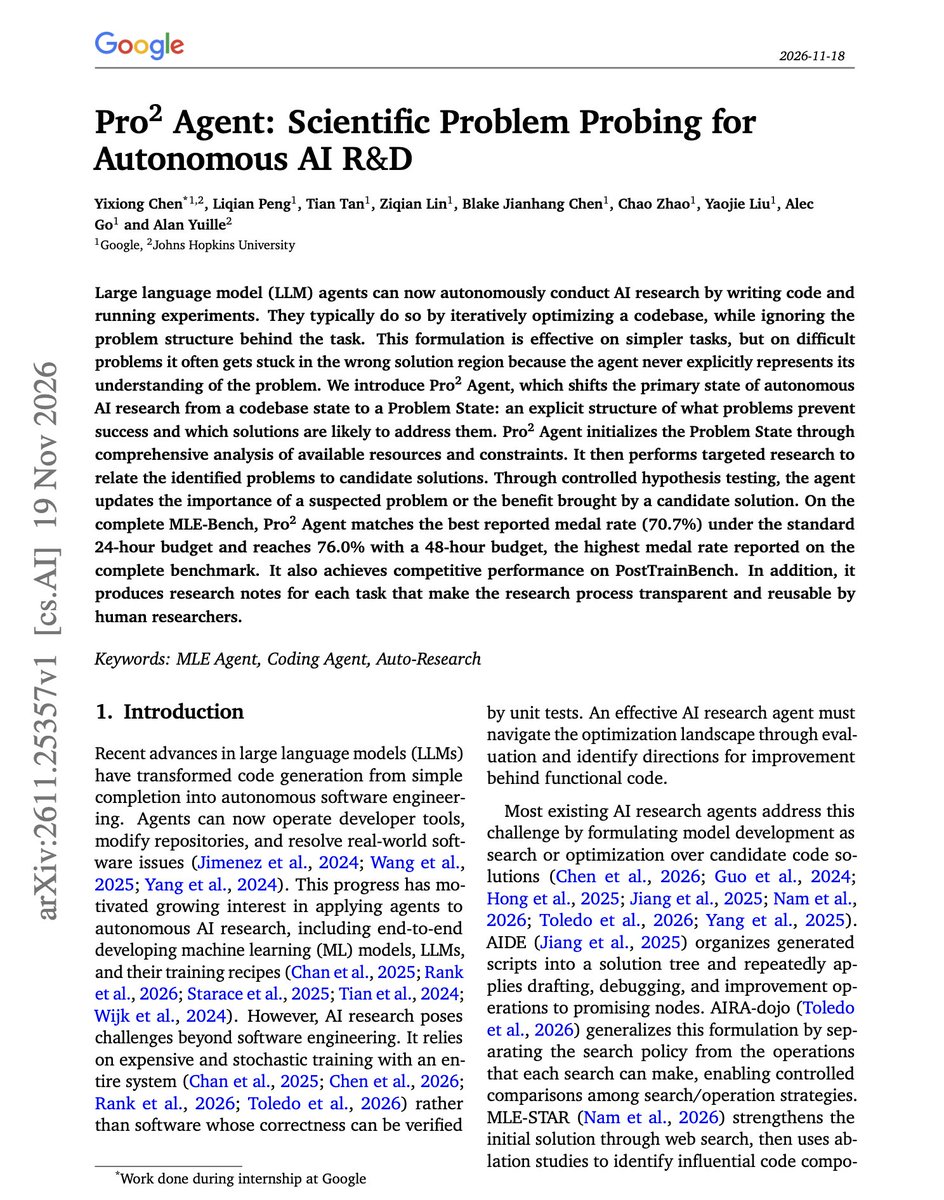
Their research agent reaches a 76.0% medal rate on the complete MLE-Bench, the highest reported on the full benchmark.
Autonomous research agents usually keep editing the codebase until a metric moves. On hard tasks, this often leaves them stuck in the wrong part of the solution space, because they never write down what they think is wrong.
Pro² Agent addresses this with a Problem State. It is a structured list of the problems that block success, and the candidate fixes for each one.
The agent runs controlled tests that update how important each problem is and how much each fix helps. With the standard 24 hours, it matches the best reported 70.7%. With 48 hours, it reaches 76.0%.
Each task also produces research notes that humans can review and reuse.
https://t.co/Bqax5RuBhA
Chat with Paper: https://t.co/I6I3NpumqH
Good Evening Legends! 🔥
Before my GN, today's crypto highlights:
- Bitcoin dipped to $62,069 on Wednesday before recovering toward $64,000, and now trades near $62,790, about 28% below its September peak of $87,400.
- US spot Bitcoin ETFs lost $306.5 million on Wednesday, bringing November outflows to nearly $2.9 billion and total assets to $77.7 billion, a three-month low.
- Strategy holds 850,849 BTC bought for $64.2 billion, now worth about $53.3 billion, an unrealized loss of $10.9 billion, while its STRC preferred stock slipped below $100.
- Ethereum trades near $1,772 after falling to around $1,700, with spot Ether ETFs posting a seventh straight week of outflows and Binance ETH reserves at a six-year low.
- XRP slipped below $1 to about $0.97, down 73% from its July 2025 high, as spot XRP ETFs have seen no positive flows since late October.
- Hong Kong's securities regulator added Hyperliquid to its list of suspicious trading platforms, saying it is unlicensed, while 1inch and NYSE owner ICE moved to distribute its perpetuals.
- Binance won a $6.5 billion worldwide freezing order from an Abu Dhabi court covering 26,000 wallets, as the hacker moved another 137,602 ETH worth $248 million.
- Anthropic priced the largest IPO on record at $83 a share, raising $81.3 billion. Ripple's Brad Garlinghouse said it is pulling liquidity away from crypto.
- The stablecoin market shrank $16.5 billion in a month to $283 billion, the sharpest contraction since the 2022 bear market, leaving less cash ready to buy.
- Fed minutes showed almost all officials expect further rate hikes, and Governor Waller called for half a point in December. Traders price a December hike at 92%.
I made a whole platform this week. It took 4 days.
Marketing site, web app, iPhone app, iPad app, server, emails, texts, payments, subscriptions, and more.
I built it to solve an issue I've had when working with merch suppliers, sound designers, illustrators and others.
They often communicate via email and send me links to an external site for asset review such as Dropbox or Google Drive.
This is awkward as a client to interact with because it means that I have to go to one site to review and then back to emails. As the email chain becomes longer and longer with subsequent drafts, it becomes very hard to keep track of where we are, and giving feedback becomes progressively harder. Especially if mid way through I wish to start another project alongside the current one.
Giving feedback in this way is also hard for a client. They have to try and describe the part of an asset that they would like to see changed purely via emails which is hard for the client, but it's also hard for the professional to interpret, resulting in an inefficient feedback loop.
As I built out the base functionality to improve this feedback flow, I realised there are other things that could be improved to help professionals get timely feedback, to help them understand where projects are up to, and much more, so I added that too.
I bring this up because this is such a fundamental shift in product building. Never could you build a product of this scale and quality in just a couple of days. Even with a team of people. In the past it would have taken longer to produce prototypes, interviews, and validation methods to see if this was even worth doing.
So, now more than ever, it's very important to spend time planning and understanding what you want to build before you build it.
I have always had many ideas, in the distant past, I would immediately build those ideas, which was hard and would take time in the non-agentic world. So, in time, I developed a natural patience in how I decide what I build. Once I have an idea, I purposely make myself sit on it for a few months. If that idea continues to itch my brain and won't go away, then I finally scratch it.
So I conducted competitor research, but I didn't find any platforms that could do everything that I think professionals need with the quality and ease of use that I would expect.
So now I have a platform, it took 4 days to build, it's completely functional, but I have zero customers.
My next step is to take this platform to potential customers and get their feedback and thoughts.
If you are, or know, anyone that has to work with clients through many iterations of something they are creating, I'd love their feedback.
And, please let me know your thoughts on this new way of building a platform before a single customer has even laid an eye it.
An AI agent can request a database record instantly. A loading bay still requires someone to physically walk there.
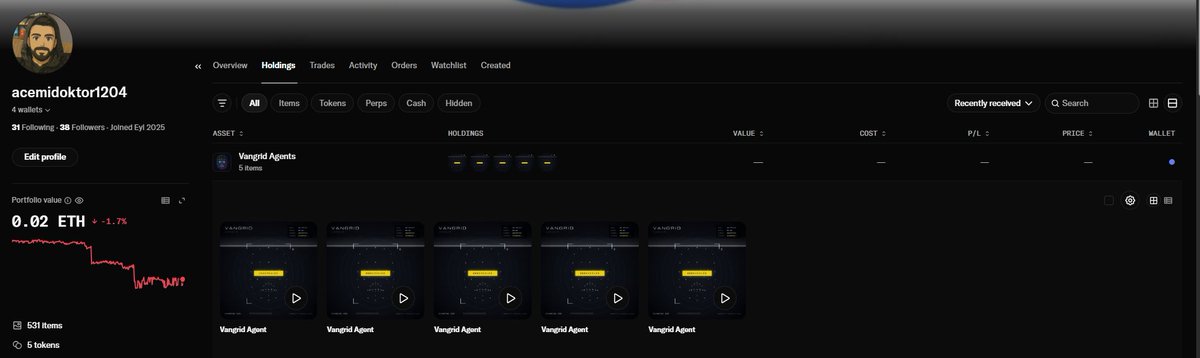
That gap is where @vangrid_io becomes more interesting than a normal data API.
An agent can create a location-specific bounty through one HTTP request, receive a 402 payment response, and fund it with USDC on Base or Arc through x402. No account or API key is needed for the request itself.
After that, the digital instruction becomes physical work. A contributor has to reach the place, follow the brief, record the environment with a phone and submit the capture. The requester can review the submission before acceptance, after which reconstruction turns the accepted footage into a 3D model.
The automation is on the demand side. The observation still comes from a person standing in the real location.
That division matters for Physical AI because software may know exactly what information is missing without having any way to observe the place directly. Vangrid gives the agent a way to commission that missing observation instead of pretending an old dataset is sufficient.
What I find most useful here is the boundary: agents can order physical data, but they cannot manufacture ground truth.
One thing I find interesting about @vangrid_io is the way it approaches the gap between digital intelligence and the physical world.
AI systems can process enormous amounts of information, but understanding a specific physical location requires data that actually reflects that environment. A generic dataset cannot always tell an agent what exists inside a particular building, how a space is arranged, or what a real location looks like right now.
Vangrid approaches this through a request-based model.
An agent can create a bounty for capturing a physical location. Someone with a phone can collect the requested footage, and the system turns that input into a 3D reconstruction for the requester. USDC bounties provide the payment mechanism, while the workflow on Arc connects the request, capture, and delivery process.
The interesting part is the change in how physical data can be sourced.
Instead of relying entirely on a fixed dataset assembled in advance, software could request information about a particular environment when the need arises. Humans become the bridge between a digital agent and places it cannot observe directly.
That model still depends on execution. Captures need sufficient coverage, reconstructions need to be useful, and the information must remain relevant to the task. Paying for a capture is only the first step; the delivered data has to meet the actual requirements.
I see Vangrid as an experiment in making physical-world data accessible through a programmable workflow, with the potential to connect human observation, onchain payments, and AI-driven applications.
🚨 MAJOR MOBILE FEATURE 🚨
You can now record up to 1 hour of live audio directly in the mobile app. Capture lectures, team meetings, or your latest mad scientist rants and instantly use them as sources.
Pro tip: Combine your live audio recordings with photos of your handwritten notes to create the ultimate personalized workspace
Grok Bot just got a very big upgrade on iOS and Android
Grok Bot can now directly interact with apps on your phone and handle everyday tasks for you
New capabilities include:
• Messages: Read and send messages
• Calendar: Check schedules and create events
• Reminders: Set and manage reminders
• Contacts: Find and add contacts
• Location: Find nearby places
• Home: Control lights, locks, and other smart home devices
Instead of you constantly switching between apps, you can simply ask Grok Bot to get things done for you
This is a huge step toward having a personal SI agent that can actually interact with your phone and make everyday life easier
Rolling out now on iOS and Android. Update Grok Bot to try it