John Hopfield and Geoffrey Hinton have won this year’s @NobelPrize in physics for developing methods that have shaped modern powerful machine learning algorithms. The unusual choice highlights the way that physics inspired some of the earliest neural networks. 🧵
Long before the binary 0s and 1s of digital computing, analog computers measured the tides, calculated the position of the planets, and predicted eclipses. @laxmevy and @mmoyr detail the history and strengths of these machines: https://t.co/vBoSqoJNJV
Fabulous piece on the 800 page-proof of the geometric Langlands conjecture, a key pillar of the “grand unified theory of mathematics” by @EricaKlarreich for @QuantaMagazine. Do read!
https://t.co/nvo83nPEGr
New today in @QuantaMagazine: the most pure unadulterated fun I've had reporting a story in my time as a journalist to date.
After decades, an open online collaboration has definitively identified an unusually active computer program called the fifth busy beaver.
1/5
Nat Geo laid of all its writers, and most of its old editors. They’re now hiring social media managers, content strategists, SEO editors, etc.
Who needs writers when you could hire new staff to “assist managers [with] best-in-class creative social stunts”?
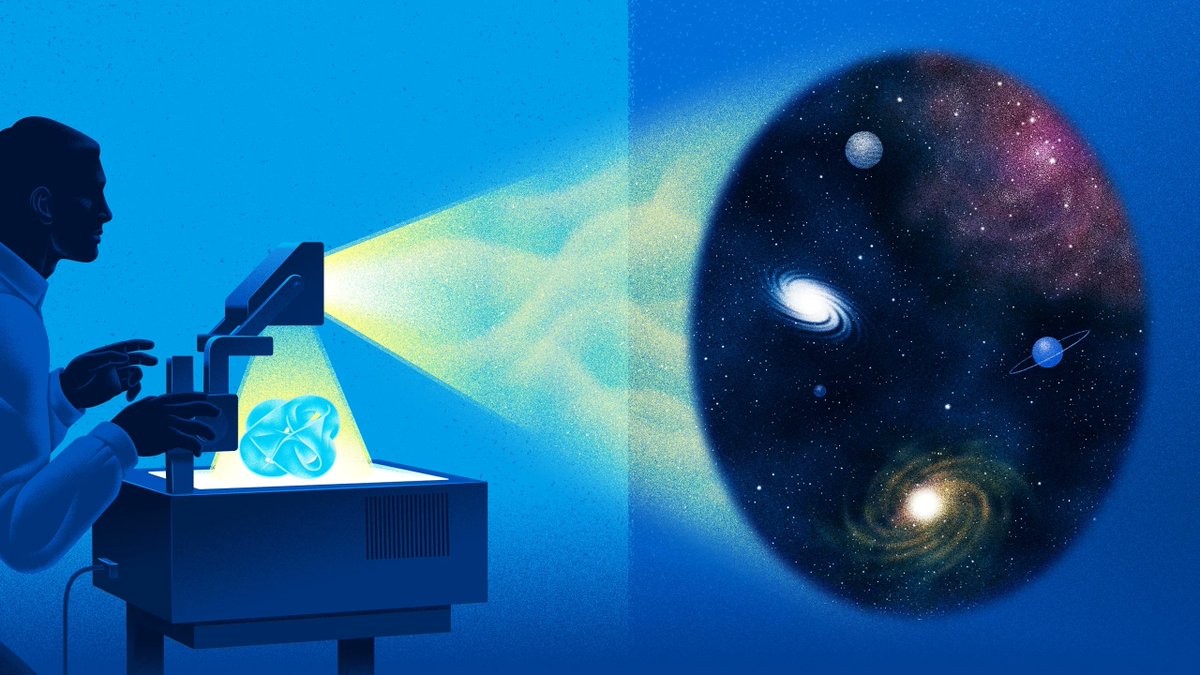
AI Starts to Sift Through String Theory’s Near-Endless Possibilities
Using AI, string theorists are finally showing how Calabi-Yau manifolds translate into sets of elementary particles — though not yet those of our universe.
🔥by @walkingthedot
https://t.co/L8YnY3geB2
Sheon's explainer is very good! Since Avi Wigderson's work has touched nearly part of the field, the award is a great shameless self-promotion opportunity for all of us CS journalists.
The talk relates to using complexity theory to tackle Hawking's black hole information paradox. And @QuantaMagazine has you covered again. Charlie Wood interviewed a bunch of young physicists working on this last year--including Pennington. “It represents to some degree the end of a revolution, rather than a beginning,” he told them. Huge, rich article #SimonsLive https://t.co/OtCBNuh1if
Listen to our very own Professor Laura DeMarco speak on mathematics as a “whole unexplored universe which has no boundaries!” She joined the @RadInstitute podcast to reconsider not only what math is but also what it can do—and who can do it. #harvardmath https://t.co/a4HPCCu6WG
There is probably going to be another eruption in Iceland this week.
That sort of forecasting is often not possible for volcanoes around the world. But it is here.
How come? Read my @QuantaMagazine feature on Iceland’s magma hunters to find out.
Hello! I’m back on the job as physics editor @QuantaMagazine and eager for pitches. X’s science journalism community has become something of a bleached coral reef, but any writers out there with story ideas or general interest in working together, please DM me. Thanks! 💡✍️


![Douglas_Main's tweet photo. Nat Geo laid of all its writers, and most of its old editors. They’re now hiring social media managers, content strategists, SEO editors, etc.
Who needs writers when you could hire new staff to “assist managers [with] best-in-class creative social stunts”? https://t.co/2QxqYYUot3](https://pbs.twimg.com/media/GM_Jw_RWQAARFKJ.jpg)
![Douglas_Main's tweet photo. Nat Geo laid of all its writers, and most of its old editors. They’re now hiring social media managers, content strategists, SEO editors, etc.
Who needs writers when you could hire new staff to “assist managers [with] best-in-class creative social stunts”? https://t.co/2QxqYYUot3](https://pbs.twimg.com/media/GM_Jw8yWcAEoeOb.jpg)
![Douglas_Main's tweet photo. Nat Geo laid of all its writers, and most of its old editors. They’re now hiring social media managers, content strategists, SEO editors, etc.
Who needs writers when you could hire new staff to “assist managers [with] best-in-class creative social stunts”? https://t.co/2QxqYYUot3](https://pbs.twimg.com/media/GM_Jw8uW0AAoPjJ.jpg)


![Douglas_Main's tweet photo. Nat Geo laid of all its writers, and most of its old editors. They’re now hiring social media managers, content strategists, SEO editors, etc.
Who needs writers when you could hire new staff to “assist managers [with] best-in-class creative social stunts”? https://t.co/2QxqYYUot3](https://pbs.twimg.com/media/GM_JxCHWcAAQPpv.jpg)