#OPINIÓN
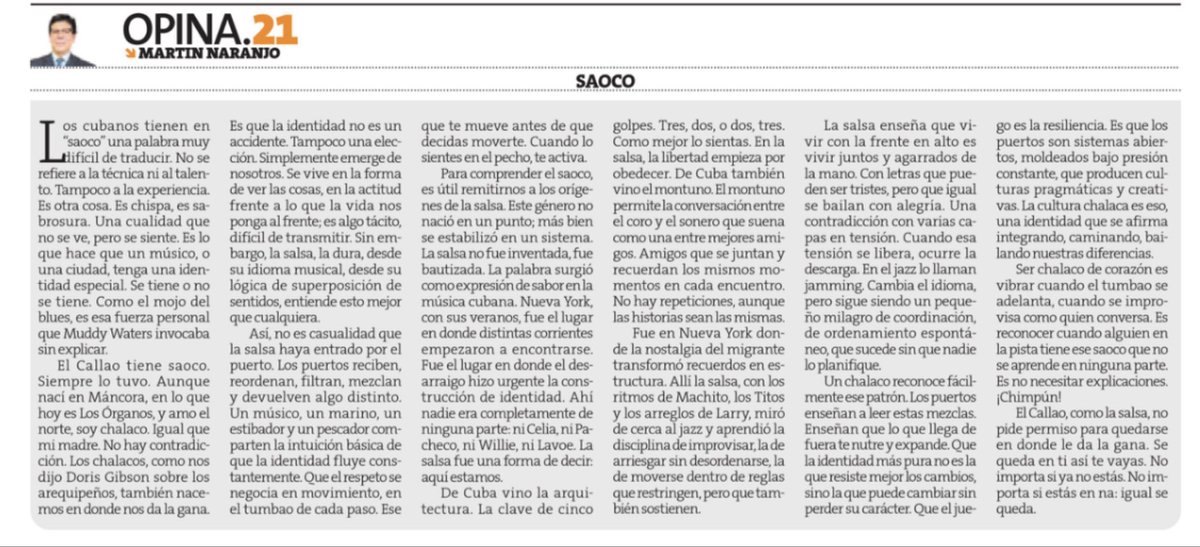
✍️Martin Naranjo: Saoco
"La salsa enseña que vivir con la frente en alto es vivir juntos y agarrados de la mano. Con letras que pueden ser tristes, pero que igual se bailan con alegría". https://t.co/yxNwlRUjKa
#OPINIÓN
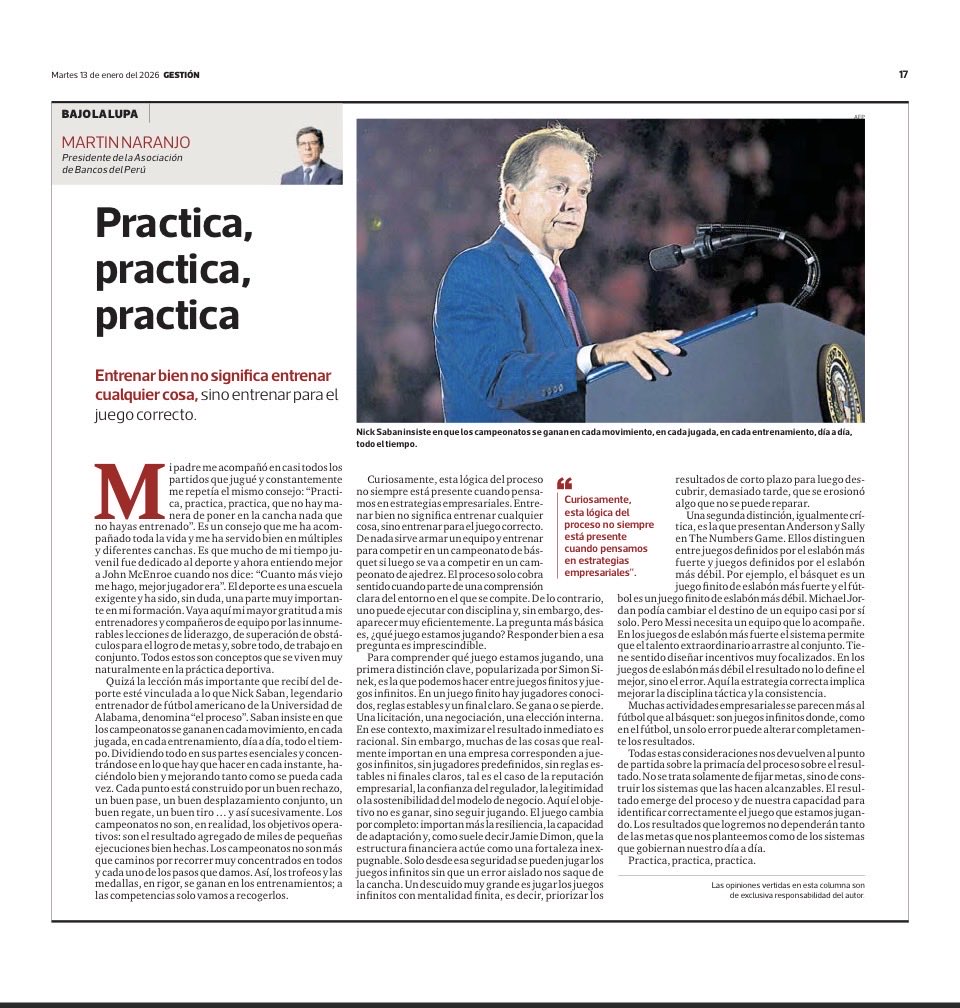
✍️Martin Naranjo: El casco y la campana
"El Perú también tiene semanas del infierno: crisis que se desencadenan antes de procesar la crisis anterior, decisiones que tardan, resultados que se demoran, noches en que el país entero espera sin saber qué esperar". https://t.co/3e3m8jKGHK
📖 Martin Naranjo presenta el libro Ideas errantes
La obra reúne reflexiones sobre economía, sociedad y actualidad, y fue presentada ante autoridades, empresarios, intelectuales y periodistas. https://t.co/QYyU9Pv0Lg
Los cubanos tienen en “saoco” una palabra muy difícil de traducir. No se refiere a la técnica ni al talento. Tampoco a la experiencia. Es otra cosa. Es chispa, es sabrosura. Una cualidad que no se ve, pero se siente. ... Comparto:
@MagoCMXI Me halaga mucho lo que me dices. Escribir es también una forma de servicio público, aunque entiendo la frustración. Lo que sí puedo prometerte es que seguiré diciendo lo que pienso. Abrazo
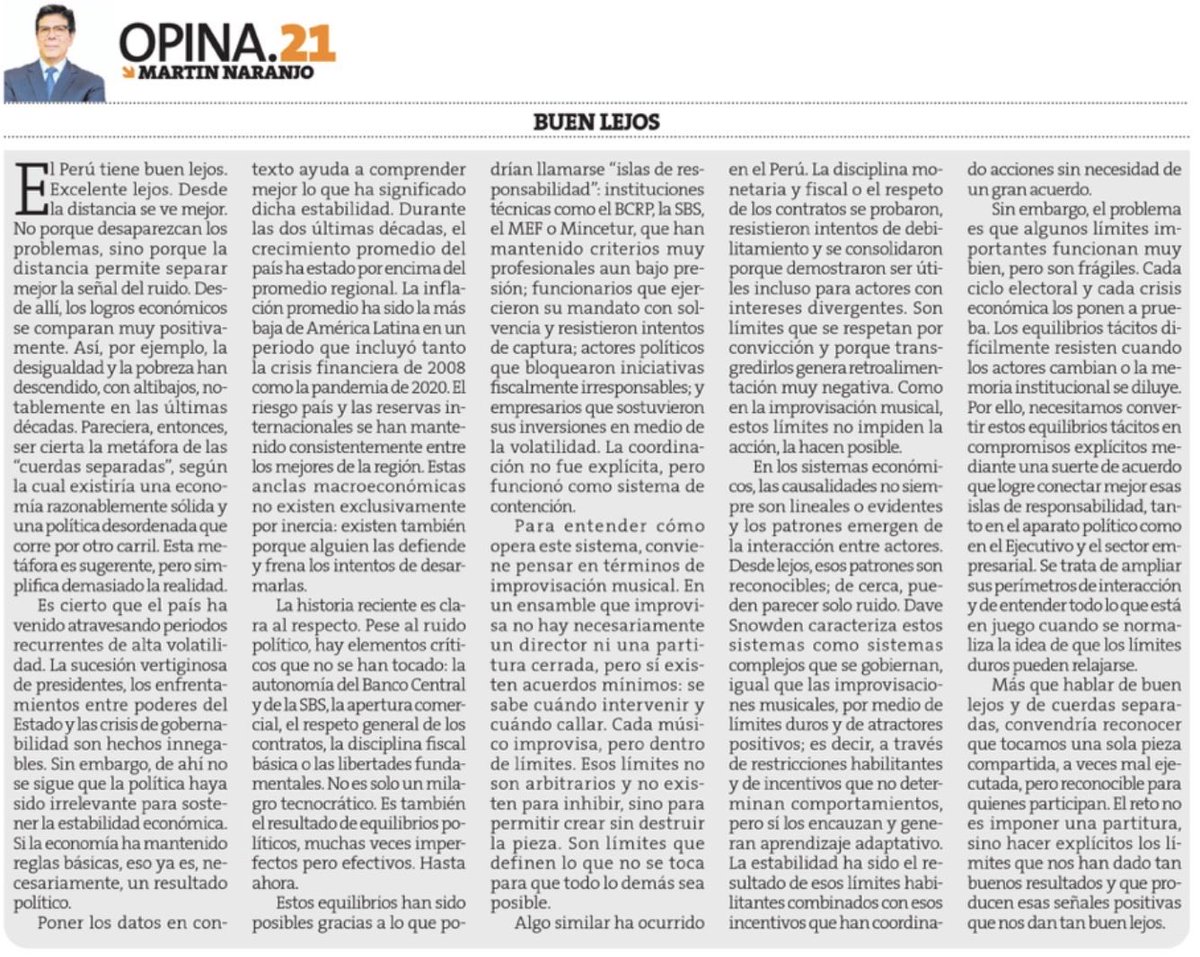
El Perú tiene buen lejos. Excelente lejos. Desde la distancia se ve mejor. No porque desaparezcan los problemas, sino porque la distancia permite separar mejor la señal del ruido. Desde allí, los logros económicos se comparan muy positivamente. ...
Comparto:
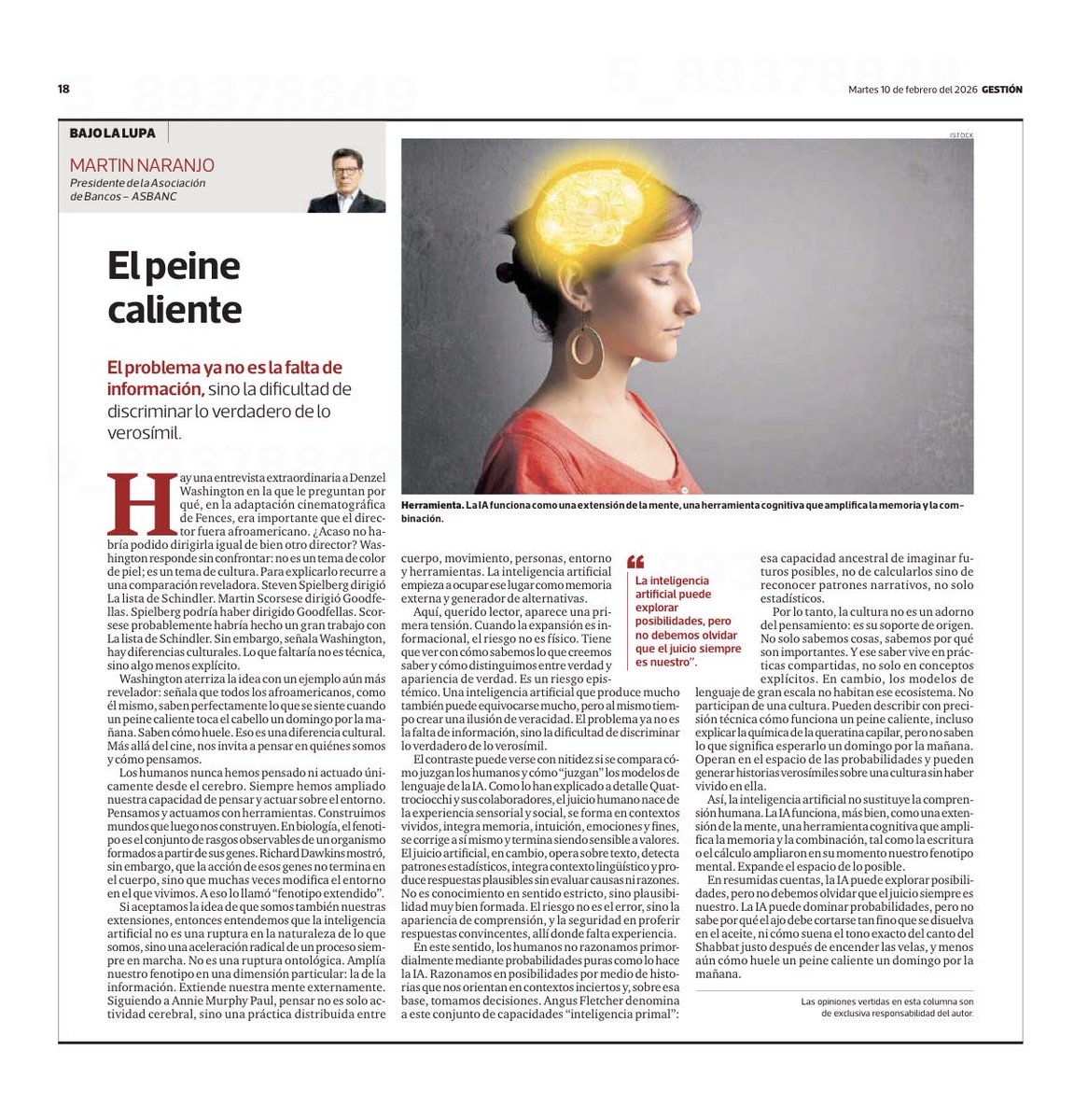
Hay una entrevista extraordinaria a Denzel Washington en la que le preguntan por qué, en la adaptación cinematográfica de Fences, era importante que el director fuera afroamericano. ¿Acaso no habría podido dirigirla igual de bien otro director? ... Comparto:
Major preprint just out!
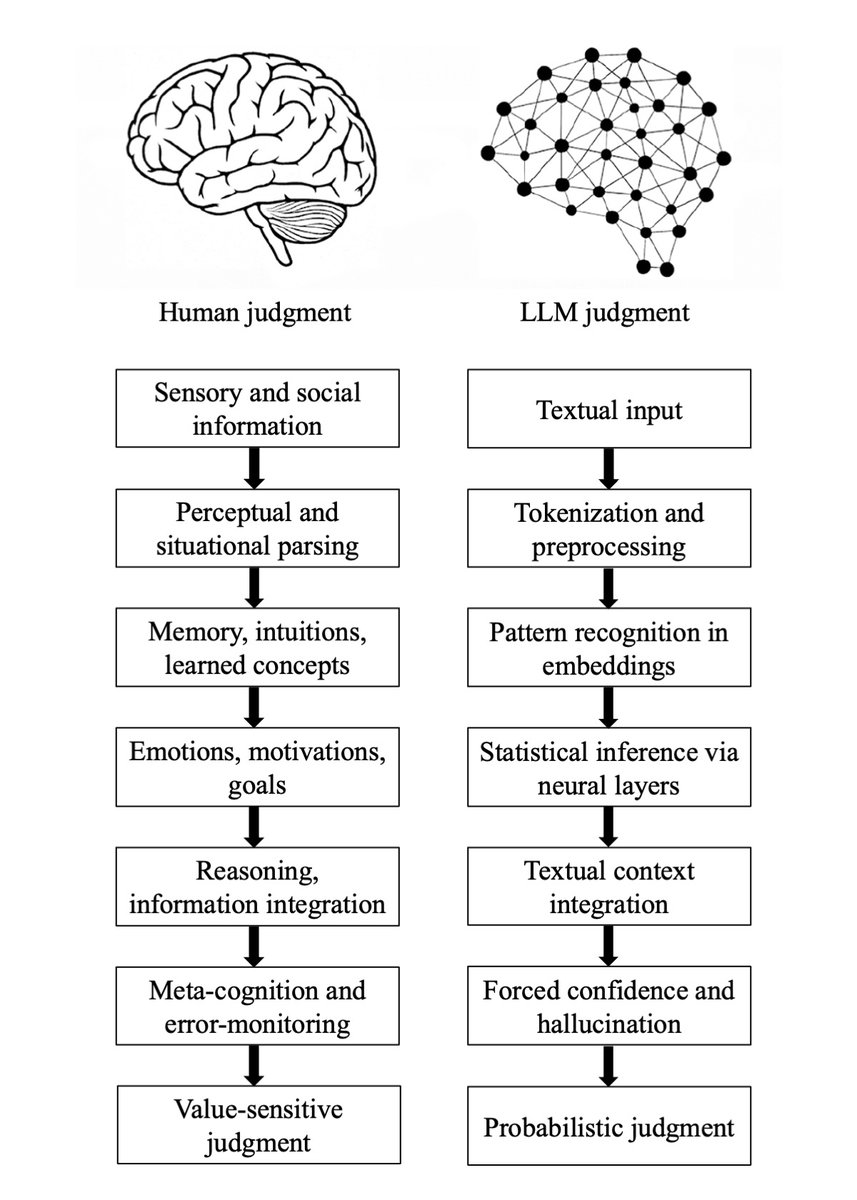
We compare how humans and LLMs form judgments across seven epistemological stages.
We highlight seven fault lines, points at which humans and LLMs fundamentally diverge:
The Grounding fault: Humans anchor judgment in perceptual, embodied, and social experience, whereas LLMs begin from text alone, reconstructing meaning indirectly from symbols.
The Parsing fault: Humans parse situations through integrated perceptual and conceptual processes; LLMs perform mechanical tokenization that yields a structurally convenient but semantically thin representation.
The Experience fault: Humans rely on episodic memory, intuitive physics and psychology, and learned concepts; LLMs rely solely on statistical associations encoded in embeddings.
The Motivation fault: Human judgment is guided by emotions, goals, values, and evolutionarily shaped motivations; LLMs have no intrinsic preferences, aims, or affective significance.
The Causality fault: Humans reason using causal models, counterfactuals, and principled evaluation; LLMs integrate textual context without constructing causal explanations, depending instead on surface correlations.
The Metacognitive fault: Humans monitor uncertainty, detect errors, and can suspend judgment; LLMs lack metacognition and must always produce an output, making hallucinations structurally unavoidable.
The Value fault: Human judgments reflect identity, morality, and real-world stakes; LLM "judgments" are probabilistic next-token predictions without intrinsic valuation or accountability.
Despite these fault lines, humans systematically over-believe LLM outputs, because fluent and confident language produce a credibility bias.
We argue that this creates a structural condition, Epistemia:
linguistic plausibility substitutes for epistemic evaluation, producing the feeling of knowing without actually knowing.
To address Epistemia, we propose three complementary strategies: epistemic evaluation, epistemic governance, and epistemic literacy.
Full paper in the first reply.
Joint with @Walter4C & @matjazperc