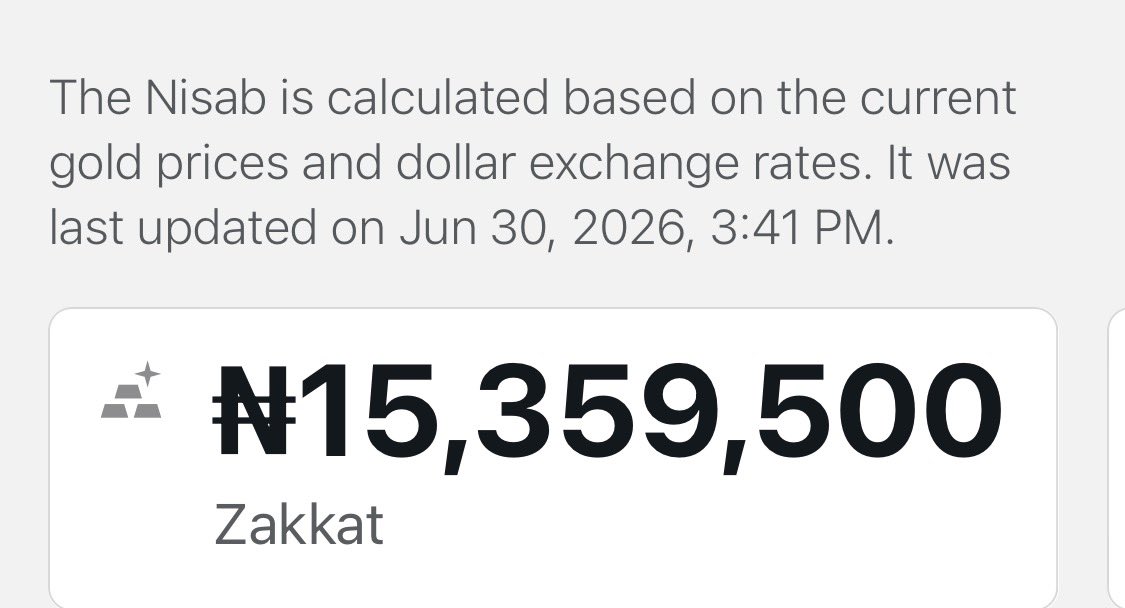
I say let me remind you, that as at 30th June 2026, the Nisāb for Zakāt is estimated at ₦15,359,500.00.
What does that mean?
Nisab is the minimum amount of wealth a Muslim must own continuously for one lunar (Hijri) year before Zakat becomes obligatory. In this case, based on the current value of 85 grams of gold and the prevailing exchange rate, anyone whose total Zakatable assets—such as cash, savings, gold, silver, business inventory, investments, and money owed to them (after deducting eligible debts)—equal or exceed ₦15,359,500 is required to pay Zakat. The amount of Zakat due is 2.5% (one-fortieth) of the qualifying wealth, not the entire ₦15.36 million. For example, if your net Zakatable wealth is exactly ₦15,359,500, your Zakat would be about ₦383,988 (2.5%), provided you have held that level of wealth for a full Hijri year.
Fear Allãh and give out your Zakāt.
You made $1M, this is how much you keep after taxes
🇦🇪 UAE - $1,000,000
🇲🇨 Monaco -$1,000,000
🇰🇾 Cayman Islands -$1,000,000
🇭🇰 Hong Kong -$850,000
🇸🇬 Singapore -$780,000
🇺🇸 USA - $680,000
🇨🇭 Switzerland - $670,000
🇬🇧 United Kingdom -$575,000
🇦🇺 Australia - $565,000
🇩🇪 Germany - $555,000
🇨🇦 Canada - $540,000
🇪🇸 Spain - $535,000
🇳🇱 Netherlands - $520,000
🇦🇹 Austria -$500,000
🇫🇷 France -$495,000
🇯🇵 Japan - $490,000
🇧🇪 Belgium - $485,000
🇸🇪 Sweden -$480,000
🇫🇮 Finland -$475,000
🇩🇰 Denmark - $445,000
Sources: PwC, Tax Foundation, IRS (2026). Based on earned income. not crypto or capital gains.
Internal data like databases and APIs are valuable.
So giving AI agents direct access can be risky.
In this handbook, Mayur shows you how to build a Model Context Protocol (MCP), which is a structured, secure way to give multiple AI agents access to your data.
https://t.co/H5xn8QfacM
COUNTRIES BY ESTIMATED NUMBER OF ABORTIONS PER YEAR — 2024
Top 10
1 🇮🇳India — 16.6 million
2 🇨🇳China — 9.7 million
3 🇵🇰Pakistan — 2.24 million
4 🇳🇬Nigeria — 2 million
5 🇮🇩Indonesia — 1.77 million
6 🇻🇳Vietnam — 1.63 million
7 🇧🇩Bangladesh — 1.58 million
8 🇺🇸United States — 1.14 million
9 🇪🇬Egypt — 1.05 million
10 🇲🇽Mexico — 1.04 million
Nigeria is the highest-ranked African country by estimated annual abortions. This reflects its large population and number of pregnancies, not the world’s highest abortion rate.
#Statisense
(WPR)
Nigeria has now been delisted from the International Maths Olympiad, whose finals are happening in Shanghai, China, this July.
It is one of the most prestigious academic competitions in the world.
Nigeria can now only participate as an observer nation, while other countries can participate fully.
This was because of the Ministry of Education’s inability to fund students for 4 consecutive years through National Mathematical Center.
It’s a big shame for Nigeria.
Sometimes the hardest injustices to recognize are our own.
Pharaoh was the ultimate tyrant who wielded his power to harm others.
None of us will rise to his level of cruelty, but all of us hold some degree of power in our relationships, workplaces, communities, and homes.
And where there is power, there is the potential to misuse it.
It's easy to identify the wrongs committed against us. It's harder to ask:
- Have I apologized when someone told me I hurt them?
- Have I dismissed another person's experience because it challenged my own?
- Have I used my power to serve others or to serve myself?
Ashura is a reminder that Allah is with the oppressed.
And it’s also a reminder to ensure we are not contributing to another person's hardship.
"O you who believe! Stand firmly for justice, as witnesses for God, even against yourselves..." [ Qur'an, 4:135 ]
Reflect on more teachings about Ashura in Yaqeen’s blog: “What Happened on the Day of Ashura? Contextualizing the Events and Meaning of Ashura” by Yaqeen Institute. https://t.co/259Ntx9N61 #yqnblogs
On a Monday morning in March 2023, Amara Nwosu woke up to discover she had bought a house.
She had not bought a house.
She had never signed any document.
She had never met the seller.
But somewhere in the Lagos land registry, her BVN, her NIN, her signature — perfect, precise, indistinguishable from the one she had used her entire adult life — had authorised the purchase of a property worth ₦47 million.
And the loan taken to buy it was in her name.
Amara was 34.
A data analyst at a telecoms firm in Victoria Island.
She was the kind of person who used different passwords for different accounts, who read privacy policies, who had set up two-factor authentication on everything she owned before most Nigerians knew what two-factor authentication meant.
She was, professionally and personally, a woman who understood how data worked.
Which is why, when she saw the loan alert on her phone at 6:47am, her blood went cold in a specific way.
Not panic.
Recognition.
Someone had been inside her life.
Laughter is anti-inflammatory. Crying is regulating. Hugging is immunoprotective. Singing is vagal toning. Dancing is neurogenic.
Joy is a biological necessity.
CBN's New HoldCo Rules: What Investors Need To Know
========
The Central Bank of Nigeria (CBN) is proposing new rules for financial holding companies (HoldCos) such as Access Holdings, GTCO, UBA, First HoldCo, FCMB Group, and Stanbic IBTC.
The goal is simple: make banking groups stronger, better capitalized, and less exposed to risks.
Key Changes
🔹 More Capital Required
HoldCos will need to maintain additional capital above the minimum required for their subsidiaries.
This could force some groups to raise fresh funds in the future.
🔹 Minimum 51% Ownership
HoldCos must own at least 51% of every subsidiary.
Groups with lower ownership may need to buy more shares or restructure.
🔹 Tighter Corporate Governance
Directors and executives will face stricter rules on how they serve across group companies.
This is aimed at reducing conflicts of interest.
🔹 Less Dependence On Bank Subsidiaries
HoldCos will no longer be able to rely heavily on their banking subsidiaries for funding.
Each entity will be expected to stand on its own financially.
🔹 Stronger Risk Management
Every subsidiary must have its own risk, compliance, and internal control systems.
What This Means For Shareholders
Some HoldCos may return to the market to raise additional capital.
Operating costs could increase as groups comply with the new rules.
Dividend growth may slow in the short term for some companies.
In the long run, stronger governance and capital buffers could make these institutions more stable.
The Bottom Line
The CBN wants stronger and safer banking groups.
For investors, the biggest issue to watch is whether these new requirements will lead to fresh capital raises, changes in dividend policies, or corporate restructuring among the major HoldCo stocks listed on the NGX.
@StockmanNigeria
I finally understand what Machiavelli meant when he said, “Never play fair in a game where others cheat.” It doesn’t mean become evil. It means stop being naive. Stop bringing honesty to people who study manipulation, stop giving access to people who weaponize closeness, and stop expecting clean hands from people who already showed you they’ll throw dirt. Sometimes wisdom is not revenge. Sometimes wisdom is learning the rules of the room before the room uses your goodness against you.
BIG CHANGE:
YOU CAN NOW OFFICIALLY
GENERATE ELECTRICITY FOR YOURSELF, USE WHAT YOU NEED, AND SELL EXCESS ELECTRICITY BACK TO THE GRID THROUGH YOUR DISCO
The Nigerian Electricity Regulatory Commission (NERC) has commenced the Net Billing Regulations 2026, a new framework that allows eligible electricity users to generate power mainly through solar energy for their own use and export excess electricity back to the distribution network.
In simple terms, if your solar system generates more electricity than you consume, you can now send the extra power back to your DisCo and receive credits under a regulated billing arrangement.
This effectively creates what the sector calls a “Prosumer” ;meaning you are both a consumer and producer of electricity.
However, there are conditions.
This is not yet targeted at the average small residential solar setup.
To qualify:
-You must already be connected to a DisCo network.
-Your renewable energy system must have a minimum installed capacity of 50kWp and a maximum of 1.5MWp
-You must obtain approval from your DisCo.
-You must sign a Net Billing Agreement and register with NERC.
Approved users will receive bidirectional meters that track: ➡️Electricity imported from the grid
⬅️Electricity exported back to the grid
Yesterday, Chinese Ambassador to Nigeria posted on Twitter that Nigerians can now export cow bones duty-free to China.
Under the comment sections, some Nigerians were asking the ambassador to tell them what they are using the cow bones for😁
Some were telling the ambassador to tell his people to come and setup the processing facility here in Nigeria, so they can create jobs.
Funny people. I laughed at our inability to do simple Google search.
As a livestock farmer and Agro commodities trader, I already know the uses of cow bones.
And about building a factory here in Nigeria? Nigerians are the ones to do it, but sadly everyone is building hotels😁
Let me tell you a few uses of cow bones.
Here are 4 major uses of cow bones you can mention in your content;
✍🏻Bone meal fertilizer: Cow bones are processed into bone meal, rich in phosphorus and calcium, used to improve soil fertility.
They prefer this to fertilize their soil not the chemical sold to our rural farmers.
✍🏻Animal feed supplement: Processed bone meal can be used as a mineral supplement in livestock feed, especially for calcium and phosphorus.
We use this for chicken feed, pig, and fish feed production.
Verify the price per kg and you’ll be shocked.
✍🏻Gelatin production: Cow bones can be processed to extract gelatin, used in food, pharmaceuticals, capsules, and cosmetics.
Just imagine the volume of cow bones wasting in your village?
Pharmaceuticals companies are paying billions of dollars to buy it from those processing it.
And I believe those Chinese companies will focus more on this.
It is big money wasting away in Africa because we don’t know anything about value addition.
✍🏻Activated carbon / bone char: Burnt bones can produce bone char, used in filtration, sugar refining, and water purification.
Pause here and think deeply with me. They use bone char for water purification in their country.
But they produce capsules and sell to us for water purification😳
Let’s not blame them. We take responsibility.
Now, let’s be honest. This is a golden opportunity for us. Let’s export the cow bones and cash out.
Also, let’s learn how to process the cow bones locally and export the finish product too.
If I tell you now that chicken feed producers in Nigeria import bone meal, you won’t believe. Research it yourself.
A ton of bone meal is around $200 - $750 currently.
Bro, just imagine earning over $200 from wastage thrown around our local markets in Africa.
Business opportunity for you. Do your research and see how you can position to serve this market
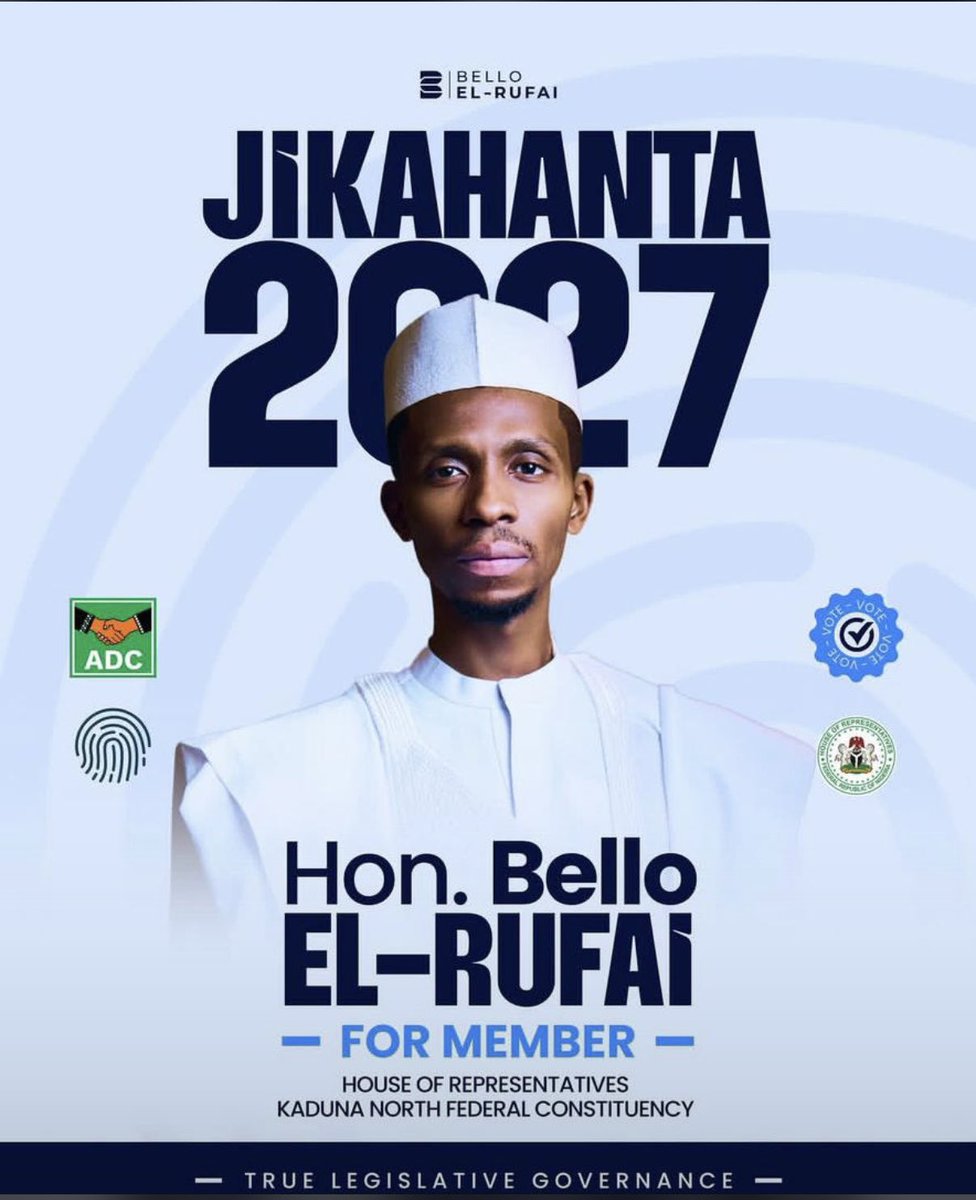
In the name of Allah SWT, the most Beneficent, the most Merciful. If running again will not be in the interest of the excellent people of Kaduna North and Nigerians as whole. Then may God give it to another. In the coming weeks, I will be going around by the grace of God to engage the people of Kaduna North in their homes and streets, as well as the stakeholders of our party, the African Democratic Congress, (ADC). I am not entitled to anything and I will work as hard as I can and always do to state our record and convince the public. We will do this while willing to support whoever emerges in the primary election. Regardless of the outcome we will campaign for the candidates in our party with the precision, honesty and transparency we are known for. My focus is still ensuring justice for our dear father, Mallam Nasir El-Rufai but we will be testing this mic from this week Insha Allah. See you soon.
Signed: Jika Hanta
Mallam’s proud son.
The scariest finding in this paper: the subjects couldn't tell it was happening.
UPenn ran this study on 48 healthy adults. One group slept 8 hours. Another slept 6. Another slept 4. For 14 straight days. They tested cognitive performance every 2 hours from 7:30am to 11:30pm.
The 6-hour group's reaction times, working memory, and sustained attention deteriorated on a near-linear curve. By day 14 they were performing at the same level as someone who hadn't slept at all in 48 hours. The 4-hour group hit that threshold by day 6.
Here's the part that should unsettle everyone who thinks they "do fine" on 6 hours: the subjects' self-reported sleepiness flatlined after the first few days. Their brains kept getting worse. Their perception of how impaired they were stopped updating. The cognitive decline was invisible to the person experiencing it.
The researchers found a hard threshold. Any wakefulness beyond 15.84 hours in a day produces cumulative neurobiological cost. That cost compounds every single day you exceed it and does not reset with a weekend of sleeping in.
About 35% of American adults sleep less than 7 hours a night. 40% of those get 6 hours or less. In 1942 that number was 11%. We built an entire professional culture around a sleep schedule that this paper says is functionally equivalent to pulling consecutive all-nighters.
"I'm fine on 6 hours" is the most common response to sleep research. The first thing chronic sleep debt destroys is your ability to notice chronic sleep debt.
When I first moved to the UK, a company sent me a cheque for a refund.
I took the cheque to the bank as we normally do in Najia.
The teller told me I could just scan it via their app. I did, and within seconds, the money was showing incoming in my account.
Then I tried to hand her the physical cheque, but she said, “You can keep it or shred it."
As a former banker, I didn't know how to react.
In Nigeria, banks store physical cheques for 10 years after transaction.
This actually happened. It's documented in court filings.
MTN launched MoMo PSB in May 2022. One of Nigeria's most anticipated fintech products. CBN licensed. Heavily backed.
Seven days after launch, a system glitch triggered 700,000 unauthorized transactions.
₦22.3 billion was transferred to 8,000 accounts across 18 Nigerian banks.
MTN shut the service down on May 25 after noticing the transfers. Resumed within 24 hours. Then sued all 18 banks case No. FHC/L/CS/960/2022 to recover what was left.
By the time it was over, ₦10.5 billion was gone for good. The rest recovered through courts.
The painful part:
This was not a sophisticated attack.
It was a system integration glitch the kind that happens when you rush infrastructure to market without exhaustive edge case testing.
MoMo was connected to partner bank platforms.
Something in those integrations broke and you know in fintech, a broken integration does not just throw an error.
It moves money.
In seven days ₦22 billion gone. 700,000 transactions that were never supposed to happen.
Test your integrations like lives depend on it.
Because in fintech, money does.






![yaqeeninstitute's tweet photo. Sometimes the hardest injustices to recognize are our own.
Pharaoh was the ultimate tyrant who wielded his power to harm others.
None of us will rise to his level of cruelty, but all of us hold some degree of power in our relationships, workplaces, communities, and homes.
And where there is power, there is the potential to misuse it.
It's easy to identify the wrongs committed against us. It's harder to ask:
- Have I apologized when someone told me I hurt them?
- Have I dismissed another person's experience because it challenged my own?
- Have I used my power to serve others or to serve myself?
Ashura is a reminder that Allah is with the oppressed.
And it’s also a reminder to ensure we are not contributing to another person's hardship.
"O you who believe! Stand firmly for justice, as witnesses for God, even against yourselves..." [ Qur'an, 4:135 ]
Reflect on more teachings about Ashura in Yaqeen’s blog: “What Happened on the Day of Ashura? Contextualizing the Events and Meaning of Ashura” by Yaqeen Institute. https://t.co/259Ntx9N61 #yqnblogs](https://pbs.twimg.com/media/HLqK5AHWUAAib_h.jpg)