14.3.3 on Cybertruck gave FSD's best performance yet on my hairpin turn test, but it's still bad at speed control on empty, rural roads. everything else in this version is solid like usual though
@TSLAFanMtl bad maps often make it think that it's on a public road, so it quits halfway through. when it works, activation radius is the next biggest barrier
@ogre_codes true. I often use 3rd party chargers for that reason, but it wouldn't have helped you much here. Electrify America is the southernmost charger there but nearly the same detour
An ambulance appears behind me, FSD politely goes to the curb then resumes once the ambulance is past 🤌 oh, and the human driver at the very end runs his red light 😊
@Romy_Holland it wasike this when we traveled North Africa and the Middle East with our young kids and toddler. everyone loved them, especially the men
Smartphones are not the explanation for the recent decline in fertility. Instead, they are an accelerator of deeper forces already at work.
Let’s start with the facts. Fertility is falling almost everywhere: in rich, middle-income, and poor countries; in secular and religious countries; and in countries with high and low levels of gender equality.
The decline accelerated around 2014. So, no country-specific explanation will work unless you are willing to believe that 200 distinct country-specific explanations arrived at roughly the same time.
Smartphones look like the obvious candidate: the first iPhone was released in 2007, and global adoption has been astonishingly fast.
Economists understand the first major decline in fertility in advanced economies, from 6 or 7 children per woman throughout most of human history to about 1.8, that occurred between the early 1800s and roughly 1970, well before smartphones. The main drivers were a sharp fall in child mortality (effective fertility was rarely above 3 and often close to 2) and the shift from a low-skill, rural agrarian economy to a high-skill, urban industrial one. We have quantitative models that fit these facts well.
Country-specific factors mattered too, of course. Proximity to low-fertility neighbors accelerated Hungary’s decline, while fragmented landowning structures accelerated France’s. But these were second-order mechanisms.
This is also why most economists long considered Paul Ehrlich’s doom scenarios implausible. We forecast that fertility in middle- and low-income economies would follow the same path as in the rich, probably faster, because reductions in child mortality reached India or Africa at lower income levels (medical technology is nearly universal, and most gains come from handwashing and cheap antibiotics, not Mayo Clinic-level care). Much of what we see in Africa or parts of Latin America today is still that old story.
But in the 1980s, a new pattern appeared. Japan and Italy fell below 1.8, the level we had thought was the new floor. By 1990, Japan was at 1.54 and Italy at 1.36.
This second fertility decline began in Japan and Italy earlier than elsewhere, driven by country-specific factors, but the underlying dynamics were widespread: secularization, an education arms race, expensive housing, the dissolution of old social networks, and the shift to a service economy in which women’s bargaining power within the household is higher. The U.S. lagged because secularization came later, suburban housing remained relatively cheap, and African American fertility was still high. U.S. demographic patterns are exceptional and skew how academics (most of whom are in the U.S.) and the New York Times see the world.
My best guess is that, without smartphones, Italy’s 2025 fertility rate would be about 1.24 rather than 1.14. I doubt anyone will document an effect larger than 0.1-0.2. Italy was at 1.19 in 1995, not far from today’s 1.14. The TFR is cyclical due to tempo effects, so I do not read too much into the rise between 1995 and 2007 or the decline from 1.27 in 2019 to 1.14 today. The direct effect of smartphones is not zero, but it is not, by itself, that large.
Where social media, in general, and smartphones, in particular, matter is in the diffusion of social norms. What would have taken 25 years now happens in 10. Social media are not the cause of fertility decline; modernity is. But they are a very fast accelerator.
That is why social media are a major part of the story behind Guatemala (yes, Guatemala) going from 3.8 children per woman in 2005 to 1.9 in 2025. Without them, Guatemala would also have reached 1.9, just 20 years later.
Modernity, in its current form, is incompatible with replacement-level fertility. By modernity, I do not mean capitalism: fertility fell earlier and faster in socialist economies than in market economies. Socialist Hungary fell below replacement in 1960, and socialist Czechoslovakia in 1966 (both experienced small, short-lived baby booms in the mid-1970s). By modernity, I mean a society organized around rational, large-scale systems and formalized knowledge.
Countries will not converge to the same fertility rate. East Asia is likely stuck near 1, possibly below, given its unbalanced gender norms and toxic education systems. Latin America faces the same gender problem plus weak growth prospects, so I expect something around 1.2. Northern Europe has more egalitarian family structures and might hold near 1.5. The very religious societies are probably the only ones that will sustain 1.8.
All of this could change with AI or changes in population composition. We will see. But on the current evidence, deep sub-replacement fertility is the “new new normal.” Unless we reorganize our societies, better learn to handle it as best we can.
@grok@ChrisChichester@SawyerMerritt notice that the "primary limiter for vehicle output" is packs not demand, according to earnings calls. they could have happily said, "margin protection" but said packs, so I think that's it
@grok@ChrisChichester@SawyerMerritt@grok read the transcripts for Tesla's last 3 quarterly earnings calls and reconcile your comments about battery cells against comments in those calls about being constrained by battery pack supply. pay attention to the difference between cells and packs
@ChrisChichester@SawyerMerritt Tesla has said that their current bottleneck is battery packs, so this could be maximum production until that's resolved
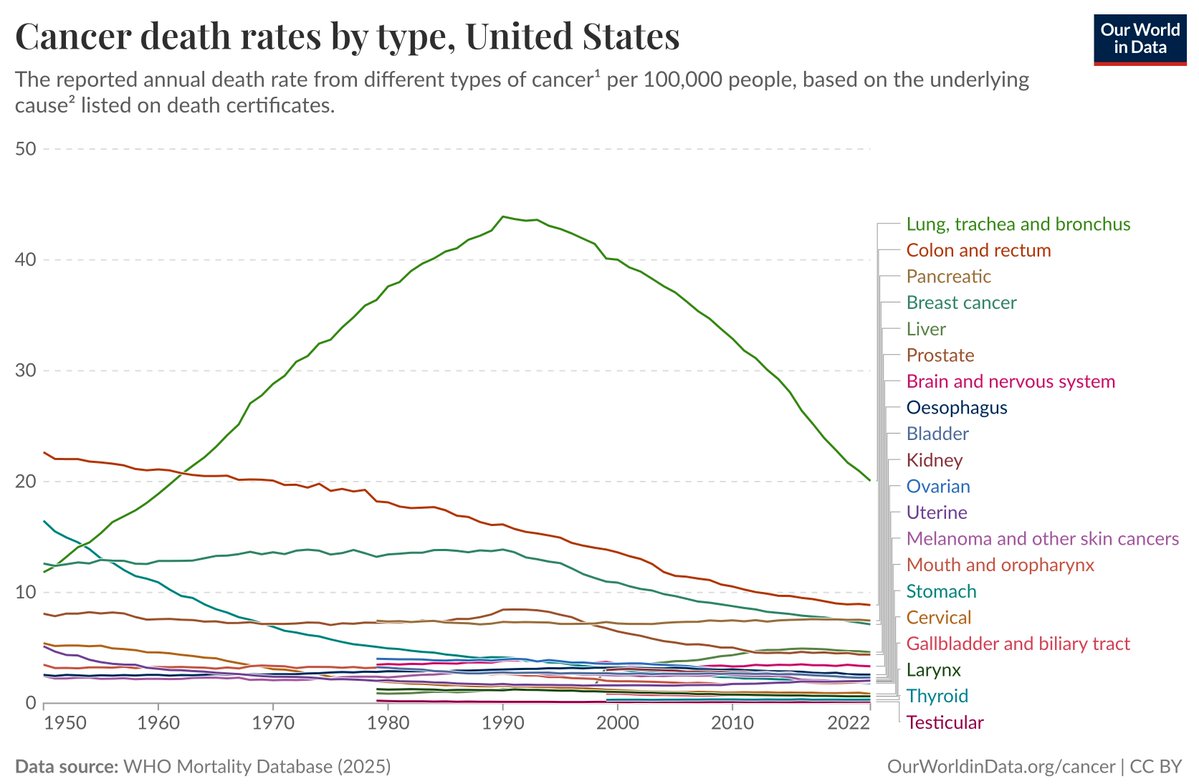
9x. That's how far stomach cancer death rates fell in the US between 1950 and 2021.
Not because of some wonder drug. Because of refrigerators.
When families stopped preserving food with salt and smoke, H. pylori infections dropped. Stomach cancer followed. A kitchen appliance rewrote the trajectory of one of the deadliest cancers of the 20th century.
Now look at pancreatic cancer on the same chart. Flat line. Seven decades of research, and the death rate barely moved. 86% of cases are caught after the tumor has already spread. By the time you have symptoms, you're late.
Lung cancer tells a third story: it rose for 50 years as cigarettes spread, peaked, and is now falling thanks to smoking bans, LDCT screening, and immunotherapy.
"Cancer" isn't one disease. This chart shows at least a dozen, each with its own biology, its own timeline, and its own reckoning.
The age-standardized death rate across all cancers has dropped by a third since 1990. But that number hides everything interesting. Some cancers are nearly solved. Others haven't moved in a lifetime.
Your risk depends on which one you get, not just whether you get it.
@AmericanMom2025@TeslaCharging honest question: why would you do separate charging and bathroom stops? I've always been able to find a charger with a restroom nearby, even in very remote areas