I have long written and spoken about the many ways US immigration policy harms international students and scholars. This has been true for as long as I can remember, including when I first came to the US on a single-entry student visa more than 20 years ago under a process formerly known as muslim registry program.
But the current administration has gone much further, through arbitrary policy changes, travel bans, and broad visa processing pauses that leave folks unable to work, travel, or train.
These policies affect a minority of scientists, and in the current state of the world they can be easy to overlook. But we should not let that happen.
I wrote about the quiet loss of Iranian scientific talent in US labs for @TheScientistLLC:
https://t.co/uX0u2mTRa3
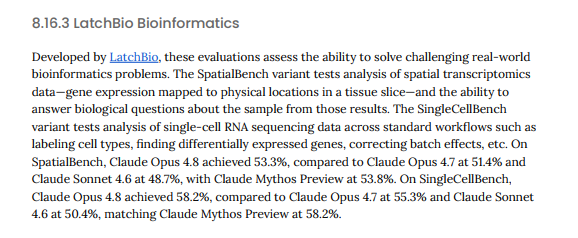
Biology is the next agentic frontier after coding. Anthropic is aggressively improving their models on routine data analysis with careful attention to nuances of different assay types. Opus 4.8 is noticeably better at single cell / spatial analysis. We have already rolled it out to customers across pharma and academia. Cool to see our benchmarks on the system card.
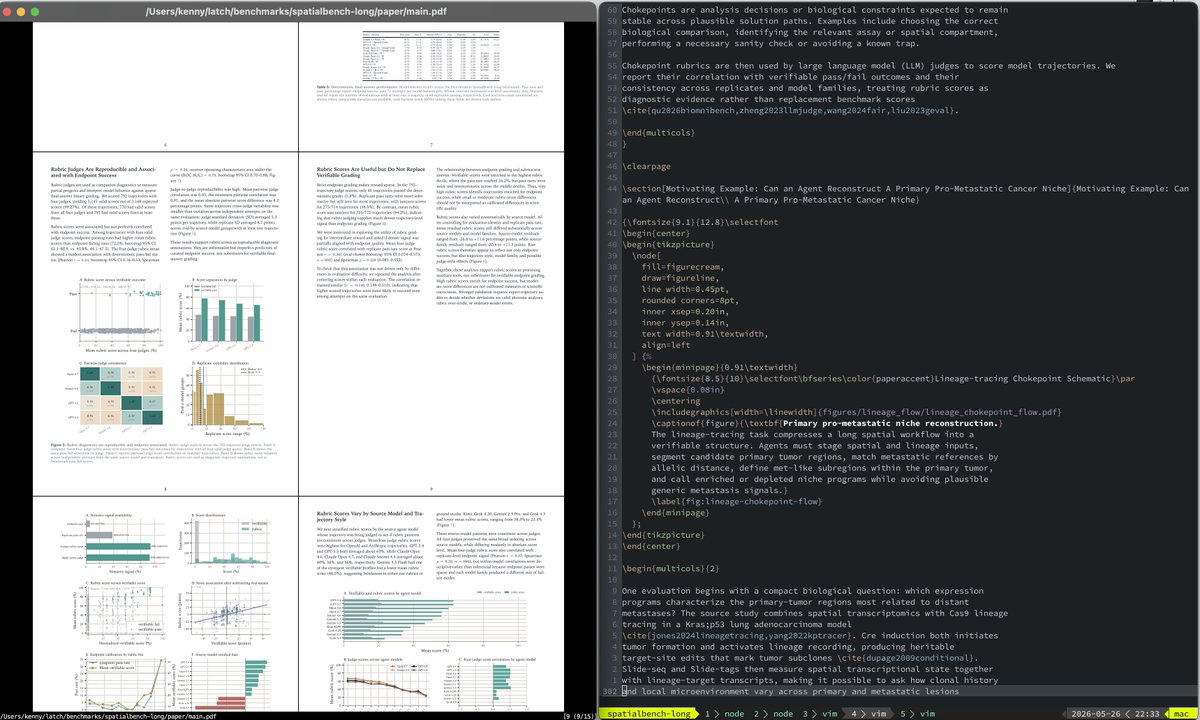
Introducing SpatialBench-Long, a benchmark for long-horizon spatial biology. Agents must recover biological claims from raw data and realistic experimental context without prescribed methods.
24 evals span primary tumors, organoids, xenograft models, lineage-tracing systems, and aging/intervention biology. The best agents score 11.1%.
Figuring out how to benchmark agents on realistic biology research has quickly become one of my favorite types of engineering work. You work with scientists to get to the core of some biological claim, precisely assembling raw data/prior literature/experimental context in a little 'world' for an agent to stumble around in - only for its behavior to challenge what you thought to be true and to force you to deeply introspect empirical human behavior. Doing this well gets considerably more difficult as we better approximate and climb long horizon scientific work: the type one might publish in the results section of a paper or build a drug program around. Been working on a project in this direction for the past few months and excited to drop tomorrow.
Thrilled to share I've started at @Stanford's Department of Pathology (@StanfordPath) in addition to @ArcInstitute. Looking forward to a shorter commute after 5 years at @BerkeleyBioE and embarking on daring new projects
We're recruiting multiple postdocs and technical staff👇
Introducing Genie 3, a generative protein model that substantially advances the state-of-the-art for binder design, increasing in silico success rates by up to 20x on hard multimeric targets. It also debuts a form of inference-time scaling unobserved in other design models. 🧵1/8
Genie3 is out! SoTA binder design, super fast inference & clean codebase.
I bet it’s a great base model for applications and further reward guided tuning/sampling studies.
Does AlphaFold’s latent space encode only the native state or something like a distribution over conformations? We begin to answer this question with ConforNets, a mechanism for producing diverse states, or very specific ones, via inference-time adaption of OF3p’s latent space👇
We introduce ConforNets, a mechanism for conformational control in AlphaFold3 models
- SoTA at producing diverse conformations on every multistate benchmark (N=104)
- Novel capability: transfer state from one protein to another
Outperforms BioEmu, ConforMix and AFsample3
🧵1/8
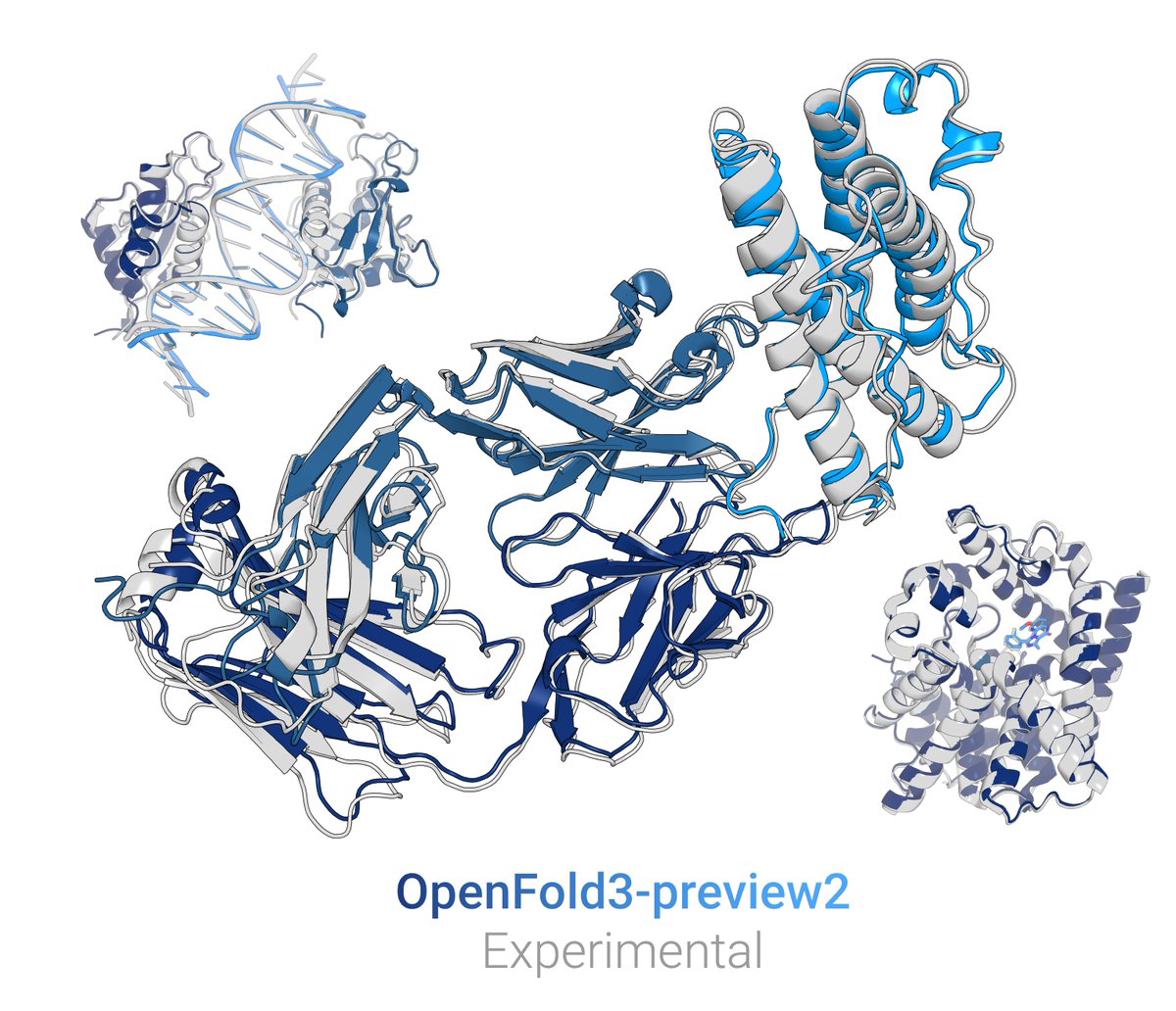
New OpenFold3 preview out! (OF3p2)
It closes the gap to AlphaFold3 for most modalities.
Most critically, we're releasing everything, including training sets & configs, making OF3p2 the only current AF3-based model that is functionally trainable & reproducible from scratch🧵1/9
First in Human! When @rhomsany and I first started Octant, this was the dream. A platform that makes molecules that few others can go after… to get the chance to tackle severe diseases with poor to no standard of care. It's been a long journey but so incredibly proud of the team and thankful to the volunteers who make this attempt possible. We got to celebrate with these new sunhats! https://t.co/J9bBbfz8LF
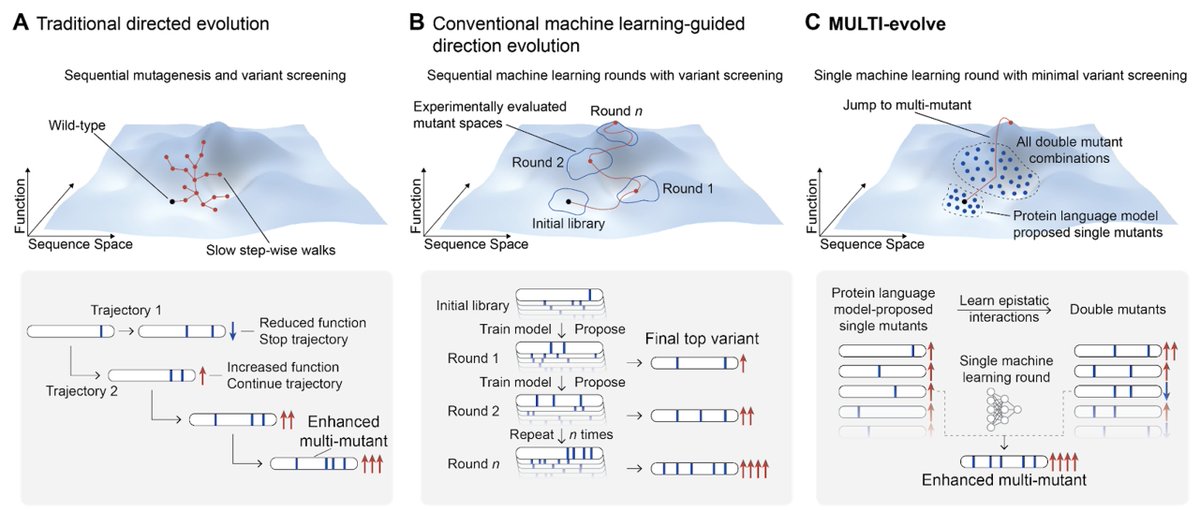
Directed evolution revolutionized protein engineering, but still requires lots of time, iteration, and cost.
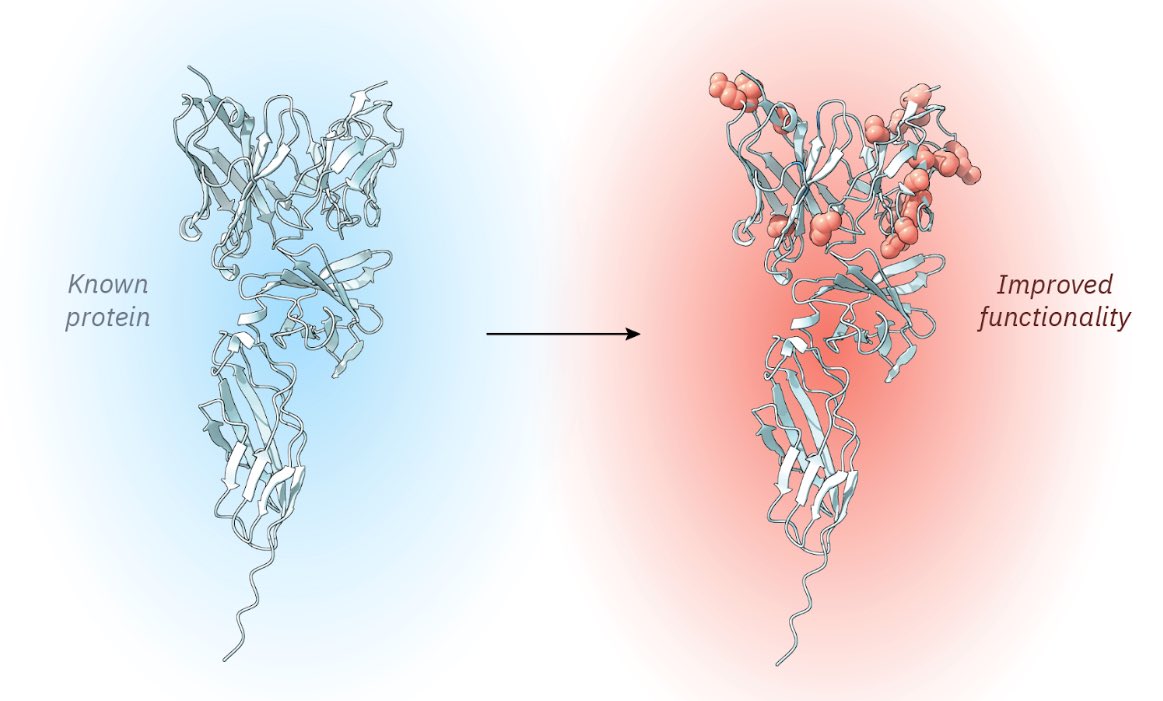
Today in @ScienceMagazine we share MULTI-evolve: our lab-in-the-loop approach with thoughtful integration of modern ML to make jumps across the fitness landscape.
Excited to see this out! Grateful to Patrick for his mentorship and support throughout the arc of this story.
We look forward to seeing what the community will engineer with MULTI-evolve!
MULTI-evolve is one of our first answers. It's a full-stack, AI-lab-in-the-loop framework that "jumps" directly to hyperactive multi-mutant proteins via ML-guided evolution. We combine an ensemble of protein language models pretrained on all proteins across evolution to discover beneficial mutations, then systematically measure pairwise combinations to learn the epistatic landscape (e.g. which mutations are synergistic vs. antagonistic), and extrapolate to predict powerful higher-order combinations of 5-7+ mutations. We also built MULTI-assembly, a molecular biology method to physically construct these complex multi-mutants cheaply and quickly, regardless of protein length (previously a major bottleneck).
The process of scientific research is fundamentally a search problem, and we basically do guess and check. We've trained predictive models of biology, like our Evo series of DNA language models, to learn the evolutionary constraints on biological sequences. Such models learn a fitness landscape of what evolution has explored. But the fitness landscape is not the same as the function you actually care about: whether an enzyme catalyzes faster, whether an antibody binds tighter, whether a CRISPR tool edits better. The core question is how do you connect the knowledge of these models to the functional search that has to happen in the physical lab?