Africa’s best creators will be in the room. 🔥
Join @gyaigyimii and Africa’s biggest creatives and leaders at #MindsetReset2026 on August 25–26 in Kigali.
Join the Reset!
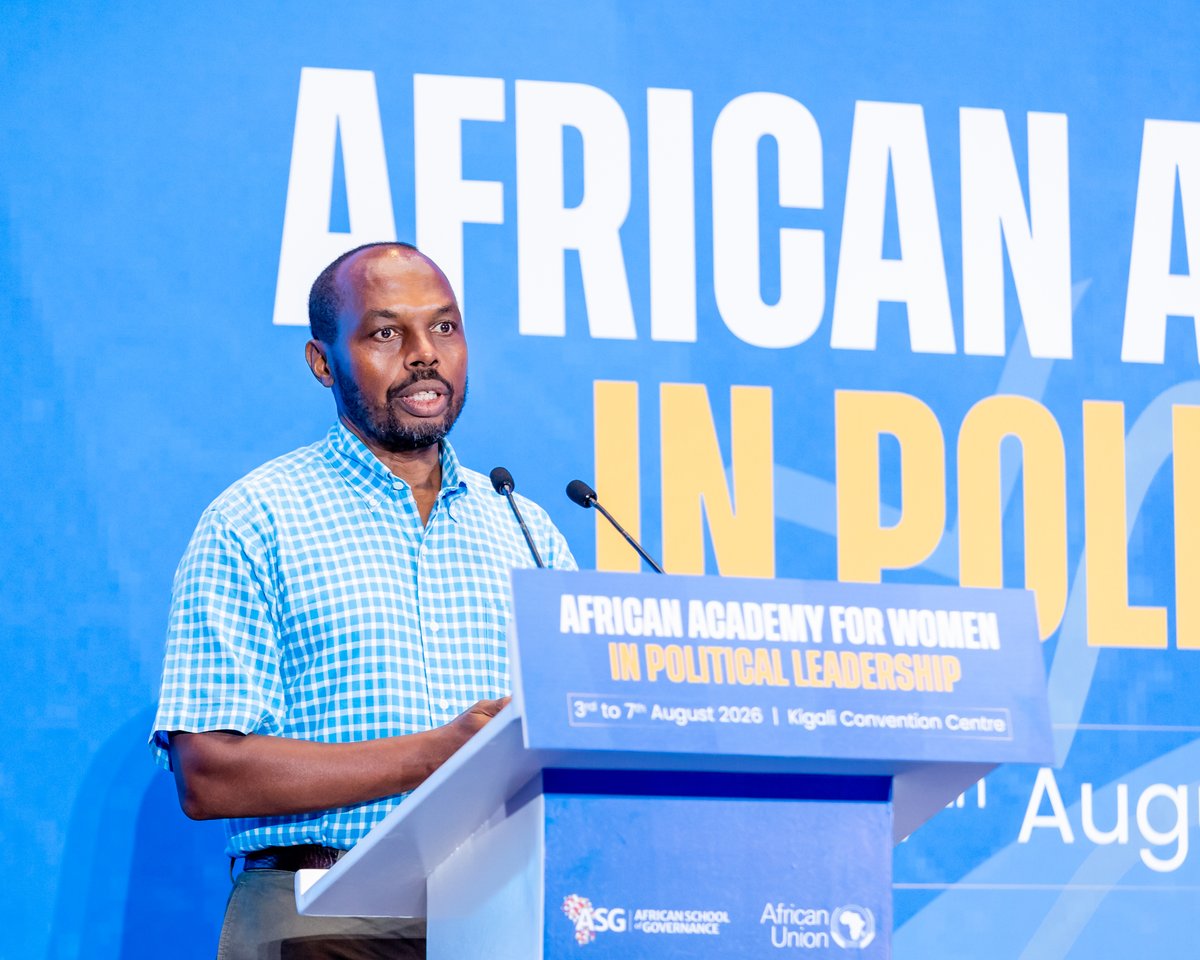
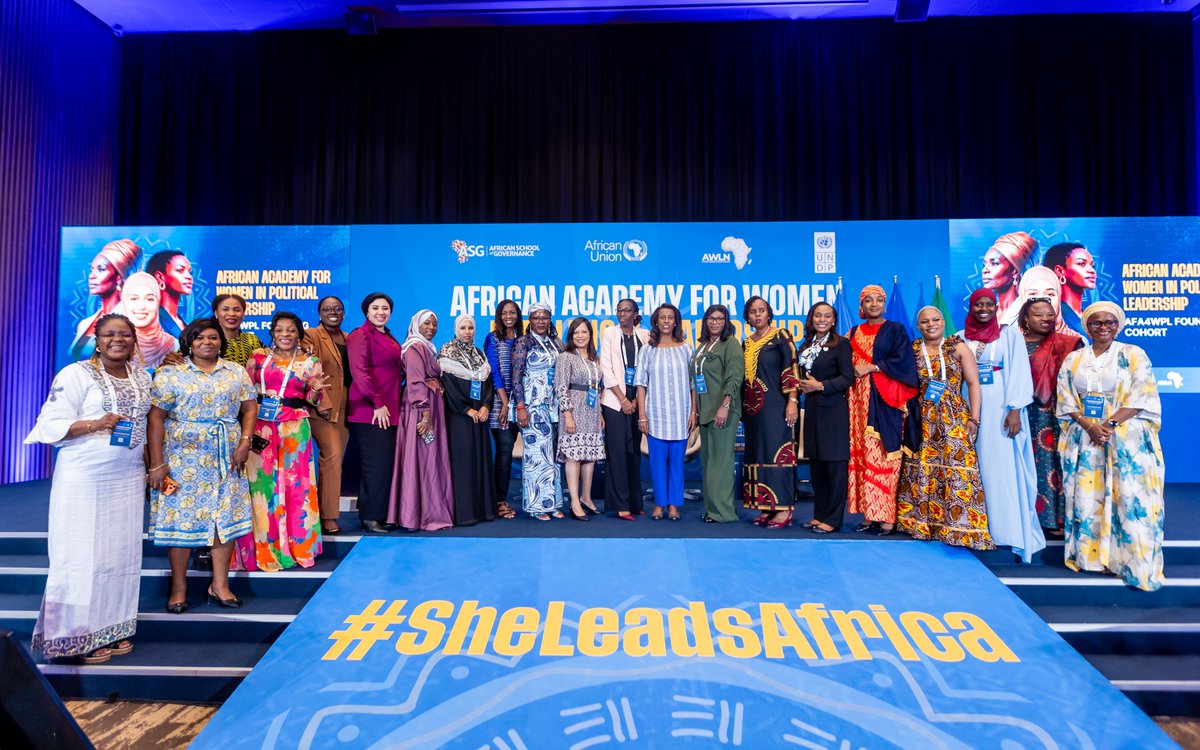
As the inaugural cohort of the African Academy for Women in Political Leadership concluded its first week of learning, @Francis_Gatare, ASG President shared closing remarks:
“At ASG, we are deeply privileged to have been entrusted with the responsibility of being part of your journey. This is just one milestone ushering you into the next phase. We are honoured to continue walking alongside you over the next several weeks.”
Today, Speaking further on the planned NYSC reform, the Special Adviser to President Tinubu on Policy Coordination, @hadizabalausman, revealed that the NYSC orientation camp would be restructured into three phases:
- The first two weeks will focus on civic responsibility, national values, and leadership development.
- The next two weeks will cover career mapping, financial literacy, business planning, and access to finance.
- The final two weeks will provide specialised training based on each corps member’s chosen career stream.
Under the new framework, corps members will select one of the newly created 11 specialised streams upon registration and will receive specialised training throughout the orientation programme in preparation for future employment and national service.
The 11 specialised streams are: Agric Corps, Medical Corps, Education Corps, Tech and Digital Corps, Legal Corps, Public Service Corps, Infrastructure Corps, Green Corps, Enterprise Corps, Creative Economy Corps, and Paramilitary and Security Corps.
She added that the specialised streams will equip graduates with practical skills tailored to their academic backgrounds, career interests, and the country’s workforce needs.
Usman noted that the reforms also review deployment procedures, including how corps members are posted across states, with greater consideration for prevailing security realities.
Details of Proposed Constitutional Amendments for the Establishment of State Police and Federal Police
1. Establishment of Federal Police and State Police (New Section 214)
• Two distinct police bodies are constitutionally established:
• (a) the Federal Police
• (b) State Police (one per State, established by State law)
The National Assembly must pass an Act prescribing:
• Structure, organisation, administration, and powers of the Federal Police
• Framework and guidelines for the establishment of State Police
• State Police cannot commence operational policing until:
• Established by a Law of the State House of Assembly, and
• Certified as meeting national minimum standards (prescribed by an Act of the National Assembly)
• Transitional provision: Until a State Police becomes operational, the Federal Police continues all policing functions in that State. After commencement, the Federal Police handles federal policing functions and may provide assistance to the State Police.
2. Responsibilities and Non-Interference (Section 214)
Federal Police is responsible for:
• Maintenance of public security, public order, and security of persons/property throughout the Federation (to the extent provided by the Constitution or National Assembly Act).
• Similar functions within a State to the extent the State has legislative power under the Constitution.
Key safeguard against federal overreach (Section 214(6)):
The Federal Police shall not interfere with State Police operations or a State’s internal security affairs except in these limited cases:
• To contain serious threats where there is a complete breakdown of law and order and the State Police is unable to respond.
• When the Governor requests intervention.
• When a State Police is unable to function due to administrative, financial, or other problems.
Any such intervention requires prior approval by the National Police Council.
Federal Capital Territory (FCT): Fully under the jurisdiction and operational control of the Federal Police.
3. Leadership and Command (New Section 215)
• Federal Police: Headed by the Inspector-General of Police (IGP).
• Appointed by the President on the advice of the National Police Council, from serving members of the Federal Police.
• Subject to confirmation by the National Assembly.
• The IGP has command over the entire Federal Police, including contingents in States.
• The President (or authorised Minister) may give lawful directions on public safety and order; the IGP must comply.
• State Police: Headed by a Commissioner of Police (CP).
• Appointed by the Governor on the advice of the National Police Council, from serving members of the State Police.
• Subject to confirmation by the State House of Assembly.
• The Governor (or authorised Commissioner) may give lawful directions on public safety and order; the CP must comply.
• If the CP believes a direction is unlawful or contradicts general policing standards, the matter can be referred to the National Police Council (whose decision is final).
4. Removal of Top Officers (New Section 216)
• IGP: Removed only by the President on the recommendation of the National Police Council for specified grounds (grave misconduct, breach of Police Act/Regulations/Code of Conduct, conviction for fraud/dishonesty, bankruptcy, or mental incapacity). Requires two-thirds majority approval of the National Assembly.
• State Commissioner of Police: Removed only by the Governor on the recommendation of the National Police Council for similar grounds. Requires two-thirds majority approval of the State House of Assembly.
5. Funding Support (New Section 216A)
The Federal Government shall provide grants or aids to State Police on the recommendation of the National Police Council, subject to approval by the National Assembly.
6. Oversight Bodies
National Police Council (restructured and renamed from the old Nigeria Police Council; new composition and expanded functions in Third Schedule):
• Broad membership including: Chairman (Presidential appointee confirmed by NA), Attorney-General of the Federation, serving senior Federal Police officer, Attorneys-General of all States, retired Commissioners of Police (one per geo-political zone), representatives of NHRC, Public Complaints Commission, NLC, NBA, NUJ, and Traditional Rulers’ Councils.
• Key functions: Appointment and discipline of Federal Police officers (except IGP); recommending State top officers (CP, DCP, ACP) to Governors based on State PSC lists; supervising Federal and State Police activities (within constitutional limits); setting standards for training, intelligence, forensics; assisting State Police on request.
State Police Service Commission (new body established for each State in Third Schedule, Part II):
• Composition: Chairman (appointed by Governor, confirmed by State HA), representatives of NHRC, Public Complaints Commission, NLC, NBA, NUJ, retired Assistant Commissioners of Police (one per senatorial district), and Traditional Rulers’ Council.
• Functions: Recommending three qualified candidates for CP/DCP/ACP to the National Police Council; appointment, discipline, and removal of State Police officers below the rank of Assistant Commissioner of Police; other functions as prescribed by Constitution or National Assembly Act.
7. Legislative Framework (Second Schedule – Concurrent Legislative List)
• National Assembly may make laws on: establishment/organisation/administration/powers/duties of Federal Police; powers/duties of State Police; national minimum standards for both; policing standards, inspection, certification, complaints mechanisms, criminal information systems, inter-governmental cooperation, federal intervention, use of force, firearms, grants, and accountability.
• State Houses of Assembly may make laws for the establishment, organisation, administration, funding, and oversight of their State Police — but must comply with the Constitution and valid National Assembly Acts.
• States may set higher standards than national minimums but not lower.
• National Assembly laws cannot give federal authorities routine command, deployment, appointment, promotion, transfer, discipline, or control over State Police personnel (except for explicitly authorised federal intervention).
8. Other Related Changes
• Updates to various constitutional provisions (e.g., Sections 34, 35, 39, 42, 84, 89, 129, 153) to replace references to “Nigeria Police Force” with appropriate “Police”, “Federal Police”, or “State Police” terminology.
• Exclusive Legislative List adjustments (e.g., light arms for policing purposes; fingerprints/biometrics/forensics shared with State Police; Federal Police listed separately).
• Consequential amendments to the Third Schedule for the new bodies and their compositions/powers.
Pleased to share my appointment by Bluecode Africa, the European payments infrastructure operator backed by leading US and European institutional investors, as Chairman of the Advisory Board of its Nigerian subsidiary, Bluecode Payments Nigeria Limited as the company formally enters the Nigerian market. Honored to support international business in the financial sector payments system anchored by policy and regulatory work I led after the global financial crisis.
#Internationalbusiness
#CorporateGovernance
#Strategy
https://t.co/vtZq5cfOxk
STATEHOUSE PRESS RELEASE
PRESIDENT TINUBU ESTABLISHES TASK FORCE ON EBOLA; APPROVES N10B FOR EMERGENCY PREPAREDNESS
President Bola Ahmed Tinubu has approved the establishment of a Presidential Task Force on Ebola Virus Disease Preparedness and Emerging Public Health Threats and ordered the immediate release of N10 billion as emergency intervention funding.
The fund will strengthen the operational preparedness of the National Centre for Disease Control and Prevention (NCDC) and support critical national public health emergency response activities.
The Presidential Task Force on Ebola will be chaired by the Chief of Staff to the President, Femi Gbajabiamila, with membership drawn from relevant Ministries, Departments, and Agencies (MDAs) and State representatives.
Ebola has recently resurfaced in the Democratic Republic of Congo (DRC) and Uganda, both neighbouring countries.
The President’s approval followed a stakeholder meeting convened under the chairmanship of the Chief of Staff to review Nigeria’s preparedness and develop strategies against the possible importation of Ebola into Nigeria.
Other critical stakeholders at the meeting included representatives from the Ministry of Interior, the Federal Airports Authority of Nigeria (FAAN), the Nigeria Immigration Service (NIS), the Nigerian Civil Aviation Authority (NCAA), the Lagos State Government, and others.
President Tinubu also directed all States hosting international airports and international border corridors, as well as relevant MDAs, to submit their plans, funding requirements and intervention needs for consideration and coordinated implementation.
Additional measures to be put in place by the Task Force are: Intensification of passenger screening at all international airports, including enhanced temperature checks and crowd-control protocols; Enhanced monitoring of passengers arriving through high-risk airline routes including Air Uganda, Rwanda Air, Air Tanzania, Air Angola, Kenya Airways, and Ethiopian Airlines; and Immediate activation of referral and isolation centres at Lagos and Abuja international airports, with other airports to follow.
Others include: Mandatory activation of QR code-based pre-arrival health declaration systems for passengers originating from or transiting through designated high-risk countries, and disinfection of departure halls, cargoes, baggage areas, and airport facilities as precautionary environmental measures.
The President mandated that the advisory group consult with security, diplomatic, and aviation bodies with a view to regulating flights from affected and designated high-risk countries.
The Task Force is further directed to designate specific airports or terminals for high-risk flights to enable controlled screening and isolation procedures, and to consider adjusting flight timings to minimise interaction between high-risk passengers and others.
Bayo Onanuga
Special Adviser to the President
(Information & Strategy)
June 09, 2026
Umuyobozi w'Akarere,Mme MUKANDAYISENGA Antoinette uyu munsi yakiriye UWINGABIYE Consolé na Dr Mohammed Ndanusa,abakozi ba @RwandaLocalGov baje mu bugenzuzi ku ngamba zashyizweho n'Akarere mu kwirinda no gukumira icyorezo cya Ebola no kureba uko zishyirwa mu bikorwa.
@RwandaHealth
Yesterday, I had the honour of receiving the President of the Senate, Senator Godswill Akpabio, GCON, the Speaker of the House of Representatives, Rt. Hon. Tajudeen Abbas, PhD, GCON, and other distinguished members of the NILDS Governing Council at the National Institute for Legislative and Democratic Studies (NILDS).
The meeting focused on reviewing the Institute’s progress and strengthening ongoing efforts towards improving legislative capacity and democratic governance.
I am encouraged by the commendation of the Council on the progress recorded by the Institute and the dedication of its management and staff.
We remain committed to doing more in service of Legislative and Democratic nation building
Taxes collected in East Africa in 2024/2025.
Kenya collected $19.9 billion from taxes in 2024/25.
Tanzania collected $11.9 Billion.
Uganda collected $8.8 Billion.
Rwanda collected $2.2 Billion
South Sudan collected $217 Million.
Ports are giving back to Kenya and Tanzania. Rwanda managed with tourism and exports.
Nigeria continues to face fundamental security challenges because we continue to postpone the real solutions: a focus on governance over politics- and an understanding that good governance is the best politics - anchored on a serious redesign of Nigeria. Call it restructuring. Call it whatever you will. But until power is devolved far more to Nigeria’s regions (better, because this creates economies of scale) or states, with control over natural resources and anything between 30-40% of resources therefrom contributed to the central government for federal functions, we are simply deferring our deliverance. “Unity” without security and real development is an illusion. State police is urgent, but it’s only part of what needs to be done for Nigeria to work for its people rather than just for politicians. This is the real agenda after the 2027 elections. Unfortunately, it’s still an elite conversation and the people are not educated enough to stand up for #restructuring.
#Oyo
Join us this Saturday for what promises to be an exciting and provocative discussion on the ongoing xenophobic and Afrophobic attacks in South Africa. It will be livestreamed here and archived on our YouTube channel. See the Zoom link to join the conversation from the "studio."
My address at the UN General Assembly (UNGA) where I called for greater respect for national sovereignty, stronger accountability and stewardship in global governance to strengthen the United Nations’ sustainable efforts.
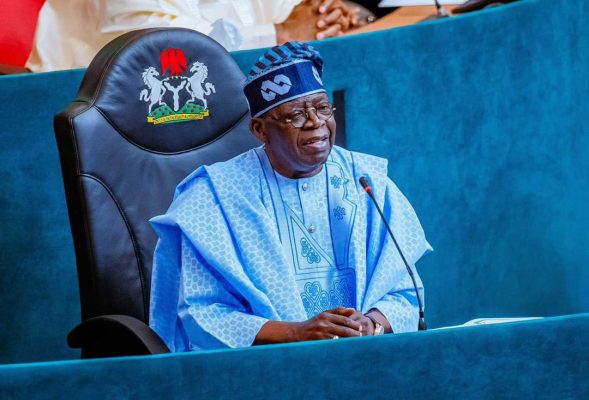
STATEMENT BY PRESIDENT BOLA AHMED TINUBU (GCFR) ON THE THIRD ANNIVERSARY OF HIS ADMINISTRATION, MAY 29, 2026.
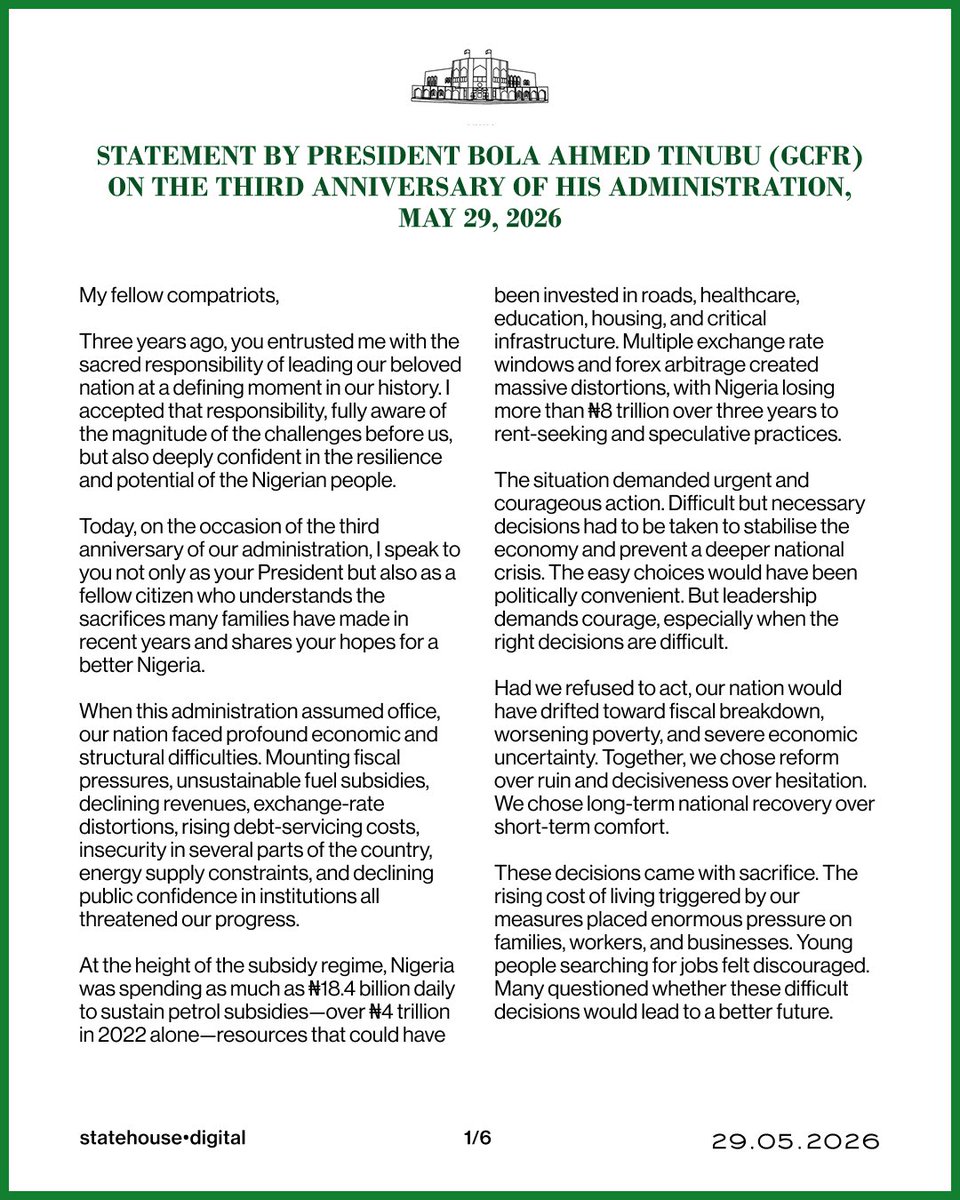
My fellow compatriots,
Three years ago, you entrusted me with the sacred responsibility of leading our beloved nation at a defining moment in our history. I accepted that responsibility, fully aware of the magnitude of the challenges before us, but also deeply confident in the resilience and potential of the Nigerian people.
Today, on the occasion of the third anniversary of our administration, I speak to you not only as your President but also as a fellow citizen who understands the sacrifices many families have made in recent years and shares your hopes for a better Nigeria.
When this administration assumed office, our nation faced profound economic and structural difficulties. Mounting fiscal pressures, unsustainable fuel subsidies, declining revenues, exchange-rate distortions, rising debt-servicing costs, insecurity in several parts of the country, energy supply constraints, and declining public confidence in institutions all threatened our progress.
At the height of the subsidy regime, Nigeria was spending as much as ₦18.4 billion daily to sustain petrol subsidies—over ₦4 trillion in 2022 alone—resources that could have been invested in roads, healthcare, education, housing, and critical infrastructure. Multiple exchange rate windows and forex arbitrage created massive distortions, with Nigeria losing more than ₦8 trillion over three years to rent-seeking and speculative practices.
The situation demanded urgent and courageous action. Difficult but necessary decisions had to be taken to stabilise the economy and prevent a deeper national crisis. The easy choices would have been politically convenient. But leadership demands courage, especially when the right decisions are difficult.
Had we refused to act, our nation would have drifted toward fiscal breakdown, worsening poverty, and severe economic uncertainty. Together, we chose reform over ruin and decisiveness over hesitation. We chose long-term national recovery over short-term comfort.
These decisions came with sacrifice. The rising cost of living triggered by our measures placed enormous pressure on families, workers, and businesses. Young people searching for jobs felt discouraged. Many questioned whether these difficult decisions would lead to a better future.
I remain deeply conscious of those sacrifices, and I assure you: your sacrifice has not been in vain. And today, I can say with confidence that Nigeria has stabilised and is moving forward again. Across the country, visible progress is taking shape.
VISIBLE PROGRESS AND ECONOMIC GROWTH
Our economy is now more competitive and better positioned for sustainable growth than it was in 2023. Public finances are improving. States and local governments have greater resources to invest in their people. Investor confidence is growing. The stock market is booming, with the All Share Index rising from 53,000 and market capitalisation of N30 Trillion in 2023 to a record All Share Index of 250,000 and market capitalisation of N160 Trillion this year. Companies are declaring record profits and dividends.
Critical infrastructure projects are advancing at an unprecedented scale. Over 2,700 kilometres of highways and major roads are under construction, reconstruction, or rehabilitation, including the Lagos-Calabar Coastal Highway, the Sokoto-Badagry Super Highway, the Abuja-Kaduna-Zaria-Kano Road, the East-West Road, and many rural access roads. Significant sections are already completed or nearing completion, improving transportation, reducing travel time, boosting regional trade, and creating thousands of jobs.
Rail modernisation projects are ongoing to improve connectivity, logistics, and economic integration across the federation.
In the oil and gas sector, the reforms we instituted have attracted billions of dollars in fresh investment from the international oil companies that had shunned our country. The $5 billion NLNG Train 7 project is nearing completion to boost LNG production capacity, exports, and dividends.
Domestic gas utilisation is expanding. Local refining capacity has improved our energy security. With large-scale domestic and modular refineries operational, Nigeria is reducing its dependence on imported petroleum products and conserving foreign exchange.
For years, the power sector suffered from debt, underinvestment, and uncertainty, which weakened generation capacity and limited growth. Today, we are confronting those challenges directly.
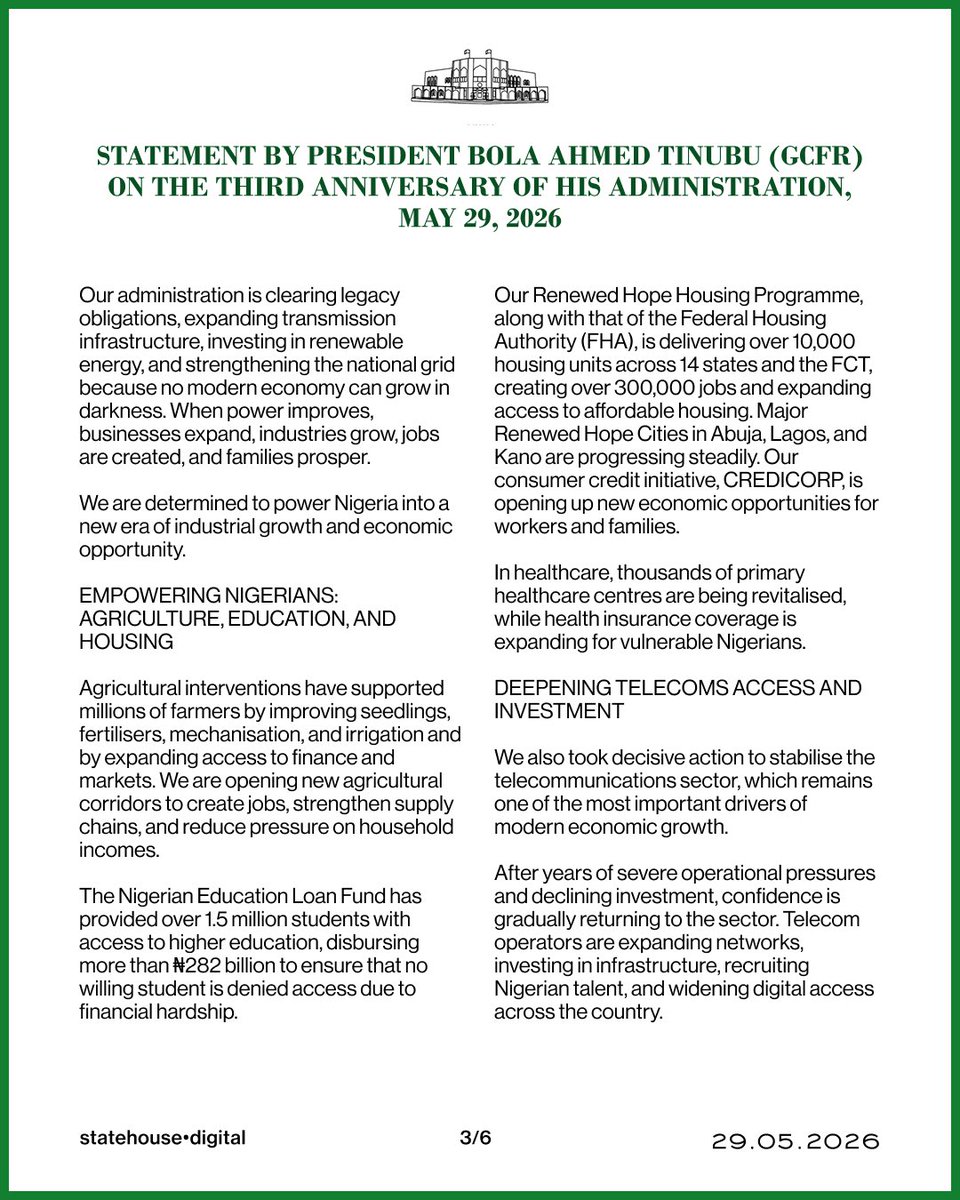
Our administration is clearing legacy obligations, expanding transmission infrastructure, investing in renewable energy, and strengthening the national grid because no modern economy can grow in darkness. When power improves, businesses expand, industries grow, jobs are created, and families prosper.
We are determined to power Nigeria into a new era of industrial growth and economic opportunity.
EMPOWERING NIGERIANS: AGRICULTURE, EDUCATION, AND HOUSING
Agricultural interventions have supported millions of farmers by improving seedlings, fertilisers, mechanisation, and irrigation and by expanding access to finance and markets. We are opening new agricultural corridors to create jobs, strengthen supply chains, and reduce pressure on household incomes.
The Nigerian Education Loan Fund has provided over 1.5 million students with access to higher education, disbursing more than ₦282 billion to ensure that no willing student is denied access due to financial hardship.
Our Renewed Hope Housing Programme, along with that of the Federal Housing Authority (FHA), is delivering over 10,000 housing units across 14 states and the FCT, creating over 300,000 jobs and expanding access to affordable housing. Major Renewed Hope Cities in Abuja, Lagos, and Kano are progressing steadily. Our consumer credit initiative, CREDICORP, is opening up new economic opportunities for workers and families.
In healthcare, thousands of primary healthcare centres are being revitalised, while health insurance coverage is expanding for vulnerable Nigerians.
DEEPENING TELECOMS ACCESS AND INVESTMENT
We also took decisive action to stabilise the telecommunications sector, which remains one of the most important drivers of modern economic growth.
After years of severe operational pressures and declining investment, confidence is gradually returning to the sector. Telecom operators are expanding networks, investing in infrastructure, recruiting Nigerian talent, and widening digital access across the country.
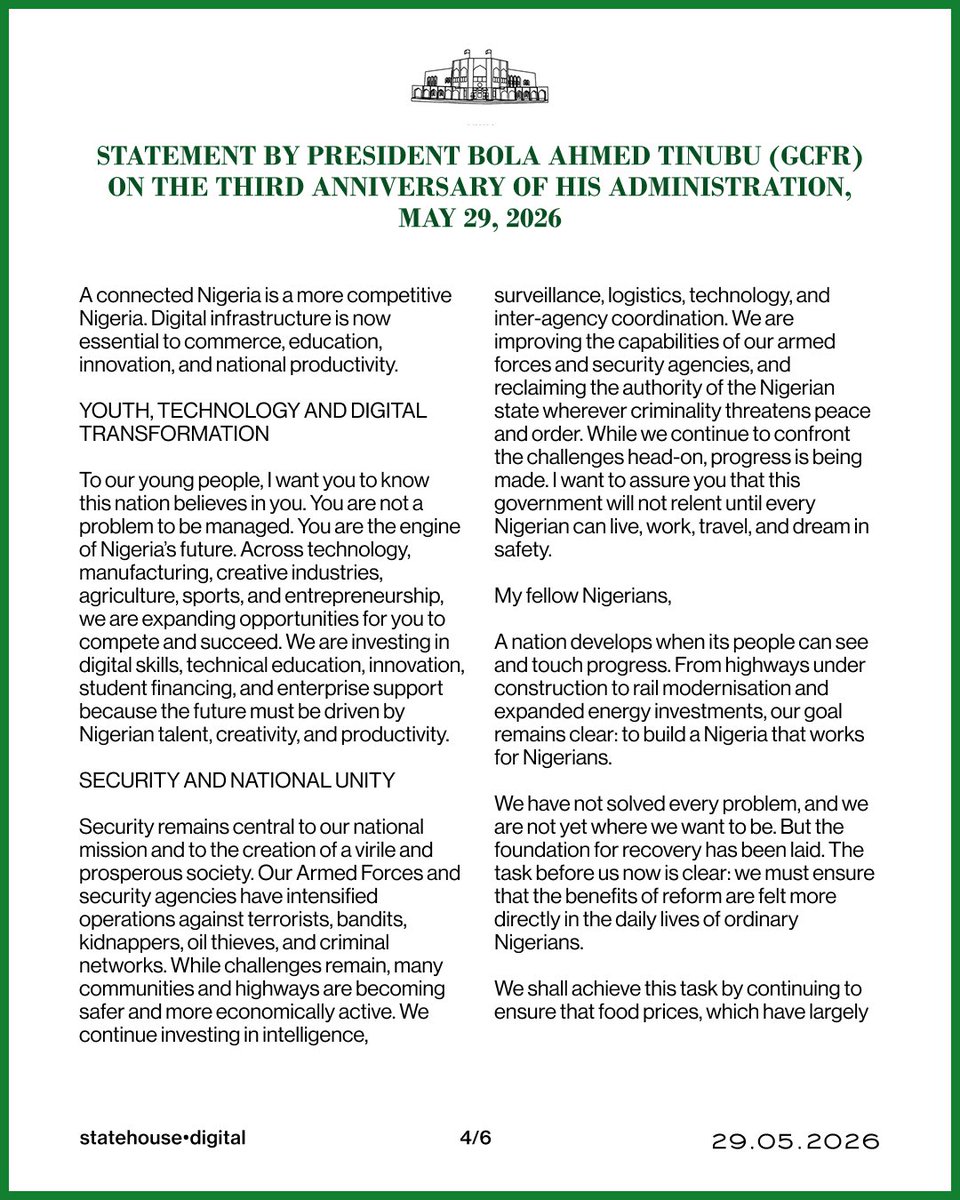
A connected Nigeria is a more competitive Nigeria. Digital infrastructure is now essential to commerce, education, innovation, and national productivity.
YOUTH, TECHNOLOGY AND DIGITAL TRANSFORMATION
To our young people, I want you to know this nation believes in you. You are not a problem to be managed. You are the engine of Nigeria's future. Across technology, manufacturing, creative industries, agriculture, sports, and entrepreneurship, we are expanding opportunities for you to compete and succeed. We are investing in digital skills, technical education, innovation, student financing, and enterprise support because the future must be driven by Nigerian talent, creativity, and productivity.
SECURITY AND NATIONAL UNITY
Security remains central to our national mission and to the creation of a virile and prosperous society. Our Armed Forces and security agencies have intensified operations against terrorists, bandits, kidnappers, oil thieves, and criminal networks. While challenges remain, many communities and highways are becoming safer and more economically active. We continue investing in intelligence, surveillance, logistics, technology, and inter-agency coordination. We are improving the capabilities of our armed forces and security agencies, and reclaiming the authority of the Nigerian state wherever criminality threatens peace and order. While we continue to confront the challenges head-on, progress is being made. I want to assure you that this government will not relent until every Nigerian can live, work, travel, and dream in safety.
My fellow Nigerians,
A nation develops when its people can see and touch progress. From highways under construction to rail modernisation and expanded energy investments, our goal remains clear: to build a Nigeria that works for Nigerians.
We have not solved every problem, and we are not yet where we want to be. But the foundation for recovery has been laid. The task before us now is clear: we must ensure that the benefits of reform are felt more directly in the daily lives of ordinary Nigerians.
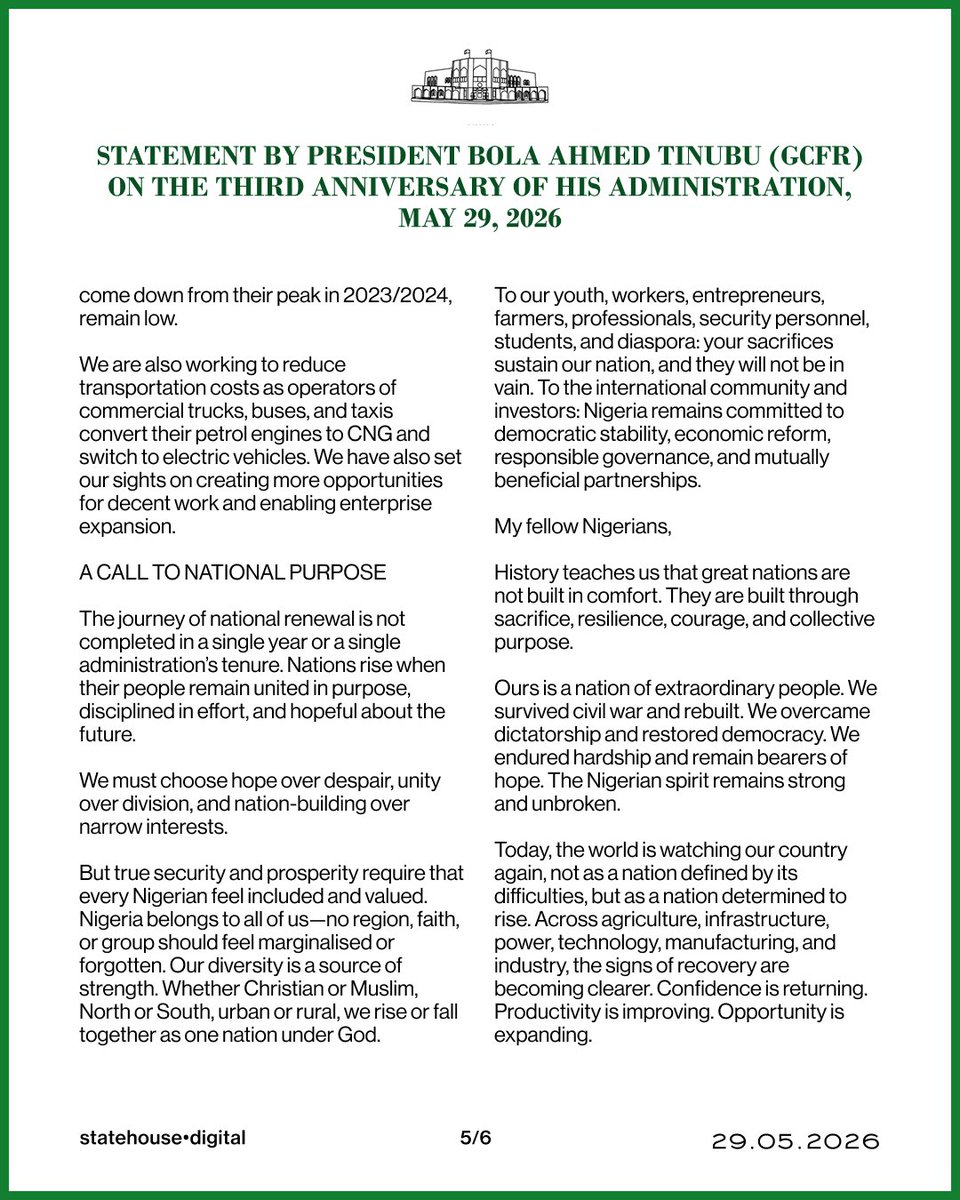
We shall achieve this task by continuing to ensure that food prices, which have largely come down from their peak in 2023/2024, remain low.
We are also working to reduce transportation costs as operators of commercial trucks, buses, and taxis convert their petrol engines to CNG and switch to electric vehicles. We have also set our sights on creating more opportunities for decent work and enabling enterprise expansion.
A CALL TO NATIONAL PURPOSE
The journey of national renewal is not completed in a single year or a single administration's tenure. Nations rise when their people remain united in purpose, disciplined in effort, and hopeful about the future.
We must choose hope over despair, unity over division, and nation-building over narrow interests.
But true security and prosperity require that every Nigerian feel included and valued. Nigeria belongs to all of us—no region, faith, or group should feel marginalised or forgotten. Our diversity is a source of strength. Whether Christian or Muslim, North or South, urban or rural, we rise or fall together as one nation under God.
To our youth, workers, entrepreneurs, farmers, professionals, security personnel, students, and diaspora: your sacrifices sustain our nation, and they will not be in vain. To the international community and investors: Nigeria remains committed to democratic stability, economic reform, responsible governance, and mutually beneficial partnerships.
My fellow Nigerians,
History teaches us that great nations are not built in comfort. They are built through sacrifice, resilience, courage, and collective purpose.
Ours is a nation of extraordinary people. We survived civil war and rebuilt.
We overcame dictatorship and restored democracy. We endured hardship and remain bearers of hope. The Nigerian spirit remains strong and unbroken.
Today, the world is watching our country again, not as a nation defined by its difficulties, but as a nation determined to rise. Across agriculture, infrastructure, power, technology, manufacturing, and industry, the signs of recovery are becoming clearer. Confidence is returning. Productivity is improving. Opportunity is expanding.
LOOKING FORWARD
The work ahead is enormous, but I remain optimistic because I believe deeply in this country and in you, the Nigerian people.
I ask you to keep faith with Nigeria. Let us reject cynicism and division. Let us move forward together, united in purpose, disciplined in effort, compassionate toward one another, and confident in the greatness that lies ahead.
My fellow Nigerians, history tests nations before it elevates them. Nigeria is passing through such a test. But I believe with all my heart that we shall emerge stronger, fairer, more united, and more prosperous than ever before.
Let us continue this journey together. Let us build a Nigeria that is secure, prosperous, inclusive, and respected worldwide. Let us continue to believe in the promise of our nation.
May God bless you all.
May God bless the Federal Republic of Nigeria.
Thank you.
This week’s Saturday Tribune column explains why dropping Shettima from Tinubu’s 2027 ticket may look like religious balancing on paper but could detonate the very northern Muslim emotional compact that made Tinubu president. https://t.co/Iyr33ioCc1
STATEMENT BY PRESIDENT BOLA AHMED TINUBU (GCFR) ON THE THIRD ANNIVERSARY OF HIS ADMINISTRATION, MAY 29, 2026
My fellow compatriots,
Three years ago, you entrusted me with the sacred responsibility of leading our beloved nation at a defining moment in our history. I accepted that responsibility, fully aware of the magnitude of the challenges before us, but also deeply confident in the resilience and potential of the Nigerian people.
Today, on the occasion of the third anniversary of our administration, I speak to you not only as your President but also as a fellow citizen who understands the sacrifices many families have made in recent years and shares your hopes for a better Nigeria.
When this administration assumed office, our nation faced profound economic and structural difficulties. Mounting fiscal pressures, unsustainable fuel subsidies, declining revenues, exchange-rate distortions, rising debt-servicing costs, insecurity in several parts of the country, energy supply constraints, and declining public confidence in institutions all threatened our progress.
At the height of the subsidy regime, Nigeria was spending as much as ₦18.4 billion daily to sustain petrol subsidies—over ₦4 trillion in 2022 alone—resources that could have been invested in roads, healthcare, education, housing, and critical infrastructure. Multiple exchange rate windows and forex arbitrage created massive distortions, with Nigeria losing more than ₦8 trillion over three years to rent-seeking and speculative practices.
The situation demanded urgent and courageous action. Difficult but necessary decisions had to be taken to stabilise the economy and prevent a deeper national crisis. The easy choices would have been politically convenient. But leadership demands courage, especially when the right decisions are difficult.
Had we refused to act, our nation would have drifted toward fiscal breakdown, worsening poverty, and severe economic uncertainty. Together, we chose reform over ruin and decisiveness over hesitation. We chose long-term national recovery over short-term comfort.
These decisions came with sacrifice. The rising cost of living triggered by our measures placed enormous pressure on families, workers, and businesses. Young people searching for jobs felt discouraged. Many questioned whether these difficult decisions would lead to a better future.
I remain deeply conscious of those sacrifices, and I assure you: your sacrifice has not been in vain. And today, I can say with confidence that Nigeria has stabilised and is moving forward again. Across the country, visible progress is taking shape.
VISIBLE PROGRESS AND ECONOMIC GROWTH
Our economy is now more competitive and better positioned for sustainable growth than it was in 2023. Public finances are improving. States and local governments have greater resources to invest in their people. Investor confidence is growing. The stock market is booming, with the All Share Index rising from 53,000 and market capitalisation of N30 trillion in 2023 to a record All Share Index of 250,000 and market capitalisation of N160 trillion this year. Companies are declaring record profits and dividends.
Critical infrastructure projects are advancing at an unprecedented scale. Over 2,700 kilometres of highways and major roads are under construction, reconstruction, or rehabilitation, including the Lagos-Calabar Coastal Highway, the Sokoto-Badagry Super Highway, the Abuja-Kaduna-Zaria-Kano Road, the East-West Road, and many rural access roads. Significant sections are already completed or nearing completion, improving transportation, reducing travel time, boosting regional trade, and creating thousands of jobs.
Rail modernisation projects are ongoing to improve connectivity, logistics, and economic integration across the federation.
In the oil and gas sector, the reforms we instituted have attracted billions of dollars in fresh investment from the international oil companies that had shunned our country. The $5 billion NLNG Train 7 project is nearing completion to boost LNG production capacity, exports, and dividends.
Domestic gas utilisation is expanding. Local refining capacity has improved our energy security. With large-scale domestic and modular refineries operational, Nigeria is reducing its dependence on imported petroleum products and conserving foreign exchange.
For years, the power sector suffered from debt, underinvestment, and uncertainty, which weakened generation capacity and limited growth. Today, we are confronting those challenges directly.
Our administration is clearing legacy obligations, expanding transmission infrastructure, investing in renewable energy, and strengthening the national grid because no modern economy can grow in darkness. When power improves, businesses expand, industries grow, jobs are created, and families prosper.
We are determined to power Nigeria into a new era of industrial growth and economic opportunity.
EMPOWERING NIGERIANS: AGRICULTURE, EDUCATION, AND HOUSING
Agricultural interventions have supported millions of farmers by improving seedlings, fertilisers, mechanisation, and irrigation and by expanding access to finance and markets. We are opening new agricultural corridors to create jobs, strengthen supply chains, and reduce pressure on household incomes.
The Nigerian Education Loan Fund has provided over 1.5 million students with access to higher education, disbursing more than ₦282 billion to ensure that no willing student is denied access due to financial hardship.
Our Renewed Hope Housing Programme, along with that of the Federal Housing Authority (FHA), is delivering over 10,000 housing units across 14 states and the FCT, creating over 300,000 jobs and expanding access to affordable housing. Major Renewed Hope Cities in Abuja, Lagos, and Kano are progressing steadily. Our consumer credit initiative, CREDICORP, is opening up new economic opportunities for workers and families.
In healthcare, thousands of primary healthcare centres are being revitalised, while health insurance coverage is expanding for vulnerable Nigerians.
DEEPENING TELECOMS ACCESS AND INVESTMENT
We also took decisive action to stabilise the telecommunications sector, which remains one of the most important drivers of modern economic growth.
After years of severe operational pressures and declining investment, confidence is gradually returning to the sector. Telecom operators are expanding networks, investing in infrastructure, recruiting Nigerian talent, and widening digital access across the country.
A connected Nigeria is a more competitive Nigeria. Digital infrastructure is now essential to commerce, education, innovation, and national productivity.
YOUTH, TECHNOLOGY AND DIGITAL TRANSFORMATION
To our young people, I want you to know this nation believes in you. You are not a problem to be managed. You are the engine of Nigeria’s future. Across technology, manufacturing, creative industries, agriculture, sports, and entrepreneurship, we are expanding opportunities for you to compete and succeed. We are investing in digital skills, technical education, innovation, student financing, and enterprise support because the future must be driven by Nigerian talent, creativity, and productivity.
SECURITY AND NATIONAL UNITY
Security remains central to our national mission and to the creation of a virile and prosperous society. Our Armed Forces and security agencies have intensified operations against terrorists, bandits, kidnappers, oil thieves, and criminal networks. While challenges remain, many communities and highways are becoming safer and more economically active. We continue investing in intelligence, surveillance, logistics, technology, and inter-agency coordination.