🚨 BREAKING: Someone built an AI that replaces 6 months of literature review with a single workspace.
It's called Moara.
You dump your research papers in. The AI organizes, analyzes, and synthesizes everything across hundreds of millions of academic sources.
You come back and there's a structured literature review waiting. Not a chatbot answer. Not a vague summary. The actual research synthesis.
A full research workspace that thinks like a scientist.
Works for medicine, engineering, social sciences, law, business, humanities — every discipline.
Here's what it does on its own:
→ Searches hundreds of millions of papers across PubMed, arXiv, Google Scholar, Semantic Scholar, ClinicalTrials .gov, Cochrane, and more in one shot
→ Screens and tags results automatically, pulling out methodologies, findings, and contributions from every paper
→ Lets you chat with your entire library at once, find themes, spot gaps, and compare findings across dozens of papers simultaneously
→ Integrates with Zotero, LibKey, RIS, and BibTeX so your existing research workflow doesn't break
→ Traces every AI insight back to its original source so nothing is hallucinated and everything is verifiable
→ Supports full team collaboration so entire research groups can screen and synthesize together
Try it here:
https://t.co/3n1sqOFU0x
Most researchers waste 70% of time on these 3 things
➝ Identifying the right set of research papers
➝ Extracting relevant data from those papers
➝ Comparing those research papers
Now you can do all these things in seconds.
1. Go to https://t.co/znYDKB1Vlg
2. Click on 𝐺𝑒𝑡 𝑆𝑡𝑎𝑟𝑡𝑒𝑑 and then on 𝑁𝑒𝑤 𝐿𝑖𝑏𝑟𝑎𝑟𝑦
3. Now click on 𝐴𝐼 𝑆𝑒𝑎𝑟𝑐ℎ
4. Enter your research topic or question
5. moara will identify the papers for you.
6. Add relevant papers to the library
7. Now to extract from these papers, click 𝐸𝑛𝑟𝑖𝑐ℎ𝑚𝑒𝑛𝑡𝑠
8. Then click on 𝐶𝑢𝑠𝑡𝑜𝑚 𝐸𝑛𝑟𝑖𝑐ℎ𝑚𝑒𝑛𝑡𝑠
9. Describe what you want to extract e.g., datasets
10. 𝐦𝐨𝐚𝐫𝐚 will extract and add this as new column
11. Finally, to compare papers, click on 𝐿𝑖𝑏𝑟𝑎𝑟𝑦 𝐶ℎ𝑎𝑡
12. Enter what you want to compare e.g., datasets
13. moara will compare papers with respect to dataset
With these features, you can 10x your research experience.
Try 𝐦𝐨𝐚𝐫𝐚 today
https://t.co/znYDKB1Vlg
Conduct literature reviews
↳ 𝐆𝐚𝐭𝐬𝐛𝐢 → https://t.co/CG5MKiWMxz
Extract data from research papers
↳ 𝐦𝐨𝐚𝐫𝐚 → https://t.co/oUZgshdHw2
Identify right journal for paper
↳ 𝐑𝐞𝐯𝐢𝐞𝐰-𝐢𝐭 → https://t.co/7CUrF1Y76O
Many AI research tools want to replace literature reviews with a Q&A engine. We're betting on the opposite.
We just shipped a major update to https://t.co/fNvwN6SHv4, built on the simple thesis that researchers should be working with more papers, not fewer.
The earliest use cases in this space were super flashy:
→ Natural language search. Often at par with Google Scholar, sometimes worse.
→ AI-generated summaries. Cover 10 papers max. Great for hobbyists, but not serious research.
→ Ask questions about a paper’s contents. Try doing this across a library of 100 or 1,000.
We think AI should focus on the boring stuff - the things at the heart of every serious literature review:
→ Building and maintaining a large, complete library (including gray literature)
→ Screening papers at scale to decide what deserves full-text review
→ Collaboration - dual independent review, contribution tracking, shared notes
→ Documentation and compliance - include/exclude reasons, risk of bias assessments (even outside systematic reviews)
→ Tool orchestration - because the future is a stack of products, not one platform
The core organizing mechanism for a literature review should be a significant corpus of papers rather than an AI summary.
That's the update. See it in action → https://t.co/BNuUjmH9sy
6,459 studies → 39 final papers
We need to see more systematic reviews across all disciplines!
Full session: https://t.co/8ToeKPwATJ
Hit me up with questions about systematic reviews with https://t.co/DOs2RjvlGN
Retractions are growing at a CAGR of ~22%. Overall publications are ~6%. AI has significantly reduced the costs of retrieving and citing new papers.
Researchers need to button up their screening processes!
Full video → https://t.co/NstwiBmynu
Try https://t.co/DOs2RjvTwl
We reviewed the biggest retraction stories of 2025 - and the trends behind them.
Key themes:
• Retractions growing 3x faster than publications
• Fake peer review, paper mills, and AI content
• Higher rates in fast-moving fields
• Implications for lit reviews
📺 Watch the session: https://t.co/NhOUPAqD4W
📅 Join future Friday Labs: https://t.co/1fI6w3RZlT
Thanks to @RetractionWatch, @gcabanac, and others for their excellent data and reporting.
Key study: https://t.co/I8uepl2a1T
Our team at https://t.co/DOs2RjvTwl ran a comparison across 5 AI literature search engines using the same question and evaluated the top 10 results from each.
TLDR; @UndermindAI is the clear winner.
📄 Analysis: https://t.co/795hBkBvnp
📽️ Walkthrough: https://t.co/Dyo4wU6aD6
We just launched a freemium reference manager from https://t.co/jLTTszug6M.
Built for real literature review workflows: deduplication, full-text discovery, and clean metadata.
Try it free → https://t.co/dmAXzTmYSW
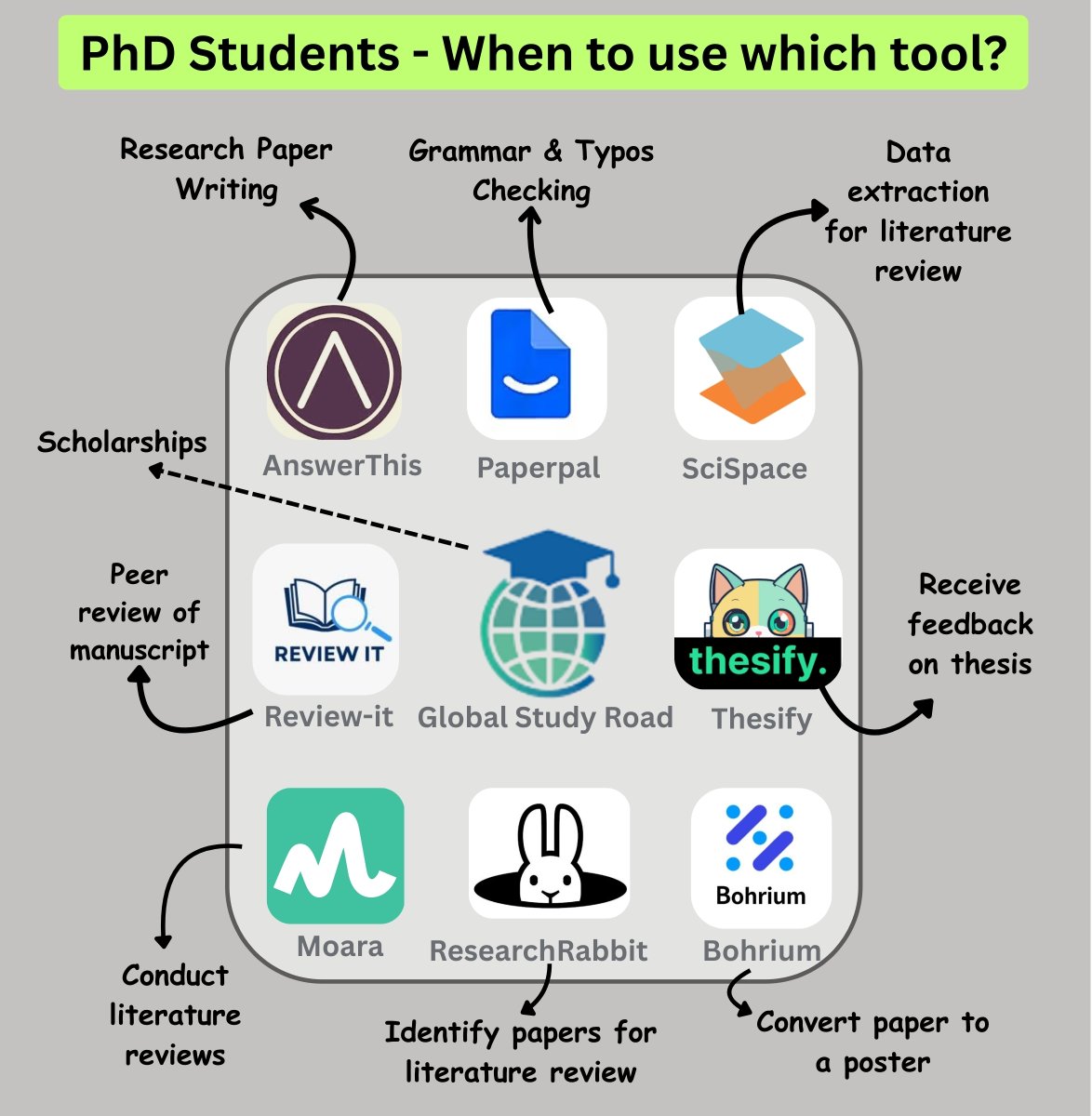
PhD Students - When to use which tool?
1. Writing research papers ➝ 𝐀𝐧𝐬𝐰𝐞𝐫𝐓𝐡𝐢𝐬
Link: https://t.co/EagIhCGWn4
2. Grammar and typos checking ➝ 𝐏𝐚𝐩𝐞𝐫𝐩𝐚𝐥
Link: https://t.co/jLDR3VwrSL
3. Data extraction for literature review ➝ 𝐒𝐜𝐢𝐒𝐩𝐚𝐜𝐞
Link: https://t.co/8Kg056Opce
4. Peer review of manuscript ➝ 𝐑𝐞𝐯𝐢𝐞𝐰-𝐢𝐭
Link: https://t.co/PMrNAhnkJM
5. Scholarships ➝ 𝐆𝐥𝐨𝐛𝐚𝐥 𝐒𝐭𝐮𝐝𝐲 𝐑𝐨𝐚𝐝
Link: https://t.co/1nDbIUmRK1
6. Receive feedback on thesis ➝ 𝐓𝐡𝐞𝐬𝐢𝐟𝐲
Link: https://t.co/dkmQJWRdlC
7. Conduct literature reviews ➝ 𝐌𝐨𝐚𝐫𝐚
Link: https://t.co/MlJOSIZgTy
8. Identify papers for review ➝ 𝐑𝐞𝐬𝐞𝐚𝐫𝐜𝐡𝐑𝐚𝐛𝐛𝐢𝐭
Link: https://t.co/S1BaWRcb8u
9. Convert paper to a poster ➝ 𝐁𝐨𝐡𝐫𝐢𝐮𝐦
Link: https://t.co/rNB7rdA0RT
Any other tool you'd like to add?
Try for FREE:
🔗 https://t.co/oT7wCDI16u
------------------------
Useful find? Pass it on!
🔄 Retweet
👋 I’m @RaziaAliani
Click my name + follow + 🔔
I post about AI in #research & #analysis
Want FREE tips on using AI in research?
↳ Join 16K+ researchers:
🔗 link in bio
----------------------
#aiinresearch
Just dropped our new https://t.co/jLTTszuNWk quick-start demo.
If you do literature reviews (academic or R&D), this will save you time.
Full video → https://t.co/GX2bKFnuhN
"Let's just admit it: Google Scholar is a damn good product."
Product -> https://t.co/Yuw5DDFlWv
Blog post -> https://t.co/xBhy9iBtV2
#AcademicTwitter#Research#Science
If you want to run your lit review methodologically ⤵️
Try moara(dot)io
It has clear stages, a guided progress, and space for collaboration!
It brings structure to every stage of the process:
— Import: Upload papers or reference files, integrate your Zotero account, or search directly within the platform.
— Screening: Extracts key data so you can quickly prioritize papers (high, medium, low)
— Full Text: Read through your full-text articles on one page. Make annotations that are structured and saved down to a central database.
— Synthesize: Spot themes as they emerge —> no sticky notes taking over your office.
— Export: Share your full review or export by category
Moara is a glimpse into what modern literature reviews should look like:
—> structured, transparent, and built for collaboration.
Try for FREE:
🔗link in the thread
#aiinresearch
Our first post.
AI tools for research are evolving from Q&A chatbots toward structured, collaborative workflows.
We wrote about how this shift is unfolding - and where https://t.co/jLTTszug6M fits in.
https://t.co/Ms0EYckpot