Research evidence, citizen values & stakeholder insights to generate action in low/middle-income country health systems. Tweets by Kaelan Moat of @mcmasterforum
How can we better put evidence at the centre of everyday life? Listen to some of the great insights shared in the webinar we co-hosted last week with @CochraneConsumr and @WHO's Evidence-informed Policy Network. Watch the recording >> https://t.co/f59ED1CvZF
#Evidence4Life
We're excited to partner with @CochraneConsumr and @WHO's EVIPNet to host a webinar on putting evidence at the centre of everyday life. Join us on June 29! https://t.co/f59ED1CvZF #Evidence4Life@cochranecollab
Stay up to date with the latest evidence that can help inform decisions about strengthening health systems. Register now for a free account on Health Systems Evidence https://t.co/Ip4keRYtgK
Over the past 14 years, we have generated action on the pressing health and social issues of our time based on the best-available research evidence, as well as experiences and insights from citizens, organizational leaders, and government policymakers https://t.co/aM6wFCPqjk
.@Wilson_MichaelG is now the Forum’s Scientific Director, recognizing the integral role that he plays in our high-volume evidence synthesis and deliberative process work. Read more https://t.co/FjwghCokz9
Since our 12-year anniversary report, we have extended our reach and accelerated our impacts by co-leading action-oriented networks at the provincial level with @OHTrise. Read more https://t.co/UU96aMzSlv
.@TDRnews is supporting participation at the Cochrane Colloquium in London 2023 for evidence-informed policy practitioners working in low- and middle income countries. Check out the details of how to apply https://t.co/IZ6m6opuEZ #CochraneLondon#LMICs
One year has passed since the publication of the @EvidenceComm report. Their one-year update is now available in Chinese, English, French, Portuguese, and Spanish and will be available shortly in Arabic. Learn more in our newsletter https://t.co/fFP250cSA9
Based on a total of 39 currently active RESSAs underway, @EvidenceComm finds that most countries include few of the features of an evidence-support system, and even fewer are working optimally, especially when crises emerge. Learn more in our newsletter https://t.co/EPlgLBJNRT
Our work to help formalize and strengthen domestic evidence-support systems was recognized at #GSF2023. Watch this video shared by @SDSNGSF to learn more
https://t.co/ggDqvVXSo2 @UNSDSN@SDSNCanada
For #GSF2023, Dr. Lavis from @McMasterU has explored the opportunity to strengthen domestic evidence-support systems for more transparent & systematic management of societal challenges.
Learn more about his work here.⤵️
https://t.co/3xeezRAdXB
Join one of our webinars to learn more about what we've accomplished since the launch of the Evidence Commission report. We'll also share our 2023 action plan. Register now >> https://t.co/LcLndcyG7W
Join one of our two webinars to learn more about what we've accomplished since the launch of the Evidence Commission report. We'll also share our 2023 action plan. Register now >> https://t.co/WMoF5siHII
In November, we hosted a series of events to share insights from our #QEScholars who recently travelled to Australia, India, Lebanon and South Africa. Watch the recordings to learn more about their work https://t.co/Qkvfi5ZxbD @afelkadi @tusharsood2224@_MaiuraM
Today we hosted our final Global Partners Meeting - we learnt so much from this group during the pandemic. The work of @EvidenceComm continues (one of the many legacies of COVID-END) & COVID-END partners are invited to join the Evidence Commission Implementation Council
If anyone can make this happen with resounding success, it's @ACE_UJ! EVIDENCE 2018 was a masterclass in how to optimize technology to engage a broad audience of EIPM champions!
EVIPNet country teams and other policy teams can refer to this manual at any stage in the process of preparing for, developing and moving forward with evidence briefs for policy https://t.co/LbXeMWr2T6 @K2PCenter
Policymaking is a highly complex process. This study on the governmental health policy-development process for Syrian refugees highlights the need for interested and committed policymakers who value the role of research evidence in informing policymaking https://t.co/PZ6hNLwaXL
Last year, the ESPIE Project developed 49 different evidence briefs addressing a range of public health issues & convened 49 stakeholder dialogues across Brazil over a two-day period. Read more in the latest issue of Networks Update https://t.co/sJFBKSP5JZ @evipnetbrasil
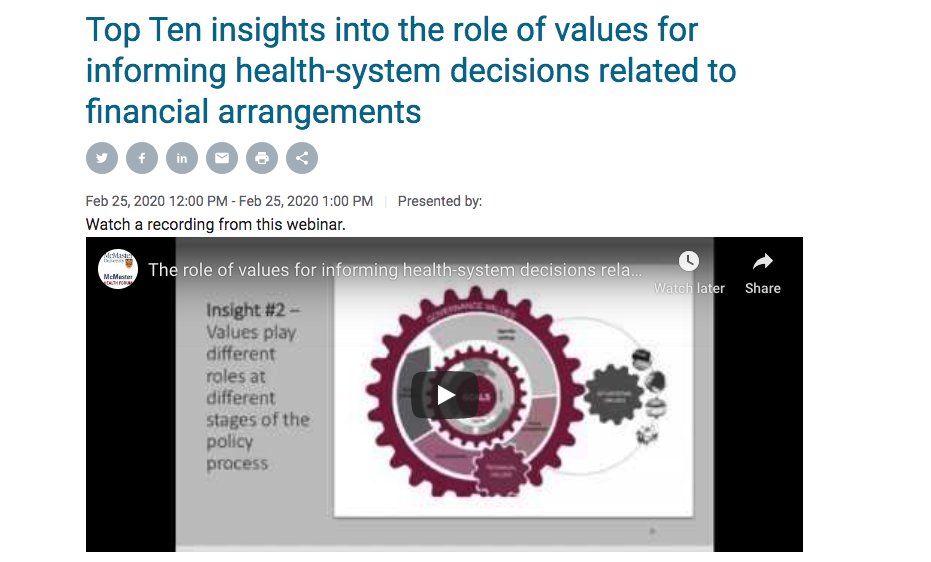
Last month, recent @McMasterForum student and @MacHPPhD graduate @clamavelez shared insights into the role of values for informing health-system decisions related to financial arrangements. Watch a recording from this webinar https://t.co/j40q6M4gbo #MHFtop10