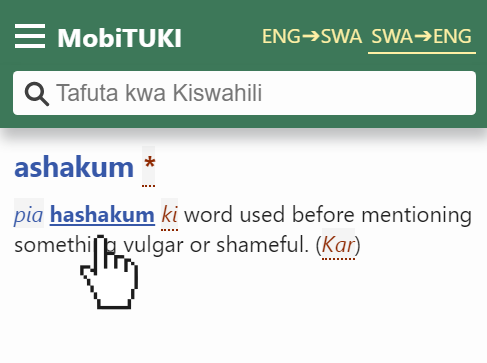
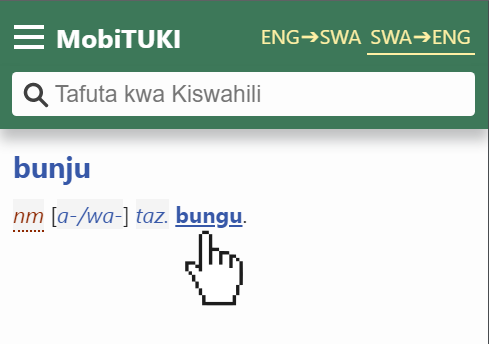
#Fact 📊 According to a study we have just conducted, 15% of Swahili words in our Swahili to English dictionary have an Arabic origin.
📋 To be precise, they are 2,274 out of 14,577 entries.
No one can say that Swahili is "an Arabic dialect" anymore!
@Kalisha_Holmes Yes! Just browse https://t.co/F5c0g6RUBh then tap on "add to Home screen" and you will have it in your home screen just as a normal iOS app, working even without Internet connection 😎
@AllanBrian1 @QwikeyTz @BantuLanguages Right. Here (page 8-12) there's a beautiful overview of the history of Swahili by the classic Polome:
https://t.co/Fj2QNh5zlR
It seems like Arabs traded in East Africa in times of Ptolemy, 1st century AD!
@AllanBrian1@BantuLanguages The grammatical structure of Swahili is much alike other Bantu languages. But it has a lot of vocabulary from Arabic. As you may know, it was born as a traders' lingua franca in East Africa.
What do you mean by "native"?
@SosoTheWanderer Not implying anything, but the TUKI dictionary has 26 Swahili words starting by "nyi-". On the possible origin of the "nyi-" concordant, I suggest Edgar C. Polomé's "Swahili language handbook".
And definitely, nyingi does not mean mother.
From today, you can find Swahili irregular plurals in MobiTUKI Swahili dictionary. That's 145 words that are no more hidden! English irregular plurals are coming soon :-)
Tangu leo, unaweza kupata nomino za wingi zisizofuata kanuni za kunyambulika (irregular plural nouns) kwenye kamusi yetu ya MobiTUKI. Maneno 145 hayafichiki tena! :-)