@tianluranic "Men make their own history, but they do not make it as they please; they do not make it under self-selected circumstances, but under circumstances existing already, given and transmitted from the past." - Marx
Without reading theory, history acts on you, not you upon history.
@thejelvprint Atomic idempotent functions need upper bounds in time and space if they're to scale w.r.t. input size predictably & it's efficient to compress representation into a minimal object, as data transfer occurs in discrete packets. Otherwise network latency bottlenecks.
@thejelvprint Can you explain how you support arbitrary length relational data fields, while maintaining deterministic guarantees in your response times, under real time constraints, globally, without data loss or service downtime? WhatsApp uses protocol buffers, websockets, and rdbms.
@BolshevikBeyond Warning: it's super tech bro brained because it's commercialized neuroscience research for AI/ML. Consequently though, their theory must have operational, profitable praxis, forcing violation of the cartesian or neokantian norms of computer science research & software eng.
@BolshevikBeyond 100%. You might find the "Thousand Brains Theory " model interesting to support this as well. Functions of the individual brain are enacted by decentralized collaborative process of units "voting" in a network. It still reifies the individual but that's only a contingent limit.
@BolshevikBeyond@Flynn_Chester You're right on individualism & 4E, but its proponents aren't Marxist. Thompson's dialectic in Mind in Life is heuristic, but cites the laws of dialectics from The Dialectical Biologist ( interpenetration is Engelsian & ontological) to argue autopeotics solves mind/body w/in Kant
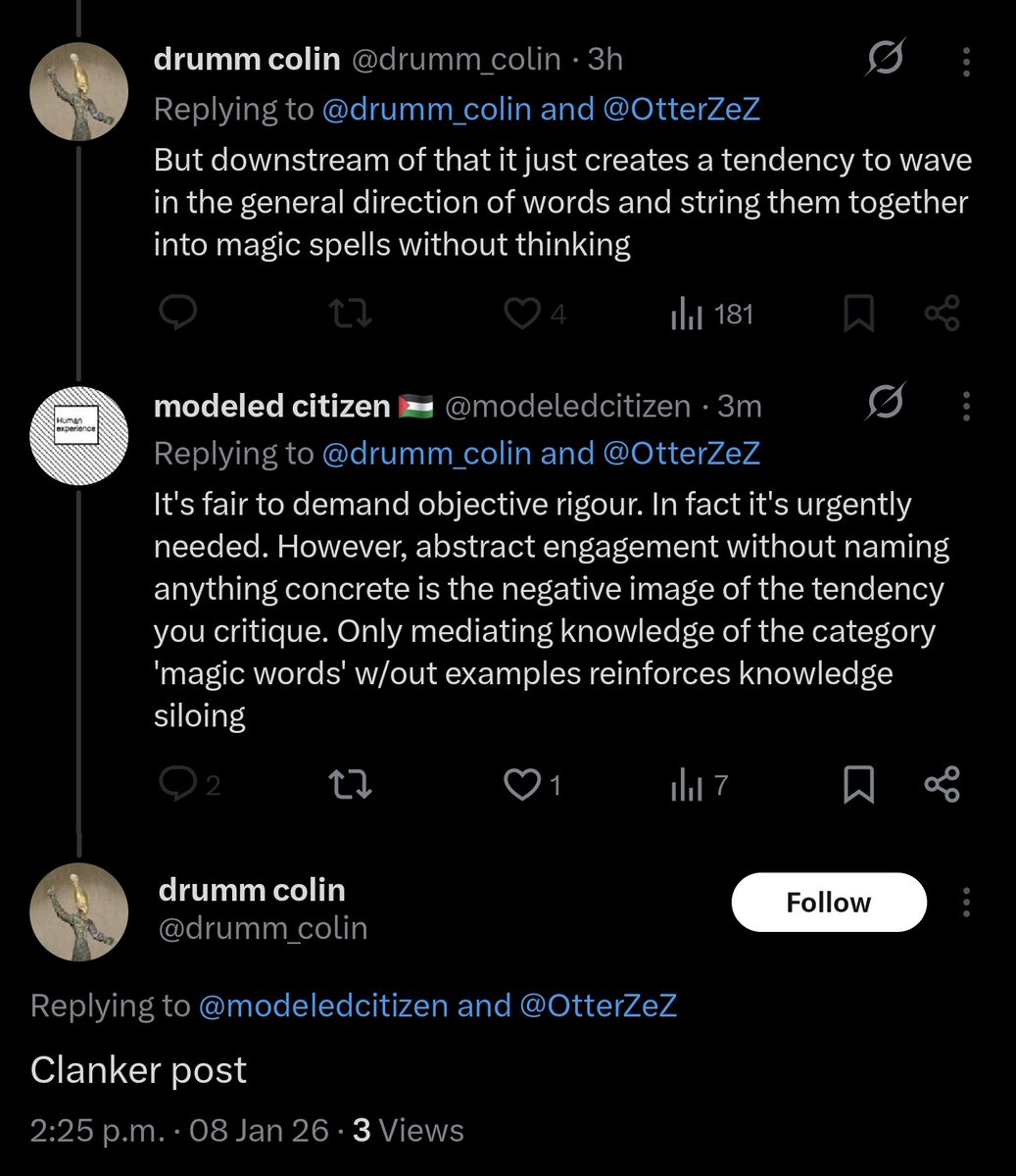
@drumm_colin @OtterZeZ I'm sure you're not intending to, but presenting only the abstract & hand waving follow ups for concrete instances leaves the recipient less primed to act or identify what you've pointed out in practice
@drumm_colin @OtterZeZ It's fair to demand objective rigour. In fact it's urgently needed. However, abstract engagement without naming anything concrete is the negative image of the tendency you critique. Only mediating knowledge of the category 'magic words' w/out examples reinforces knowledge siloing
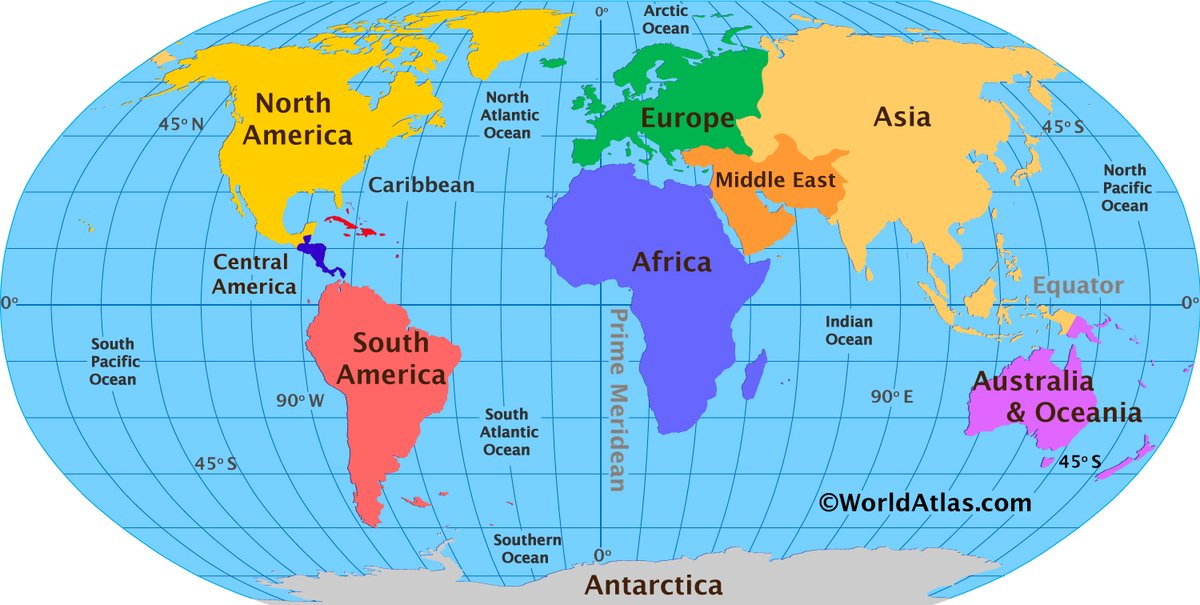
European men named ALL the Continents. This is a reflection of their uniquely panoramic mind. The inhabitants of nonwhite civilizations, India, China, Africa had no idea where they were located.
1. Africa
"Africa" derives from Roman usage after their defeat of Carthage (Tunisia) around 146 BC. The Romans applied it to their North African provinces, and over time, European explorers, starting with the Portuguese in the 15th century, extended the name to the entire continent as they mapped it.
2. Asia
Yes, "Asia" originates from the Ancient Greek term Asía, used by Herodotus around 440 BC. It initially referred to Asia Minor (modern-day Turkey) and then the Persian Empire. As European exploration and scholarship grew, "Asia" was extended to encompass the vast landmass east of Europe.
3. Europe
The name "Europe" is linked to Greek mythology, with the term first appearing geographically in the 6th century BC (used by Anaximander and Hecataeus) to refer to lands west of Asia.
4. The Americas
The Americas were named after Amerigo Vespucci, an Italian explorer who, between 1499 and 1502, recognized that the lands discovered by Columbus were not part of Asia but a distinct "New World." The name was proposed by German cartographer Martin Waldseemüller in his 1507 map, Universalis Cosmographia.
5. Australia
The term "Terra Australis Incognita" (Unknown Southern Land) was a speculative concept in ancient Roman and medieval European geography. The name "Australia" evolved from this. While James Cook claimed eastern Australia for Britain in 1770, the name "Australia" was popularized later by Matthew Flinders in 1814.
6. Antarctica
"Antarctica" comes from the Greek antarktike ("opposite to the north"), tied to its position relative to the Arctic. While the continent wasn't fully mapped until the 19th century, the name is credited to European cartographic tradition, with Scottish cartographer John George Bartholomew often associated with its formal adoption around the 1890s.
the implicit argument here is that immanent critique doesn't apply within the science of its own application, and it should forever consider itself against bourgoise metrics, blindly pursuing efficiency & efficacy without clarity of its measure, not its relations of causation
To be clear, I would be someone categorized as a high-woke Stalinist with sensitive feelings, but I'd much rather debate "Stalinism" than orient my energy around becoming the cartoon version of an ineffectual communist that scares a bourgoise positivist
All the while stifling conversation that would lead to its becoming a threat by pretending that process can be ignored and is itself the roadblock. Communism can't be something theoretized as possible to create ex nihilo by sheer will oriented at terrorizing bourgoise.