My view is that regulatory AI capture by Anthropic is the certain end of humanity, so it’s important to go full force opposing it
Yes, who knows what will happen as AI gets more capable and even faster, but hoping for the best on that front is certainly better than living in a zoo run by Dario
I work at OpenAI and personally think AI has been and will continue to be an extremely beneficial technology to humanity
The conversation should be around how many billions of lives it will save
Fan Affinity laws
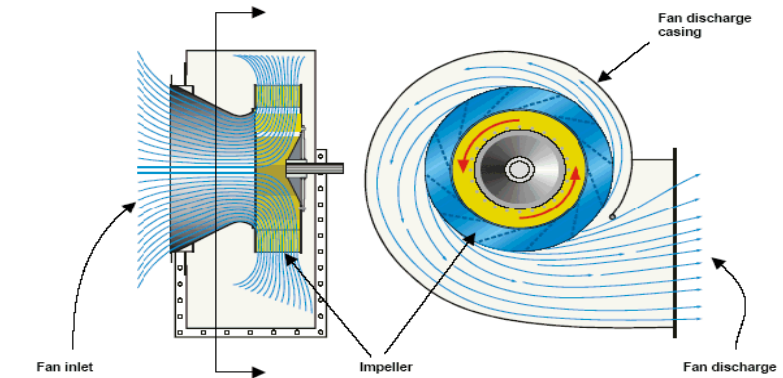
Fan affinity laws rest on three specific mathematical relationships that turn an ordinary spinning fan into a small case study in exponential behavior.
Airflow changes in direct proportion to speed, so increasing rotational speed by 20 percent increases airflow by roughly 20 percent as well, following a simple linear pattern that matches everyday expectations.
Pressure, however, follows a squared relationship with speed, meaning that same 20 percent increase in speed produces an increase in pressure of about 44 percent.
Power consumption follows an even steeper curve, rising with the cube of speed, so that identical 20 percent increase in speed translates into a power demand increase of approximately 73 percent.
Reversing the direction reveals why efficiency conversations around fans focus so heavily on speed reduction rather than blade redesign or size changes.
A reduction of 50 percent in speed produces an striking outcome, cutting power demand down to 12.5 percent of the original value, a detail that explains why variable frequency drives in industrial fans and HVAC systems have become standard tools for cutting electricity costs.
These numbers raise a further question about how such a small adjustment on a control dial can produce savings measured in thousands of dollars annually across large ventilation systems, and why so few people outside engineering fields ever encounter this relationship despite living with its effects in nearly every building equipped with mechanical airflow.
More than half a century ago, a 33-year-old scientist named Nick Holonyak Jr. coaxed the first visible glow out of a semiconductor, a tiny red spark that his own colleagues nicknamed "the magic one," simply because, unlike the invisible infrared lasers of the day, human eyes could actually see it work.
It's worth sitting with that for a moment.
Before Holonyak's LED, light from electronics was something machines could sense but people couldn't.
He didn't just build a more efficient light source, he built the first one that let humans witness electricity turning directly into visible light.
That single red dot in 1962 is the ancestor of every screen you've looked at today, every traffic light, every energy-efficient bulb in your home.
A tiny spark gap and a huge vacuum gap can both resist electricity jumping across?
That's Paschen's law at work.
It was discovered in 1889 and explains that the voltage needed to create a spark in gas doesn't just depend on the distance between two electrodes. It depends on the combination of gas pressure and that distance multiplied together.
Here's the surprising part; thin gas at very low pressure makes sparking harder, not easier, because electrons have too few molecules to crash into and build up energy. Pack the gas in tighter, and electrons collide too often, never building enough speed. Somewhere in the middle sits a sweet spot, the easiest condition for a spark to form.
This is why vacuum-insulated equipment and tiny microelectronic gaps behave similarly. Both sit on the far end of the curve where sparking actually becomes difficult again.
Founded in 1880, the American Society of Mechanical Engineers was created largely in response to frequent and deadly steam boiler explosions. ASME developed its first boiler and pressure vessel code in 1914, which remains a global standard today. It has since issued 600+ codes covering fasteners, pipelines, elevators, and more.
A carbide insert is a small replaceable tip that is used for cutting in a CNC machine.
When one edge dulls, insert is rotated to expose a fresh edge for continuous cutting. The procedure is called indexing. No tool swap or re-setup is required.
A single insert can carry 4, 6, even 8 usable cutting edges.
In 1914, Erik Oberg and Franklin Jones published a small pocket reference for machinists. It had 1,100 pages and fit in an apron pocket.
That book is now 2,900+ pages and has never gone out of print.
Machinery's Handbook is the closest thing mechanical engineering has to a sacred text.
Tolerances, gear formulas, thread standards, material properties, cutting speeds all of it, in one place, updated across 32 editions without losing a single original chapter.
Roads have existed for thousands of years, but it was bitumen that turned them from dirt tracks into something durable.
The material melts between 100 and 200°C depending on grade, bonds at a molecular level with stone aggregate, and flexes under repeated load without fracturing.
The first modern asphalt road was laid in Paris in 1854, and the engineering logic behind it has barely changed since.
Today over 100 million tonnes of bitumen are produced annually, with 85% going directly into road surfaces across the world.
When electrons are fired across a vacuum and stopped suddenly by a tungsten target, the energy released has nowhere to go. Most of it escapes as heat, but a small fraction converts into X-rays, radiation that passes through soft tissue and stops at dense material like bone, leaving a shadow on whatever film or detector sits behind.
Wilhelm Röntgen discovered this by accident in 1895, and within a year surgeons were already using it to locate bullets inside wounded soldiers.
The entire field of diagnostic imaging grew from that single observation, electrons decelerating fast inside a metal target.