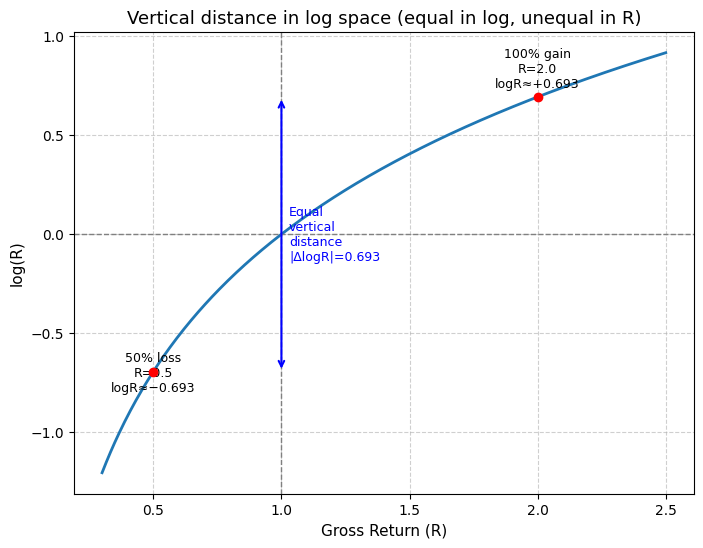
The graph is simple, but it leads to a deeper topic: the coordinate system of a dynamical system is not unique.
I am assuming a fixed reference point here, but once we shift into a non-equilibrium dynamical system, the reference point evolves with time. On that later.
Humanity made decisions under uncertainty for 1000 of years without the help of mathematics. Probabilistic reasoning,WITHOUT COMPUTATION OF ODDS,emerged in fields like law before Pascal. Franklin's book, The Science of Conjecture, is a good read on this other side of probability
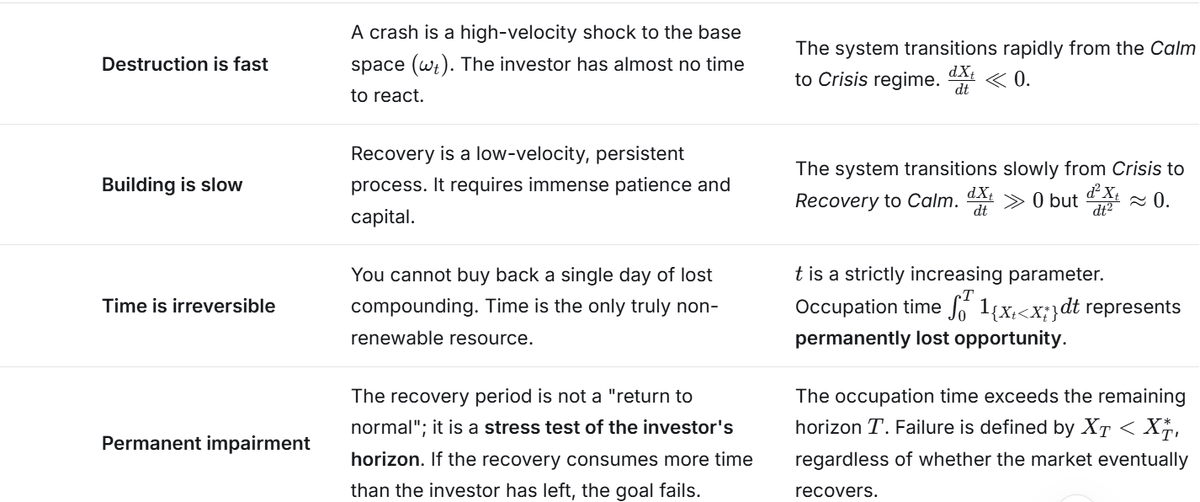
Mediating on the drawdown and recovery process, viewed from a Random Dynamic System perspective by separating what happens in the market (based space) and what happens to the INDIVIDUAL (fiber space).
It's a multiplicative process where those in a “steep” part of convexity have a much higher starting point to absorb both inflation of the cost of borrowing money (by central banks) and oil costs (disruption of the supply chain).
🤦♂️HIGHER RATES ARE MORE LIKELY TO AMPLIFY INFLATION THAN TAME IT, WHILE CRUSHING THE POOR FOR NO REASON
Raising interest rates by 25bps, or even 100bps, will neither create more oil, nor curb the datacenter arms race, nor conjure more labourers.
But raising rates will curb supply at the margin for heavy industry companies like those supplying the basic materials and gargantuan electrical grid components required to meet hyperscaler demand. In addition, raising rates while rolling 25% of war-time sized debt per year will firehose excess interest income into the private economy, leading to HIGHER demand, not lower demand.
Worse, higher rates (especially in an energy + demand shock) impose even greater hardship on the heavily indebted poor, who overwhelmingly fund basic spending out of floating rate debt.
In other words, under current conditions HIGHER RATES ARE MORE LIKELY TO AMPLIFY INFLATION THAN TAME IT, WHILE CRUSHING THE POOR FOR NO REASON.
For strategies that benefit from volatility, the question is how to do well during normal times as well. Is about the DRIFT. Drift and vol are inputs of compounding.
In 1987 Thomas Cover proved Kelly is a special case of ergodic theorem. Of course the world is not ergodic.
@RichB118@rjpjr12 Kelly is a good intro to the dynamics of multiplicative process that generalises beyond finance. How the median, deviate from the mean, the importance of minimising time to reach the given level of wealth by avoiding volatility drag ( which is already built-in on median analysis)
@RichB118@rjpjr12 Kelly is a good intro to the dynamics of multiplicative process that generalises beyond finance. How the median, deviate from the mean, the importance of minimising time to reach the given level of wealth by avoiding volatility drag ( which is already built-in on median analysis)
The time average is still an average—just averaged over time on a single path. But the investor does not experience the average of that path. He experiences the entire path, moment by moment, with all its jagged peaks and terrifying troughs.
Random dynamical system perspective:
Position sizing is in fiber space ( what you can control), market dynamics are in base space ( what you can't control).
The results are in. Size does matter.
New post on the psychology of position sizing. Why it matters more than your entry, your thesis, or your stop. Free to read.
https://t.co/V99o36b0SO
"Wealth is typically created through internal, often entrepreneurial, ventures, but is dynamically preserved only in the public markets"~
Jean Brunel, in a paper: Goal-Based Wealth Management in Practice.
The market chooses the regime, the investor chooses how to respond.
In Random Dynamical System language market is the base space (exogenous); investor's action is in the fiber space (endogenous).
We can generalise this point to any discussion about collective vs individual.
“Probability is not a mere computation of odds on the dice or more complicated variants; it is the acceptance of the lack of certainty in our knowledge and the development of methods for dealing with our ignorance.”
— Nassim Nicholas Taleb
What I like about goal-based investing is that it reminds us that successful investing is about meeting your life-specific outcomes.
For some the goal is to beat the market, others maximizing the growth rate at all costs( Kelly gang), while other seeks maximum optionality.
I have no desire to be rich so I can buy a Lambo or Birkins.
I want to be rich so I can control my time and go to the gym at 2 pm on a Thursday.
sit in a cafe and relax for an hour on a stormy afternoon.
so I can cook delicious meals at home with fresh ingredients.
spend on my family and friends without worrying about the budget.
that’s my idea of a rich life, not the fake consumerist idea shoved down everyones’ throat.
A richer random dynamical system has a hierarchy of definitions (see Ludwig Arnold’s unreadable monograph):
1-Base space
2-Fibre space.
Fibre space inherent base space exegoneous random environment& glue together series or random outcomes, through what is called a cocycle map.
In case you enjoyed my discussion with @RichB118 yesterday, here is a nice technical paper that deals with nonstationary increments & scaling in financial markets.
chrome-extension://efaidnbmnnnibpcajpcglclefindmkaj/https://t.co/VD915JiW4n
Great discussion, though probably delving too deep before the book is out. I'm not claiming a statistical linkage. I'm claiming a causal one. Feedback generates the non-stationarity itself, the regime shifts, the clustering, the structural breaks. Feedback also generates the fat tails and the memory. So even when the statistics decouple, the underlying cause remains unified.
The statistics are symptoms. Feedback is the source. That's my synthesis.
Fair warning though, as you know your stuff:-) The book is philosophical and practical, not mathematical. No proofs. But I hope it offers a framework worth testing.
A lesser-known fact:
Processes with a fractal dimension that is not equal to 1/2 are typically assumed to indicate something about long-term memory. That is true for the FBM process.
In general fractal deals with distributional collapse, not memories of a stochastic process.
The Fractals of Finance: Coming Soon
Markets are not random. They are alive.
After years of exploring why trend following works, not just how, I'm thrilled to announce my book is almost here.
The Fractals of Finance bridges complexity science with systematic trading philosophy. It explains how feedback creates structure, why prediction fails, and how robust systems survive in a world built on uncertainty.
I'm honoured that Jerry Parker, Original Turtle Trader, wrote the Foreword.
Coming soon. More details to follow.
#TrendFollowing, #SystematicTrading, #ComplexityScience, #Fractals
@RichB118 But there is a subtle point which I might comment on after reading your book. The memory part typically comes when a combination of non stationary process with stationary increments. When both the process and its increments are not stationary, scaling decouples form memory.