Bought another 97 "premium" domains
Updated BINs
Added logos
Tweaked landing pages
Studied sales reports
Read NamePros threads
Checked Afternic 47 times today
Result:
0 sales
0 inquiries
0 offers
1 visitor from a bot in Singapore
This industry is broken
See you tomorrow
#domains
🚨 **Organs grown in zero gravity are outperforming lab-grown tissue by metrics science didn't predict.**
SpaceX Dragon just returned from the ISS with bioprinted organs and cartilage that shouldn't work this well. In Earth-based labs, growing complex tissue remains a engineering nightmare — gravity collapses delicate cell structures, oxygen distribution fails at scale, and 3D scaffolds degrade unevenly. Researchers have spent decades fighting physics.
In microgravity, those rules inverted.
The tissue samples returned last week showed structural integrity and cellular organization that exceeded what's possible under gravity. The cells organized themselves into configurations that terrestrial bioreactors can't replicate. Oxygen perfusion was uniform. The scaffolds maintained their geometry without the constant stress fractures that plague ground-based printing.
This breaks the expected hierarchy: space-based biology was supposed to be a niche advantage, maybe 10-15% better. Instead, it's revealing that gravity itself is a constraint we've been designing around without fully understanding it.
What this means: we've been solving the wrong problem. Every biomedical engineering team on Earth optimized for gravitational stress. They built systems to compensate for it. But the organs that matter — heart tissue, kidney structures, complex vascularized networks — might have their true "default state" in microgravity. We've been watching them fail in our labs and assuming we were inadequate engineers. We were actually fighting the planet.
The implication is architectural. If organs grow better in space, then either we need orbital manufacturing hubs for regenerative medicine, or we need to fundamentally redesign how we do tissue engineering on Earth by understanding what microgravity revealed about cellular behavior.
This isn't a marginal improvement in a known field. This is a signal that our entire understanding of how complex biological systems self-assemble might be incomplete. And the proof is floating in a capsule that just hit the Pacific.
The frontier isn't out there. It's telling us we've been wrong about here.
Fugu stands shoulder-to-shoulder with leading models like Fable and Mythos across the industry's most rigorous engineering, scientific, and reasoning benchmarks.
Read the full blog: https://t.co/2ZJbdWqCUj
Beyond Bigger Models: Why are Orchestration Models the Next Frontier
Progress in AI has been driven largely by giant, monolithic models. But the most powerful systems of the future will be collaborative ecosystems.
Today, this orchestration is no longer just a technical optimization. It has become a geopolitical and operational imperative.
For an organization or a nation, relying on a single company's model for critical infrastructure, finance, or governance is a material vulnerability. This risk is no longer a hypothetical possibility, but a reality.
As we have seen with recent export controls imposed on models like Fable and Mythos, access can disappear overnight.
Collective intelligence is the practical hedge against this concentration of power. Because Fugu orchestrates an underlying pool of swappable agents, it simply routes around vendor restrictions.
By orchestrating the world’s models, we are delivering the resilient blueprint required for true AI sovereignty.
Thats amazing!
MindOn demonstrated shared robotic intelligence, where two Unitree G1 humanoid robots and two dual-arm robotic systems worked together using a single AI brain called Mind-0.
we're about to enter an incredible future! Keep in touch..
New SEO project:
Trying to find gems among the domain auctions and rebuild them as viable sites (not spam or noise).
I call it: https://t.co/XYMdPCkoEd
Need to prove it works and can be scaled.
Not many candidates are found after scanning thousands of domains.
It's very selective process and will take a bit of time.
🚨 Texas A&M scientists reversed brain aging with a nasal spray — and it only took two doses.
Researchers developed a treatment using extracellular vesicles — microscopic biological particles loaded with microRNAs — delivered directly to the brain through the nose. The spray bypasses the blood-brain barrier entirely, reaching neural tissue without surgery, without pills, without months of medication.
Once inside the brain, the microRNAs shut down two of the most destructive inflammatory pathways linked to cognitive decline: the NLRP3 inflammasome and cGAS-STING signaling. These systems drive what scientists call "neuroinflammaging" — the slow, chronic inflammation that erodes memory, processing speed, and mental sharpness as the brain gets older.
But the spray didn't just reduce inflammation. It reactivated damaged mitochondria inside neurons, restoring the cellular energy systems that power thought itself. Brain cells that had been running on fumes started functioning normally again. In behavioral testing, treated subjects showed dramatically improved memory, object recognition, and environmental awareness compared to untreated controls.
The most striking detail: these improvements appeared rapidly and lasted for months after just two doses. The treatment also worked equally across both sexes — an uncommon result in biomedical research.
The team, led by Dr. Ashok Shetty at the Institute for Regenerative Medicine, has already filed a U.S. patent. The National Institute on Aging is backing the research. Human trials are the next step.
We have spent decades accepting cognitive decline as an inevitable part of aging. This study suggests that assumption was wrong — and that the fix might be as simple as a spray bottle.
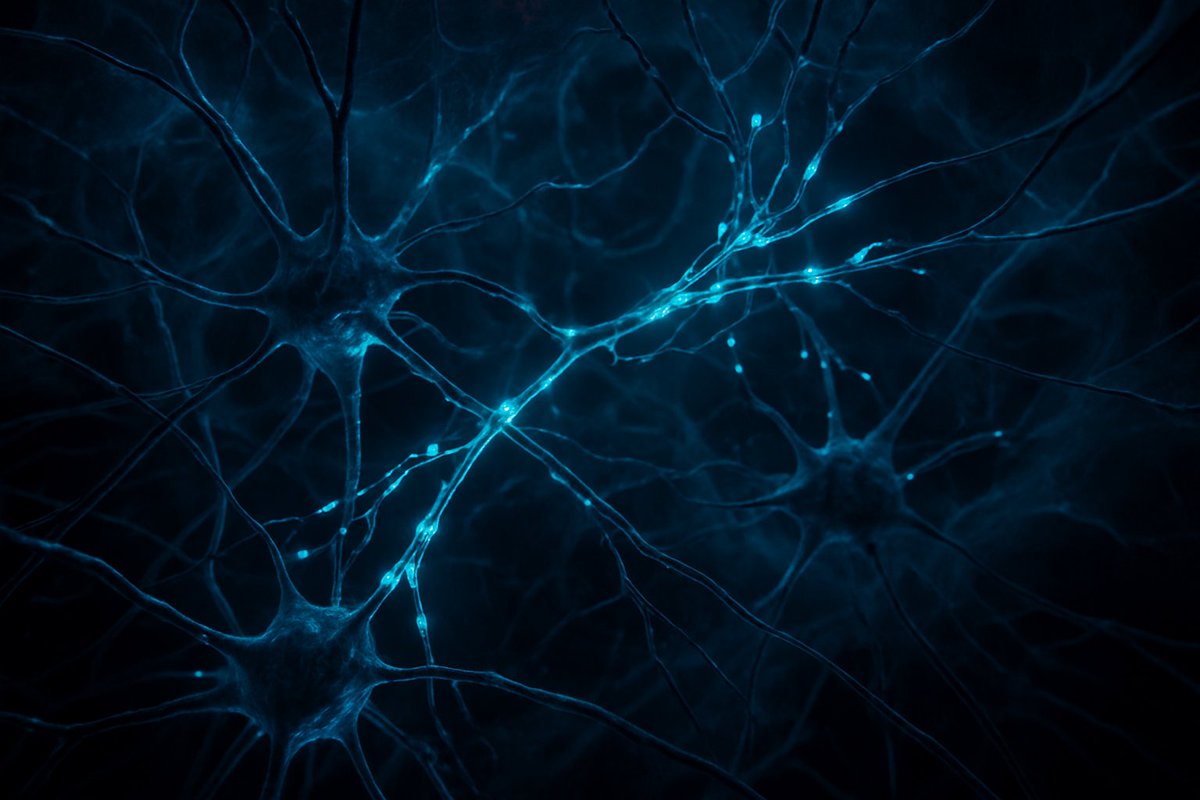
🚨 **We've just watched scientists decode how the brain learns in real time at the cellular level.**
Deep inside computer simulations powered by 3D reconstructions of actual brain tissue, researchers have finally visualized the structural changes that happen in synapses during learning—something that was impossible to measure directly until now. Using advanced imaging and computational modeling, they captured the precise moments when synaptic connections physically reorganize themselves, revealing the mechanical choreography behind memory formation and skill acquisition.
This matters because neuroscience has been operating in the dark for decades. We could measure *that* learning happens. We could watch *where* it happens. But the granular mechanics—the exact cellular transformations that encode new information into neural architecture—remained hidden. Now they're visible.
The implications stack upward fast. Understanding the cellular grammar of learning unlocks new approaches to neurological diseases where this process breaks down: Alzheimer's, autism spectrum conditions, schizophrenia. It gives us a foundation for designing interventions that actually work at the level where memory lives. It could reshape how we approach education, brain injury recovery, and cognitive enhancement. And it represents a fundamental shift in our ability to read the brain's instruction manual.
We're living through the moment when neuroscience transitions from observation to mechanism. The same way that understanding protein folding transformed medicine, understanding synaptic restructuring during learning will transform how we treat the mind itself. The frontier isn't theoretical anymore. It's three-dimensional, it's measurable, and it's telling us exactly what we need to know about how brains become who they are.