We're launching Bridge today 🌉
An AI engine that builds virtual homes. Blueprint in, walkable home out. Every plan, every option, structural changes included.
What took 3D artists months now takes days. Homebuilders can finally show buyers every home they sell.
https://t.co/QrwlM5FUjP
I poured my 10 years of teaching experience into a skill.
It's called /teach, and it can teach you anything.
Here's how it taught me to solve a Rubik's cube:
Introducing text-to-lottie: an open source skill and harness for generating production ready Lottie animations with codex/claude code.
$ npx skills add diffusionstudio/lottie
Prompts guide and repo in the comments.
Anthropic engineer:
"You're not supposed to prompt Claude. You're supposed to build a system that prompts itself."
this is one of the best workflows I've seen in a long time
in this video he breaks down exactly how most people are using Claude:
- the 14% you lose to CLAUDE.md before typing a word
- the plugins that 95% of users have never installed
- the caching setup that keeps it at 95% hit rate and almost free
- why starting every chat from zero is the slowest way to use Claude
if you've been using Claude for more than a month and never left the chat window, you've been using one project when you could be running a team of them
instead of another show tonight, watch this
make sure to bookmark it before it gets lost in your feed
full guide in the article below
Anthropic engineer:
"The agent doesn't remember anything. So we built a second set of agents whose only job is to dream about the first ones."
They wait until you log off, then reopen every session you ran, fact-check the first agents, merge the duplicates, and burn anything that went stale.
One dreaming agent per session, up to 100 at once, built to miss nothing. 95% of the tokens come back cached, so an entire memory rewrite costs almost zero.
This is the part of the workflow nobody is talking about yet.
Watch the full workshop, then save the setup below.
Next week we're launching @firecrawl monitoring - the way agents get notified when the web changes.
Watch any page on a custom cadence, and your AI agent gets a webhook or email with the diff the moment something changes.
Stay tuned 👀
GPT Image 2 + Seedance 2.0 = Latte Art 🎶
Using a few techniques I’ve shared recently, you can create musical animations like this one.
For this video, I used a Character Sheet + Storyboard + IPA.
Even though it skips a beat or two in places, that’s totally normal. I think it blended the musical tone with the artistic style instead of following every beat literally.
You can find the details below.
Agents make ugly UIs because they've never seen good design.
We've been fixing that, 2,000 DESIGN.md files from the world's best products, structured for a model to read and learn. Colors, type, spacing, layouts and more.
Free. https://t.co/mJaKNHba0O
Karpathy didn't make a course.
He made THE course.
3 hours. Free.
Tokenization. Attention. Hallucinations. Tool use. RLHF. DeepSeek. AlphaGo.
Every behavior you've ever wondered about in an LLM - where it comes from, why it exists, how it was engineered.
The gap between engineers who understand this and engineers who don't isn't technical depth.
It's the ability to conceive of entirely different things.
In 14 minutes, this Anthropic engineer who wrote "Building Effective Agents" will
teach you more about building them right than most developers figure out on their own
in months.
Bookmark this for the weekend. Then read the builder's guide below.
gm, today we're launching Shader Lab, like photoshop but for shaders
• design slick layered shader compositions
• export high-quality assets or shaders
• OSS package to plug & play
↳ https://t.co/5FjvLy8UIQ
This is what the future of design looks like. Not just this specific tool¹, but the fact that every team in the world is now is empowered to build their own 'design factory'.
Shader Lab was built with Claude Code, @threejs, @nextjs, and @vercel. To the exact needs, vision, and specification of @basementstudio.
Every time we work on a project with them, we get a glimpse of an arsenal of internal tools they've deployed. Some built specifically for a project, some more general purpose.
It's now easier to generate software re-assembling powerful building blocks, than searching and procuring the right SaaS for the job.
¹ though it's a banger
Your agent platform needs a database. One that's fully managed, Postgres-compatible, and handles both scale and just-in-time apps.
Join us to learn more about how Aurora DSQL and Vercel fit this bill. https://t.co/XBsb7tNq3s
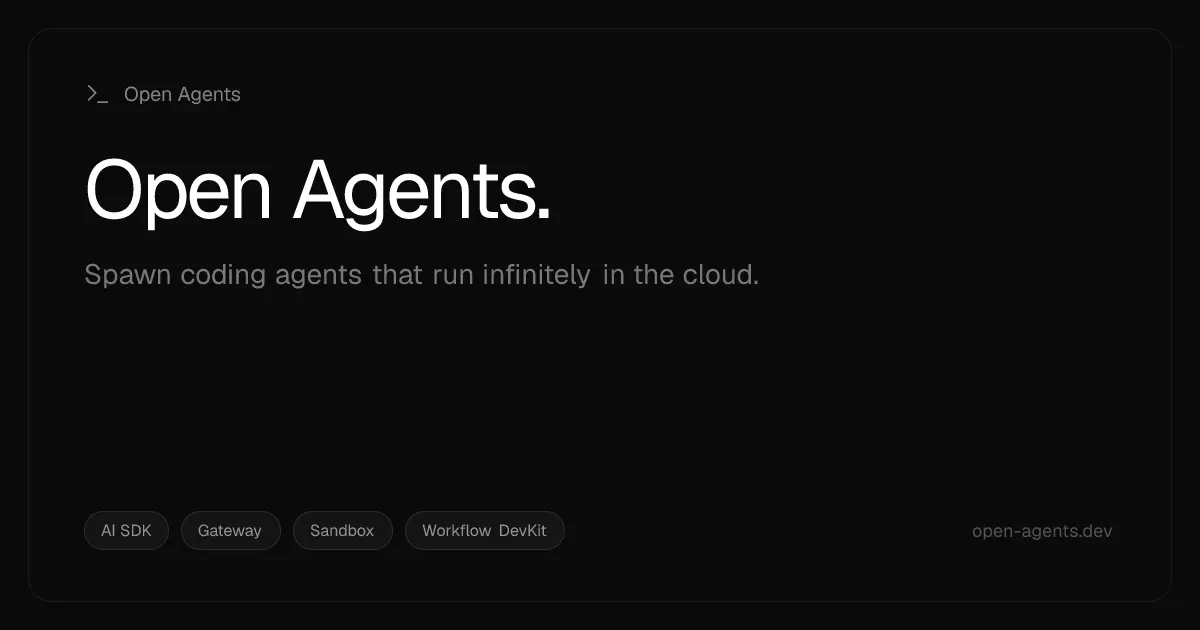
Today we're open sourcing https://t.co/p76KVdY7dG, a reference platform for cloud coding agents.
You've heard that companies like Stripe (Minions), Ramp (Inspect), Spotify (Honk), Block (Goose), and others are building their own "AI software factories". Why?
1️⃣ On a technical level, off-the-shelf coding agents don't perform well with huge monorepos, don't have your institutional knowledge, integrations, and custom workflows.
2️⃣ On a business level, the moat of software companies will shift from 'the code they wrote', to the 'means of production' of that code. The alpha is in your factory.
Open Agents deploys to our agentic infrastructure: Fluid for running the agent's brain, Workflow for its long-running durability, Sandbox for secure code execution, AI Gateway for multi-model tokens.
(Because of our focus on Open SDKs and runtimes, this codebase is a gem even if you're not hosting on Vercel.)
TL;DR: if you're building an internal or user-facing agentic coding platform, deploy this:
https://t.co/xdsc42nbDN
This 2 hour Stanford lecture on AI careers will teach you more about winning in the AI race than every piece of AI content you have scrolled past this year.
Bookmark this & give it 2 hours, no matter what. It'll be the most productive thing you could do this weekend.