Associate Research Fellow @IIGSATT | Ph.D. in International Relations |Focused on the Middle East-especially Persian Gulf Region mo.salami @ hotmail. com
What happens is the Iran-US Geneva talks to stave off war fail?
“In a war scenario, there is the possibility of Iranian missiles missing their targets and hitting inhabited regions of the countries that host American bases. This could occur due to jamming, spoofing, or an act fabricated by intelligence, even as a false flag to generate popular support.
And it is at that moment the countries that host US bases will be compelled to take action, under great pressure from the US, possibly sparking a wider regional conflagration. The countries that host American bases in the region operate more than 600 combat aircraft and tens of thousands of armoured vehicles, with a naval force of nearly 400 ships, but not as equipped with missiles as Iranian vessels. In this landscape, Saudi Arabia's aviation and the UAE's drones stand out. Both countries have an infant defense industry, but one that is growing rapidly. However, these industries are still immature to materially affect the outcome of a regional war.”
Read the article:
https://t.co/N344OJiUQT
This has already become a prewritten script: every time the United States moves to strike a Middle Eastern dictatorship, it is preceded by a nerve-racking wait, followed by feverish diplomatic contacts—and above all, the local dictator refuses to grasp the severity of his situation until it is too late.
Abbas Araghchi will not be the first foreign minister to fly urgently to meet Americans in an attempt to prevent war. Before him came Iraqi foreign minister Tariq Aziz, in a futile meeting with his counterpart James Baker. Saddam Hussein promised both President George H. W. Bush and President George W. Bush that the United States would discover hell in Iraq, that its forces would die there in droves, and that his country would stand firm. Aziz ended his life in a Baghdad prison; Saddam went to the gallows.
The Iranians are no more flexible, no less fanatical, and burdened with the same problems as their hated Iraqi predecessors. Their almost last hope of preventing action lies with the Sunni states of the Middle East. Qatar, Turkey, Egypt, and Saudi Arabia publicly warn that an American strike could escalate into a regional war. In practice, a Middle East expert told me this week, what truly worries them is the almost inevitable outcome of eliminating the ayatollahs’ regime: Israeli hegemony in the Middle East.
One does not need to believe Turkish President Recep Erdoğan’s fantasies about Israeli attempts to conquer Mount Ararat, nor buy into antisemitic conspiracy theories about a secret Netanyahu government plan to restore the days of the Kingdom of David, to understand the pressure. Nadim Koteich, a leading journalist in the Arab world and a harsh critic of Iran, wrote last week: “Regardless of your political views, the following fact cannot be denied: Israel is emerging from the post–October 7 era with unprecedented military and intelligence dominance. Its operations systematically dismantled the Iranian proxies, reshaped the security architecture of Lebanon and Syria, and demonstrated strike capabilities unmatched by any other actor in the region. Its recognition of Somaliland and expansion into the Red Sea signal ambitions broader than the traditional ones. For Saudi Arabia, which cannot normalize relations with Israel without some Israeli-Palestinian agreement, this creates an uncomfortable reality: the strongest military power in the region is not subject to any influence from Riyadh.”
For years, the Iranian threat troubled the Middle East but also bound Israel and most of its resources to the struggle against Tehran and its proxies. Now, the Iranian carcass lies in the middle of the room. For most of the Middle East, it is convenient for it to remain there—without a death certificate and without a new, far more Israeli Middle East.
Not even the Wali al-Faqih, the supposed deputy of the Hidden Imam, will stay to fight and die for his beliefs or, indeed, for the state tasked with bringing about the Imam’s return.
What a black pill. Does no one truly believe in anything anymore, deep down?
And what was all this decades-long isolation and hardship for? 🙄
End of the Islamic Republic opens door to:
- Escalating Israeli military hegemony over Arab world
- Improved Iran-US ties at expense of America's Arab allies
- Secular Iranian state functioning as regional power pole together with fellow non-Arab Israel and Turkey
- On other hand, ongoing instability in Iran could massively impact regional stability including financial lifelines of GCC states and Iraq.
Some of these concerns/considerations are unique to post-Oct 7 era, others are not.
Iran is totally different than Arab societies.
In the Arab world, there are many ( not all) authoritarian semi-secular regimes, ruling increasingly conservative Muslim societies.
In Iran, however, there is an oppressive authoritarian Islamist regime ruling an increasingly secular young Iranian society.
The collapse of this regime will give a huge boost for secularism n the Middle East.
"How Digital Platforms Promise to Reshape GCC Societies"
In his new article, @moh_salami examines the growing role of digital technologies in the #GCC and the ways platforms like social media are fundamentally reshaping #Gulf societies.
Read the full article here: https://t.co/nkYih8GVPu
"The #GCC states must adapt to the society-altering developments of the digital age."
Read the new article from @moh_salami here: https://t.co/KJmTZBVxXq
"The #GCC states must adapt to the society-altering developments of the digital age."
Read the new article from @moh_salami here: https://t.co/KJmTZBVxXq
Trump and Japan's PM Sanae Takaichi sign a framework to secure rare earth and critical mineral supplies, pledging joint investment and fair market practices
https://t.co/rSSEJyUzaz
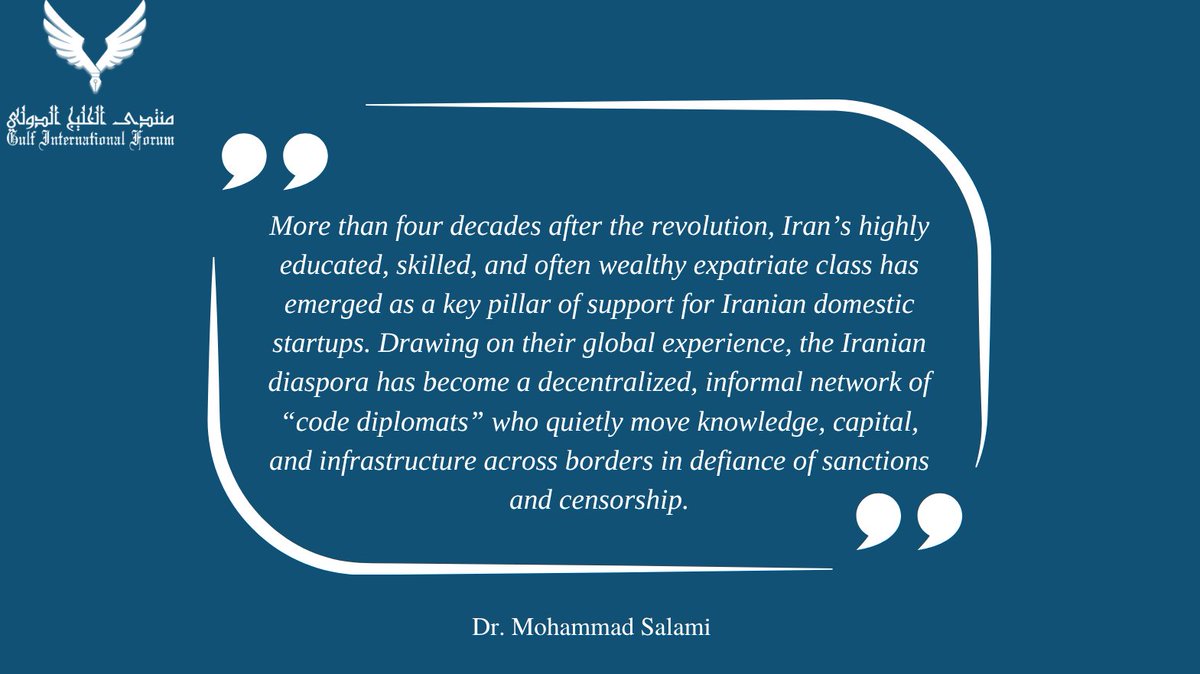
"Iranian entrepreneurs are increasingly turning to the nation’s diaspora to help develop domestic tech ventures—to the consternation of the Iranian government"
Read the new article from @moh_salami here: https://t.co/PHNJvxPvjM
"How Iran’s Expatriates Are Powering Its Tech Sector"
@moh_salami discusses how #Iran's diaspora is helping domestic entrepreneurs and tech startups grow, even amid the isolation of sanctions.
Read the full article here: https://t.co/PHNJvxQ39k
My Latest: #Pakistan_Saudi Joint Defense Pact.
"Saudi Arabia gains access to a nuclear umbrella and potentially nuclear weapons, a shift that gives Riyadh leverage in a post-October 7 regional order." @StimsonCenter
Thanks: @barbaraslavin1
https://t.co/mzKrdcfonH