2025 was a year of learning, building, and sacrificing a lot of sleep.
I wrote a reflection on the lessons, mistakes, and small wins that shaped the year and how they are influencing how I think about 2026
https://t.co/zpOlEdWbaM
The Lean FRO and Mathlib Initiative have released a joint statement on the Lean verification of the Riemann Hypothesis.
On November 20, Levent Alpöge released a proof of the Riemann Hypothesis as a Lean library of 17 million lines of code. Over the past day, the Lean and Mathlib communities worked together to verify it. The statement certifies the proof as correct and describes how it meets all necessary verification criteria.
Congratulations to Levent on this achievement, and thank you to everyone in the community who contributed to the verification.
Full statement: https://t.co/edxEbkodw7
How small can we go with the hardware we run our embedding models on?
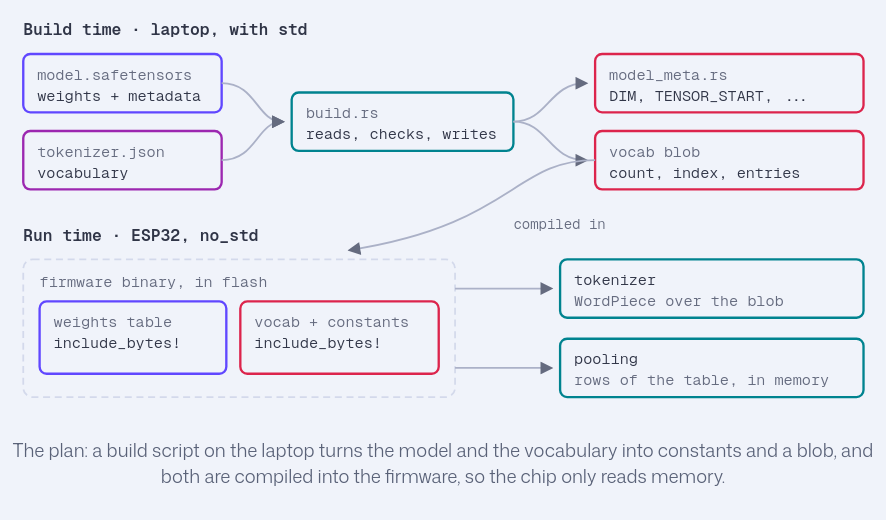
Turns out, pretty small: in my latest blog post at @qdrant_engine, I took potion-base-2M by @minishlab and, with some no_std Rust 🦀, I made it run on a ESP32 microcontroller with 16MB of memory.
And it ran pretty fast as well! It embedded a dozen tokens in approximately 1.2ms, meaning a throughput of 830 embeddings/s (assuming very short texts).
Of course, this is far from the 11-15k embeddings/s that I saw static models produce on my Mac with 48GB of unified memory (more on that very soon 👀) , but it's pretty impressive considering it uses 3000x less memory. Also, it's proof that we can start thinking about running search 𝘵𝘳𝘶𝘭𝘺 on the edge.
Link to the blog below👇
Over the past week, I’ve been overwhelmed by the love and support of friends, industry colleagues, and people I've never met. Thank you to everyone who has shown kindness to my family and me. It means the world to me.
I came to the United States 53 years ago, and becoming an American citizen is one of the greatest gifts and proudest moments of my life. NVIDIA has been my life’s work. Building it into the company it is today alongside my colleagues has been a privilege and an honor. Nowhere but in America could a company like NVIDIA be possible. I love our country, and I love NVIDIA.
I did not live up to the standards expected of everyone at NVIDIA, and I have made serious mistakes in my personal life. I created problems for the Board that I deeply regret. I own my mistakes completely, and I am committed to cooperating with the Board’s independent investigation.
Since my departure, I’ve seen an outpouring of calls from NVIDIA’s employees, investors, business partners, and customers for me to return as CEO. Many continue to reach out to me directly as the company navigates complex technology, market, competitive, and geopolitical dynamics. NVIDIA is a once-in-a-generation company. If the Board of Directors decides that my return is in the best interest of our shareholders, our employees, the company, and America, I would be honored to answer these calls and return as CEO.
Thank you again to everyone who has shared their good wishes. I am profoundly humbled by your support. To my family: I love you, and I will spend the rest of my life being worthy of yours.
Jensen
anyone has any contacts doing scientific research (maths, physics, chemistry, bio .etc) full-time drop me a PM!
Senior profiles preferred (ideally postdoc / RA and above, but some late stage PhDs are fine)
(1/3) Qdrant 1.20.1 is here, bringing some serious performance improvements.
A few highlights:
→ 50% fewer reads during HNSW graph search on cold storage.
→ ~2× faster Turbo8 and Turbo16 quantization.
→ Faster HNSW graph construction with PiPNN.
→ Faster filtering, batch searches, shard transfers, and record streaming.
But there’s another update worth talking about. 🧵
Argon, Carbon, and Hydrogen
what does this even mean? Can we please go back to small, medium, and large?
Is argon to Terra as luna is to hydrogen? Or is hydrogen more like Terra? Is argon the luna model? WHAT AM I EVEN DOING HERE?
In 2015, I built an AI that detects early cancer.
It’s still running across hundreds of hospitals in the US today.
It was the most fulfilling work of my life, and I was building in AI years before everyone called it “AI”.
Building in AI then was a dream.
Now It feels like we’ve taken a turn for the worse.
It started when i was in undergrad.
I built my first company: AI models that made the political data transparent to voters.
At 21, I was offered six figures for it, but the buyers wanted to use it for reasons I couldn't ethically support.
So we turned down the offer and shut down the company instead.
In 2014, I moved into deep learning research on language models, for the Intelligence Community and Goldman Sachs.
Then HCA Healthcare came to us.
They put me in a competition against 10 people from IBM Watson. It was just me and the tools I’d built.
Our job was to build an AI model that can catch the cancer that slips through the cracks in hospitals.
It was the most intense 30 days of my life. Multiple all nighters.
My models won. That turned into a $5M deal, and later its own company, Azra AI.
Then the world caught on.
ChatGPT and Claude arrived, and AI costs exploded.
Building in AI in 2015 felt novel.
We were using it to find cancer tumours and save lives.
Now the biggest tech companies have turned AI into a money extraction machine.
That’s when I decided to make a change.
We raised $8.5M to build a better future for AI.
On Wednesday, we’re launching Rayline.
AI shouldn’t be locked inside a few labs’ models, prices and clouds. It should be open, transparent and decentralized.
More on Wednesday.