credits:https://t.co/VdO5nRCjH3
PS: @_huntd ( https://t.co/qa55a9qi6W )helps you find live users of any B2B SaaS. Track signups when they happen, renewals, and churn across your competitors and the tools your buyers use before and alongside you.
If you’re inbound-heavy and thinking about starting outbound, your first outbound list may already exist.
@gethockeystack started with the inbound demand nobody had time to work.
For about a year, HockeyStack was 100% inbound. LinkedIn, paid media, referrals, word of mouth, and its interactive demo were already generating demand.
Thousands checked out the demo, but the co-founder and CRO @emiratli_ had no SDR function and could not follow up with everyone himself.
After its Series A, HockeyStack hired two SDRs and an SDR leader.
The first three months were used to reach those already-engaged people quickly and test the right message and channel. Calling performed better than email or LinkedIn for HockeyStack.
After the first quarter, that inbound-to-outbound motion became a repeatable system requiring roughly 20% of the team’s time. The SDR team then grew from three people to nine, with some moving into AE and account management roles.
The strategy gave the new SDR team real prospects to learn from before HockeyStack asked it to scale outbound.
#Inbound #Outbound #SDR #PipelineGeneration #GTM
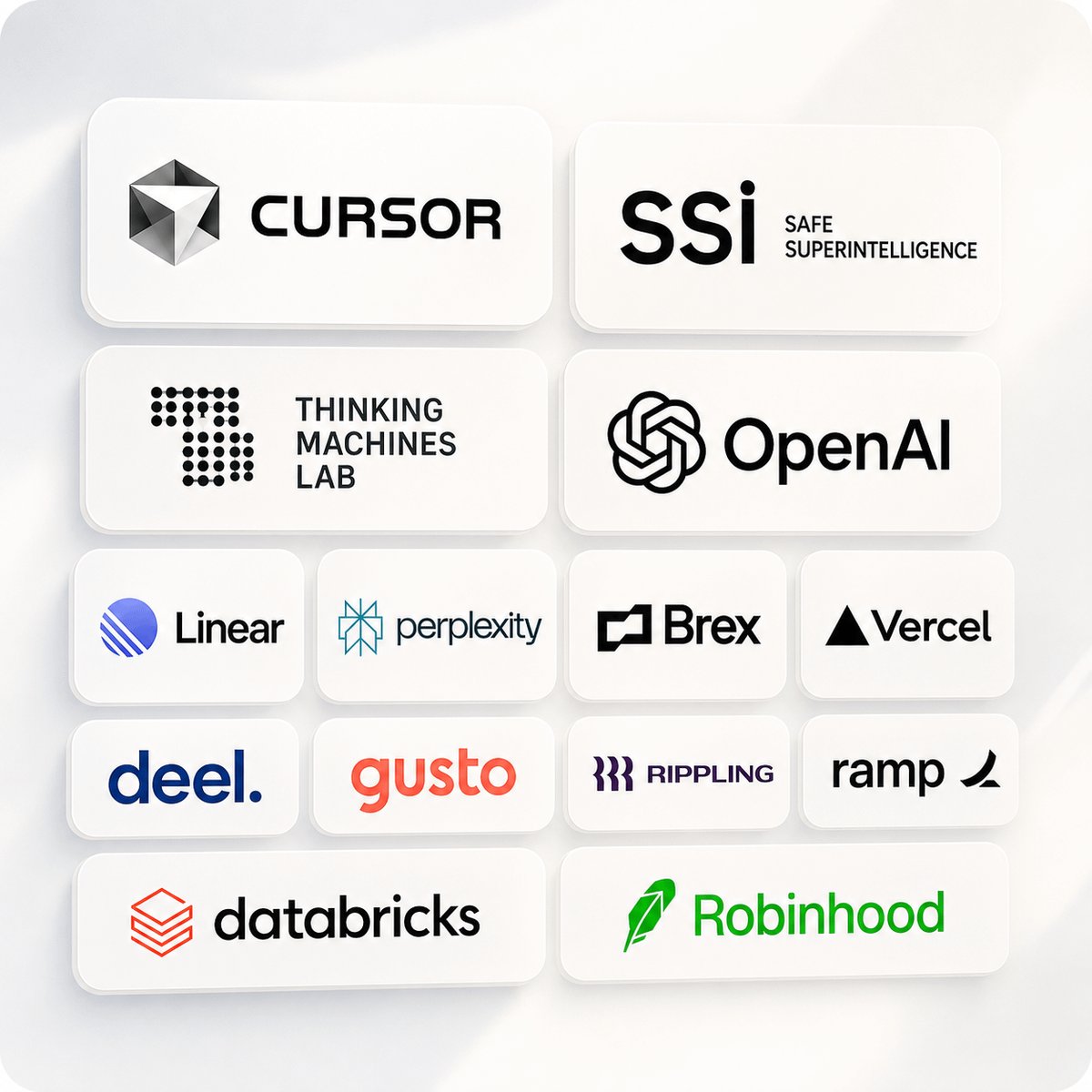
Sualeh Asif, co-founder of Cursor, was born in Pakistan.
Ilya Sutskever, founder of Safe Superintelligence, was born in Russia.
Mira Murati, founder of Thinking Machines Lab, was born in Albania.
Andrej Karpathy, founding member of OpenAI, was born in Slovakia.
Karri Saarinen, co-founder of Linear, was born in Finland.
Aravind Srinivas, co-founder of Perplexity, was born in India.
Henrique Dubugras and Pedro Franceschi, co-founders of Brex, were born in Brazil.
Guillermo Rauch, founder of Vercel, was born in Argentina.
Alex Bouaziz and Shuo Wang, co-founders of Deel, were born in France and China, respectively.
Tomer London, co-founder of Gusto, was born in Israel.
Prasanna Sankar, co-founder of Rippling, was born in India.
Karim Atiyeh, co-founder of Ramp, was born in Lebanon.
Ion Stoica, co-founder of Databricks, was born in Romania.
Vlad Tenev, co-founder of Robinhood, was born in Bulgaria.
Credits: Union Square Consulting
PS: @_huntd ( https://t.co/qa55a9qi6W )helps you find live users of any B2B SaaS. Track signups when they happen, renewals, and churn across your competitors and the tools your buyers use before and alongside you.
@AWS turned cloud-spend reviews into a motion that averaged 60% growth by using savings to unblock stalled customer projects.
Betsy Matthies, AWS’s former Global Sales Executive Engagement Leader, inherited a 150-person AWS team focused on reducing customer cloud spend, which helped retention but made sellers worry every savings conversation would shrink revenue.
The team paired CRM opportunities with spend models to find projects blocked by finance, where current workload savings could fund the next initiative.
Before engaging customers, they checked with account teams to confirm whether those projects still mattered.
When the match was real, customer optimization specialists moved beyond cost-reduction advice and became seller partners who could spot reinvestment moments, understand product gaps, and support expansion.
One wearable monitoring company wanted AI across its workflows but had no new budget for the year.
AWS found several hundred thousand dollars through workload savings, used that existing IT spend to seed AI POCs, and the account grew over 3x.
#CustomerExpansion #EnterpriseSales #FinOps #RevenueGrowth #GTM
source: https://t.co/QfTfCYvF4C
Note: @_huntd ( https://t.co/qa55a9qi6W )helps you find live users of any B2B SaaS. Track signups when they happen, renewals, and churn across your competitors and the tools your buyers use before and alongside you.
G2 moved from GEO to AEO because the goal is shifting from ranking well to owning the answer.
Sydney Sloan, G2’s CMO, explained why: the share of buyers starting research in LLMs jumped from 24% to 51% in one year.
Those buyers are also asking deeper questions before they call sales or visit the website.
So companies need to know where those LLM answers are coming from: G2 discussions, forums, developer threads, FAQs, Reddit, partner pages, and other citation sources.
Once they know those sources, the work becomes content engineering: turning buyer questions into updated answers across the places AI already trusts.
When the buyer’s first shortlist is shaped inside an LLM, companies may not lose during the deal but may lose before they are even considered.
P.S. @peec_ai is our personal favorite for AEO
#AEO #GTM #ContentStrategy #DemandGen #AISEO
Source: https://t.co/afeZOPEOIC
PS: @_huntd ( https://t.co/qa55a9qi6W )helps you find live users of any B2B SaaS. Track signups when they happen, renewals, and churn across your competitors and the tools your buyers use before and alongside you.
Stacey Justice, VP of Go-to-Market Enablement at Gong, says their enablement starts with what reps are already facing in customer conversations.
Stacey calls this an enablement flywheel.
Inside @Gong_io , her team looks across real conversations to detect patterns in skill gaps, missing behaviours, competitor mentions, and customer objections.
Those patterns become the input for Gong’s AI Builder, which helps the team create battle cards, discovery questions, job aids, and lessons reps can use in the next customer conversation.
The same field patterns are used inside Gong to create roleplays and micro-lessons, so practice is tied to the gaps showing up in the field.
Then Gong uses automated scorecards and call reviewers to check whether reps are using those new behaviours in real customer calls.
This enablement loop not only creates training content, but also helps reps practice the right behaviour, use it in real calls, and make behaviour change visible.
#SalesEnablement #RevOps #GTM #SalesCoaching #ConversationIntelligence
Source: https://t.co/WD1WP4QsJb
PS: @_huntd ( https://t.co/qa55a9qi6W )helps you find live users of any B2B SaaS. Track signups when they happen, renewals, and churn across your competitors and the tools your buyers use before and alongside you.
The AI SDR workflow starts breaking when the AI has to choose from unreliable contact data.
Charlie Saunders, co-founder at CS2, shared a client story that made this clear.
The client had Actively AI running in an AI SDR-like outbound workflow across account prioritisation, contact selection, and email writing.
A big blocker was contact quality.
Actively could prioritise an account, look for the right persona, and try to pull that contact from ZoomInfo.
But the contact data layer it was working from was not reliable enough to trust.
Some contacts were missing, outdated, or sitting under the wrong account.
So Charlie’s team had to fix the foundation first:
They used Clay tables to identify which contacts belonged inside each account, then pulled them into Salesforce.
They also found 20,000 to 30,000 leads matched to existing accounts through LeanData.
Before converting them, they used Clay to check whether each person still worked at the company, then validated the email address separately.
This is the part teams can miss.
The contact foundation decides whether the AI has the right person, under the right account, with a valid way to reach them.
#RevOps #Outbound #AI #DataQuality #SalesOps
Source: https://t.co/awepfsS03q
VPS: @_huntd ( https://t.co/qa55a9qi6W )helps you find live users of any B2B SaaS. Track signups when they happen, renewals, and churn across your competitors and the tools your buyers use before and alongside you.
I heard a useful workflow from Josh Fryszer that turns win-loss analysis into a repeatable targeting system.
On Mark Deacon’s podcast, Josh said win-loss should study what happened inside won accounts 6-18 months before they bought, not just why a deal closed. That window shows the move from passive interest to active evaluation.
He maps Gong conversations, CRM outcomes, and customer/prospect feedback across closed-won and closed-lost accounts to find the conditions that appeared before the best customers were ready to buy.
Those conditions become pain cohorts that tools like Claude Code can scan for across transcripts, CRM data, public records, websites, and account data.
Tools like Exa or DiscoLike can then expand the list with companies showing the same pattern.
Then tools like Blitzy API, FullEnrich , Prospio and MillionVerifier help find the right people and verify emails. After that choose the channel depending on where the buyer is most likely to respond.
The message is no longer built from profile data alone; it is built from the buyer’s current pain and timing.
#WinLossAnalysis #GTM #SalesIntelligence #RevOps #AccountPrioritization
Source : https://t.co/GyPKiMwxH1
PS: @_huntd ( https://t.co/qa55a9qi6W )helps you find live users of any B2B SaaS. Track signups when they happen, renewals, and churn across your competitors and the tools your buyers use before and alongside you.
Time Doctor doesn’t always stick to their ICP. They pay attention when demand keeps repeating outside of it.
Their CRO, Duane M. Dufault II, said their ICP now evolves almost every six months. For years, they sold well to BPOs and outsourcing agencies.
Later, demand shifted toward insurance and financial services. More recently, legal demand grew because legal teams had compliance and oversight needs that matched what Time Doctor already solves.
That does not mean every outside-ICP lead should get sales attention.
Enterprise accounts were evaluated quickly because the upside was high, then disqualified fast if the fit was weak.
Smaller accounts went through self-serve or automated qualification before a rep got involved.
The point is not to loosen the ICP. It is to spot when outside-ICP activity becomes a repeatable use case you can win.
#ICP #GTM #SalesLeadership #RevOps #B2BSales
Source:https://t.co/rqbei7FQat
PS: @_huntd ( https://t.co/qa55a9qi6W )helps you find live users of any B2B SaaS. Track signups when they happen, renewals, and churn across your competitors and the tools your buyers use before and alongside you.
Canibuild put an AI SDR layer before human reps on inbound leads and moved their demo-to-close above 60%.
Their CRO, Mark Deacon, explained how they used 11x’s AI SDR to respond when an inbound lead fills out a form.
The workflow starts with an SMS that gives context for the call, followed by a call within two minutes; they tested direct calls first, but pickup improved after adding the SMS step.
From there, the AI answers initial questions and checks whether the lead matches CanIBuild’s qualification criteria.
Low-fit leads get a follow-up email instead of being passed to sales, while qualified leads are routed and booked with the right rep based on location, customer type, and SMB vs enterprise fit.
Reps spent less time on low-fit conversations and entered demos with clearer context.
I’m noticing this pattern more often now: AI agents qualify leads through conversation, then hand reps the context and fit behind each lead.
#AI #InboundSales #LeadQualification #RevOps #SalesOps #AISDR
Source : https://t.co/8YOMENrwWQ
PS: @_huntd ( https://t.co/qa55a9qi6W )helps you find live users of any B2B SaaS. Track signups when they happen, renewals, and churn across your competitors and the tools your buyers use before and alongside you.
Your warmest inbound lead can go cold at the handoff.
Holly Gage, Director of Marketing Operations (Soldo), and Dana Guthrie
Senior Director of EMEA Marketing (LeanData), agree: The hand-raisers have already researched, decided, and asked to talk. Don't make them wait until the team figures out routing, ownership, and calendar cleanup.
>Before a known account even completes the form, integrated scheduling shows the right owner's calendar.
>Unknown accounts route via round robin.
>Slack alerts fire.
>Response happens in seconds to minutes.
Holly's point: the person following up should also own the calendar. Splitting routing from booking creates internal confusion and buyer friction.
Inbound revenue leaks in the gap between intent and connection .The speed-to-lead is about closing it while intent is still alive.
Source: https://t.co/NXV87WjvE9
PS: @_huntd ( https://t.co/qa55a9qi6W )helps you find live users of any B2B SaaS. Track signups when they happen, renewals, and churn across your competitors and the tools your buyers use before and alongside you.
@jshriber , CEO of Terret AI, shared a sales enablement lesson from his past experience running sales teams on a recent Pavilion podcast.
He would pull reps out of the field for a week, put them in a conference room, and walk them through the sales playbook.
Then watch most of that training disappear even before they went back to selling.
The problem was timing.
Reps were learning the playbook before the pressure of a real deal existed.
But the moment they actually needed it came later: before a call, during a deal, or when a manager was coaching them through what to do next.
That is the gap Justin solved:
Using workflows, automations, and agentic processes to bring forward the part of the playbook that mattered in that sales moment.