@salimismail Happy to see you on the India Today cover, Salim! You totally deserve it 👏
Love your sharp views and humor on the Moonshots podcast — always a great listen. Keep up the awesome work! 🔥
@shanaka86 Shanka, I’m not sure whether I’m addicted to X or to your articles in particular. Thank you for your work—providing deep dives on every subject that matters, with no noise. Keep up the great work.
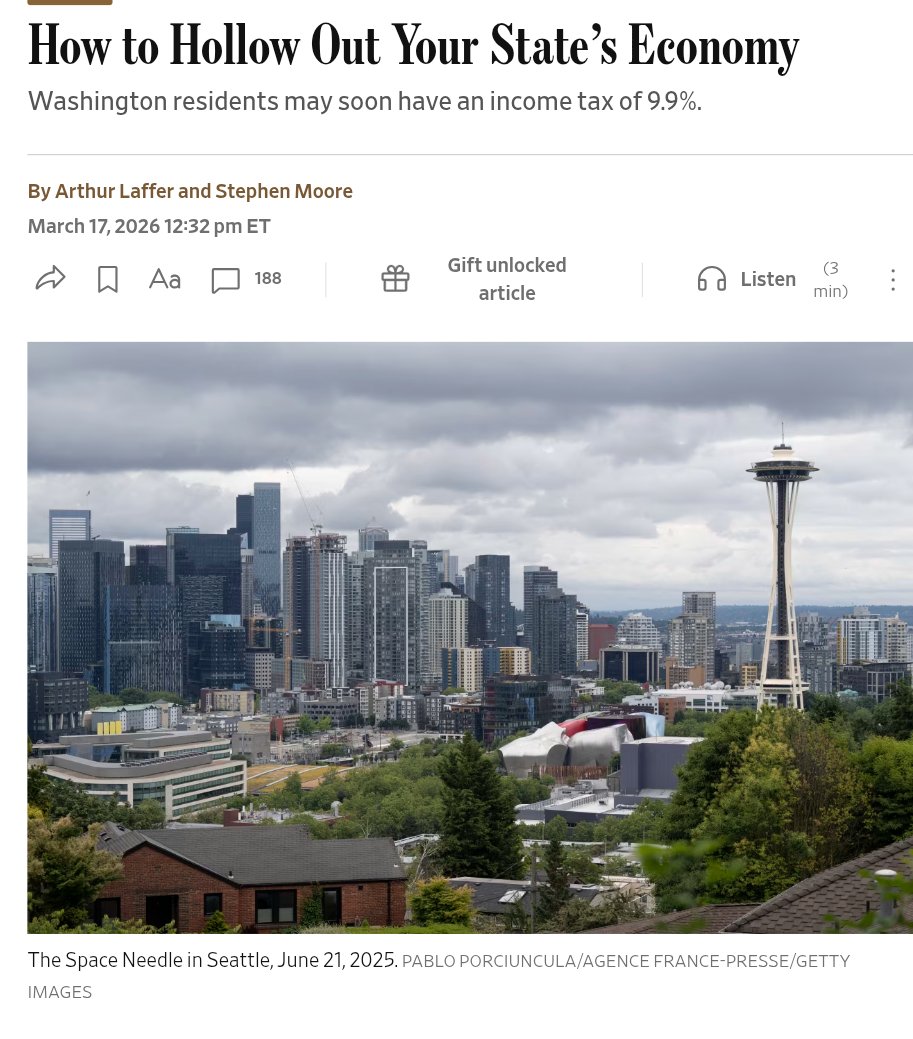
"Washington has been one of the fastest-growing states for decades. It conspicuously avoided the “blue-state disease” of low economic growth and population declines. The Seattle area is home to great companies from Microsoft and Amazon to Starbucks. Washington has been the Florida or Texas of the West Coast.
A secret to the Evergreen State’s success has been that it has no income tax. But Democrats in Olympia are perilously close to enacting a “millionaire tax” of 9.9%. Washington would go from being one of nine states with no income tax to having the fifth-highest rate in the country. The tax has passed both legislative houses and Gov. Bob Ferguson says he’ll sign it. Supporters hope the state supreme court will uphold it, overturning or brushing aside a 1933 precedent under which it is plainly unconstitutional.
The decision to enact an income tax bodes ill for Washington’s economic future. Eleven states have done so since 1960: West Virginia, Indiana, Michigan, Nebraska, Illinois, Maine, Pennsylvania, Rhode Island, Ohio, New Jersey and Connecticut. We found that every one of them significantly underperformed the rest of the nation in every economic measure we looked at, including share of the nationwide population, income, and state and local tax revenue.
The 11 states in combination accounted for about one-third of national output in 1970. Today they account for slightly more than one-fifth. Since Ohio adopted its income tax in 1971, its share of nationwide domestic output has fallen by nearly half. Since Michigan adopted its income tax in 1967, its share of total state and local tax revenue nationwide has fallen by 53%.
Pennsylvania’s share of national output declined 42% since its income tax of 1971; West Virginia has lagged national population growth by 56% since its income tax of 1961; and Rhode Island’s share of state and local tax revenue nationally has plummeted by a third since its income tax of 1971. In terms of the change in its share of the nation’s population, economic output and population, not one of the new income-tax states registers a positive number since the imposition of this tax. And the negative numbers are often highly negative.
In every state that adopted an income tax, supporters promised the added money would be used to improve education. Washington is trying to play this card, saying the tax hike is for education, but the statements from lawmakers make it clear they want a new fund for any of their spending desires.
When the Washington House approved the income tax, Rep. April Berg, chairman of the Finance Committee, triumphantly declared this plan “truly historic” because it will “make life more affordable for Washingtonians.”
Many of them will not be Washingtonians anymore. Illinois added its income tax in 1969, and since then its share of the national population has sunk by 40%. By following suit, Washington will join the ranks of the incredible shrinking states."
-- Wall Street Journal
Here is what a tax like this does:
1) It excites people with zero agency and infinite envy. Beware of these people.
2) It will keep middle class people firmly in the middle class with no real chance of getting wealthy if they stay in Washington State. It should be clear that this IS the strategy. Learned helplessness of the electorate will keep Washington State’s current elected officials in office.
3) It will never allow the upwardly mobile of building any assets or real wealth unless they move.
Capping the American Dream is a dystopian and malevolent scheme. It cannot be a valid strategy.
But unless droves of middle and upper middle class people leave Washington State, this strategy will win.
This Citrini piece reframes the AI narrative: it’s not about whether AI grows – it’s about what it displaces.
The modeled feedback loop—firms using AI to cut labor, accelerating human spending collapse—highlights a structural risk few are discussing.
The surprising thing isn’t an AI market correction…
It’s that AI’s economic success could expose vulnerabilities in demand, credit, and employment before traditional tools can respond.
Thinking in terms of real economy flows and feedback loops matters more than ever.
How to “Future-Proof” for an AI-Driven Downturn
Recalibrate what constitutes labor resilience
Focus on skills machines struggle to automate—high-order reasoning, judgment, creativity, domain synthesis, and strategic coordination.
Diversify across frictions that can’t be fully eliminated
Businesses anchored in physical logistics, regulated services, or human experience design retain meaningful barriers to AI automation.
Position in assets tied to real economic flows
Consumer staples, essential services, infrastructure, energy, and non-discretionary demand channels are less dependent on human income cycles.
Evaluate portfolio assumptions honestly
If earnings models assume stable human consumption, they may be structurally impaired in the long run.
Build policy awareness into strategy
Watch for tax/regulatory shifts on AI compute rents, universal transfers, sovereign wealth structures, or new social income frameworks.
JUNE 2028.
The S&P is down 38% from its highs. Unemployment just printed 10.2%. Private credit is unraveling. Prime mortgages are cracking. AI didn’t disappoint. It exceeded every expectation.
What happened?
https://t.co/JzzwCrbJgS
The Real AI War Isn’t About Chatbots
Most people think the AI race is about who builds the smartest chatbot.
It’s not.
The real AI war is about infrastructure, leverage, and power concentration.
Let’s zoom out.
1. AI Is a Force Multiplier
Artificial Intelligence is not just another tech wave like social media or mobile apps.
It is a horizontal technology.
That means it impacts everything:
Defense
Finance
Energy
Healthcare
Media
Cybersecurity
Manufacturing
The country that integrates AI fastest into real-world systems gains compounding advantage.
Not headlines.
Not hype.
Real compounding power.
2. Chips Are the New Oil
You cannot run advanced AI without advanced semiconductors.
That makes chip supply chains one of the most strategic assets on earth.
The new geopolitical reality is simple:
Compute capacity = Strategic capacity
GPU clusters = National leverage
Data centers = Digital infrastructure
Energy + compute + talent form the AI triangle.
Whoever controls that triangle shapes the future.
3. Talent Is the Hidden Variable
Everyone talks about models.
Few talk about people.
Elite AI talent is globally mobile.
Governments compete quietly for researchers and engineers.
In the 20th century, brain drain reshaped nations.
In the 21st century, AI talent flow will reshape power blocs.
The countries that:
Attract high-skill immigration
Fund research aggressively
Encourage entrepreneurial risk
will outpace those that over-regulate innovation.
4. Narrative Is Strategic
AI is not only about capability.
It is also about narrative control.
Who sets the rules?
Who defines ethics?
Who frames safety?
Who decides what is “acceptable use”?
Standards become strategy.
Regulation becomes leverage.
The battle over AI governance may matter as much as the battle over raw compute.
5. The Individual Level
Zoom back in.
What does this mean for individuals?
The divide is not “AI replaces humans.”
The divide is:
Adaptive vs static.
AI is a tool.
But tools amplify those who learn to use them.
In markets.
In business.
In research.
In communication.
The calm, curious, system-level thinkers will benefit the most.
Final Thought
The AI race is not about a single product.
It’s about who integrates intelligence into every layer of civilization.
Power is shifting quietly.
The question is not whether AI changes the world.
It’s who understands it early enough to position correctly.
The 21st century won’t be defined by who has more soldiers. It will be defined by who controls AI, chips, energy, and narrative.
Hard power is visible.
Soft power is subtle.
Digital power is decisive.