Read the Market Wizards chapter on Kristjan Kullamägi this weekend. The one section that really stood out was when he discussed his drawdown off of his 2021 peak.
"I started 2020 with $3.5 million and ended the year at $36 million. It was a thousand percent year. Then I ran that $36 million to a high of $105 million, and the last portion of that move from $65 to $105 million occurred in just a month and a half. For a brief period, just a few days, I was over $100 million. You have to understand what that did to my psyche. It made me feel completely detached from reality. I thought, “I’m going to get to $200 million in six months.” I was completely sure of that. I started seeing trading as a video game, which I kept winning.
Measured from my $105 million peak in November 2021 to my mid-2022 low, I lost approximately $60 million. About half of that loss represented the late 2021 retracement of the large open profits at the November peak to the stops on those positions. The initial retracement loss was so large because I was leveraged long at my peak. My long exposure was $150 million—a number I recall because I remember bragging about it to a friend"
These boom and bust type tales are as old as time. Look at Jessie Livermore as the classic example. Net worth of $0 in 1906 to a peak of $1.6 billion (inflation adjusted to 2021 dollars) in 1929. Just 5 years later he blew up and owed $104 million dollars to his brokers...
Or look at Paul Tudor Jones. Hit one of the most legendary trades in history, making roughly $200 million dollars during the 1987 crash. It cemented him as a legend. His mental coach Tony Robbins said that Jones consistently lost money for the next 4 years after that peak.
Dan Zanger parlayed $10,000 into $42 million during the late 90's. Then in late 2000 he took a 70% drawdown when he was 200% long 3-4 fiber optic stocks as the dot-com bubble was popping.
Charles Harris reached 8-figures status after he ran up his account over 4,000% from 2020-21, then experienced a -80% drawdown, mostly due to his big TSLA bet in 2021-2022.
I have seen a few people speculating on Kristjans story from the outside. Saying "I would have stopped trading at $100 million" or "I would have just taken that money and started investing". To those people I ask if you have ever experienced a real euphoric run in your trading account, let alone turning 5k into 100mil? Extreme winning streaks like the ones above breed overwhelming euphoria and overconfidence. The mind shifts its focus from process to outcomes, with ego-driven decisions overriding risk parameters and rules. From my experience I have found it near impossible to be aware of this at the peak of the run. It is almost like you are blacked out and the greed/ego completely takes over your trading.
Then the drawdown begins. The emotions shift from euphoria and greed to revenge, fear, and doubt. This is where things can really start to spiral out of control. It is only after the drawdown has run its course that you finally come back to your senses and your emotions drift back towards baseline levels. Then all you're left with is regret...
Few people ever talk about what a big winning streak can do to you. It can literally change the way you think and operate. Often the ability to achieve super returns is also its biggest drawback—a true double-edged sword. To be able to conquer both sides is the holy grail...
From the Hour Between Dog and Wolf by John Coates:
"When traders enjoy an extended winning streak they experience a high that is powerfully narcotic. This feeling, as overwhelming as passionate desire or wall-banging anger, is very difficult to control. Any trader knows the feeling, and we all fear its consequences. Under its influence we tend to feel invincible, and put on such stupid trades, in such large size, that we end up losing more money on them than we made on the winning streak in the first place. It has to be understood that traders on a roll are traders under the influence of a drug that has the power to transform them into different people."
Good rules from my good friend Stan the Man. I just spoke with him the other day. Stan is a national treasure. He calls me his "brother from another mother." If you haven't read his book, it's a classic and a fundamental must for anyone intetested in trend analysis.
The most successful traders I've met:
- Learn with an intensity and urgency
- Weren’t naturals
- Avoid limiting beliefs
- Are highly detailed
- Iterate solutions quickly
- Push through the hard work
- Collaborate and trade with others
- Still struggle and have drawdowns
5. Breadth indicators are mostly noise.
Even when market breadth looks weak, strong sectors can still thrive in their own world.
Focus on living themes, not dying averages.
When no strong sectors remain, that’s when caution matters.
1. Chart Patterns without context are randomness.
Strong uptrends don’t come from charts.
They come from real developments — industry shifts, fundamentals, and capital rotation.
Only when context aligns do setups matter.
$NVDA, if you look at closely the 30 minutes timeframe (TF), if falls the pattern at 192.45 and 191, should sell here. Then it fell & making squats during a day TF with a high volume. Better watchout!
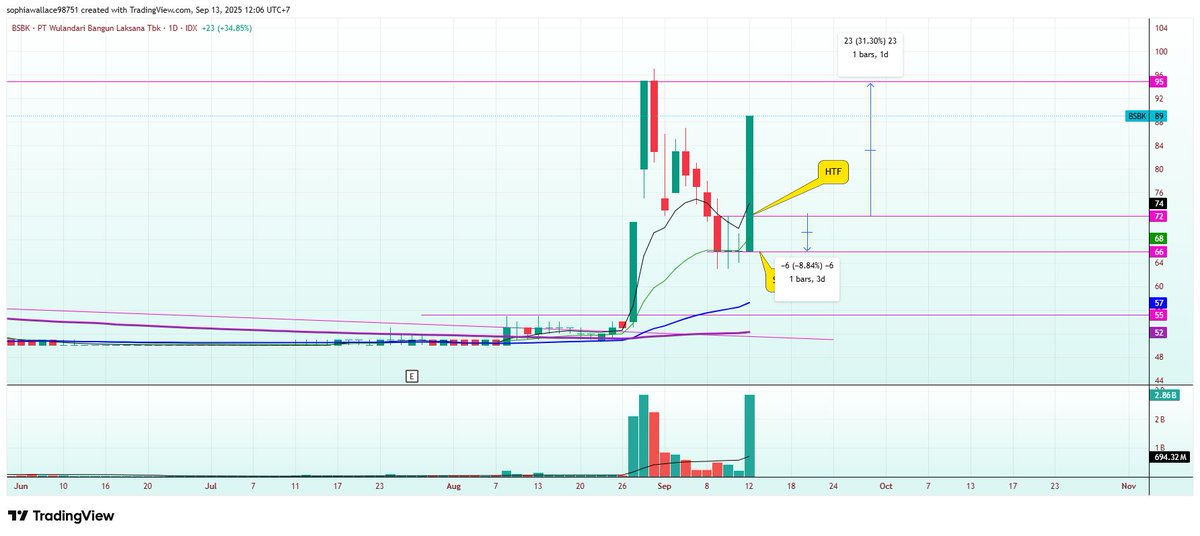
Bought the HTF $BSBK (an IDX stock) turned out to be very successfull. Risking 8% for the 30% reward with 18-20% position sizing. My mentor @LeifSoreide, do you have any comment/suggestion from my analysis?
The key to turning your trading and your life around starts with understanding that you can not outperform your mindset. You will only succeed up to your self-image, confidence, and how deserving you feel. All the knowledge, experience, and skill you can acquire won't overcome a deficit in those areas. Start there!!!
https://t.co/PNGh3HiGvg
If you want to change, you need to get unstuck on the old story you were led to believe about yourself, and start living in a new identity that is congruent with who you want to become. Then you will see your life shift to match, and your confidence will grow, and you will gain the momentum needed for serious change. It all starts with a single decision. Deciding to decide.
Children learn faster and leap further because they don’t dwell on failure.
They fall, they stumble, they miss — and then they get up and keep moving, fueled by curiosity instead of shame.
The lesson? Be more childlike.
It’s not about ignoring failure — it’s about refusing to be defined by it.
It’s a mindset.
And like any skill, you can train yourself to think like a winner.
So the next time you fail, don’t get angry.
Get curious. Ask:
“What can I learn from this?”
That shift changes everything.
Failure stops being a dead end and becomes raw material for growth.
Curiosity replaces frustration. Progress accelerates.
And here’s the truth:
To make winning a habit, you must first make thinking like a winner your habit.